SUNDI TOOLS
- Copyright © Wuxi Sundi Precision Tools Co.,LTD All rights reserved.
- Site Map
 Skip to content

Global buyers choosing FEP and PTFE tubing need more than a low quotation. They need materials that fit the fluid, temperature, pressure, and installation conditions. Roy J. Plunkett, the chemist credited with discovering PTFE, reportedly described the discovery this way: “I was just lucky.” Supplier selection should be less about luck.
This 2026 guide examines suppliers through practical questions: Can they provide clear material specifications? Do they document dimensions, tolerances, and batch traceability? Can they explain how a tube performs in the buyer’s actual application? A datasheet may look reassuring, but a measured inner diameter, a clean cut end, and consistent coil packaging can matter just as much. Details count.
Fep Ptfe tubing is not one interchangeable product category. FEP and PTFE differ in processing, flexibility, and application fit, so buyers should confirm the exact polymer and grade before comparing offers. Ask for current technical documents and sample lengths where appropriate. Check stated limits against real operating conditions, not assumptions. And verify that quotations cover the required dimensions, packaging, and shipping destination.
This overview compares suppliers for global purchasing, not as a universal endorsement. Availability, lead times, and technical support can change. Some listings may appear polished yet leave important questions unanswered. That is worth noticing. A careful buyer should request written answers, review them with a qualified materials or engineering professional, and keep the final selection tied to documented requirements.
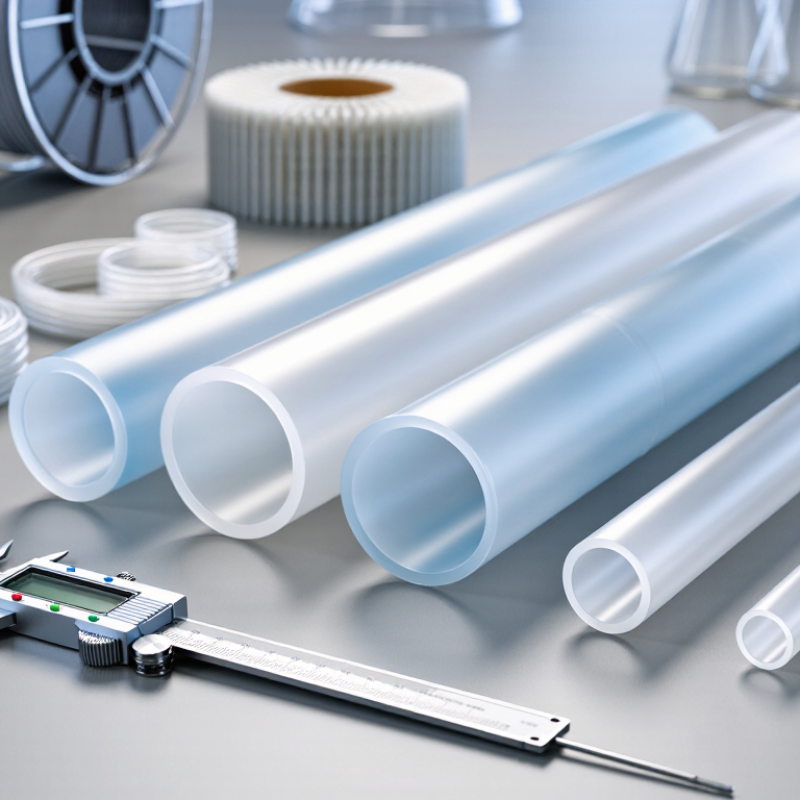
FEP and PTFE tubing both resist many chemicals, but they suit different jobs. PTFE has a higher melting point, around 327°C, and a notably low-friction surface. It works well in demanding fluid-transfer lines and electrical insulation. FEP melts at about 260°C, bends more readily, and is often transparent. That helps operators inspect fluid movement or spot trapped bubbles. Both figures describe the polymers, not guaranteed tubing service temperatures; wall thickness and fittings matter.
The distinction is practical. PTFE can feel stiff when routed around a tight instrument panel. FEP is often easier to bend and heat-seal, but its temperature ceiling is lower. Neither material is universally better. Check chemical compatibility, pressure, temperature, and bend radius against the tubing supplier’s technical data before installation. Small details count.
Market context is useful, but easy to misread. Grand View Research estimated the global fluoropolymer market at about US$11.95 billion in 2023 and forecast growth through 2030 in its Fluoropolymer Market Size, Share & Trends Analysis Report. That figure covers fluoropolymers broadly, not tubing alone. For buyers, common applications include laboratory fluid paths, chemical sampling, instrumentation, and wire insulation. A market forecast cannot determine whether a specific tube fits a specific process. Test the actual setup where possible.
| Comparison Dimension | FEP Tubing | PTFE Tubing | Buyer Considerations |
|---|---|---|---|
| Material name | Fluorinated ethylene propylene | Polytetrafluoroethylene | Confirm the polymer grade and any applicable regulatory or industry requirements before ordering. |
| Typical continuous service temperature | Commonly rated up to approximately 200°C (392°F), depending on grade and application. | Commonly rated up to approximately 260°C (500°F), depending on grade and application. | Check the manufacturer’s rating for the exact tube, pressure, environment, and exposure duration. |
| Approximate melting point | About 260°C (500°F). | About 327°C (621°F). | Melting point is not the same as a continuous-use temperature rating. |
| Transparency | Typically clear or translucent, allowing visual inspection of fluid flow. | Typically opaque or translucent; appearance varies with tube dimensions and grade. | Choose FEP when visual monitoring is important, while confirming clarity for the selected size and grade. |
| Chemical resistance | Broad resistance to many chemicals, including many acids, bases, and solvents. | Broad resistance to many chemicals, including many acids, bases, and solvents. | Verify compatibility for the specific chemical, concentration, temperature, and exposure time; no general table covers every condition. |
| Electrical properties | Excellent electrical insulation; dielectric properties are generally stable across a wide range of conditions. | Excellent electrical insulation; dielectric properties are generally stable across a wide range of conditions. | For electrical applications, request grade-specific data and test methods relevant to the operating frequency and environment. |
| Processing and fabrication | Melt-processable, which supports extrusion into clear tubing and complex continuous profiles. | Not conventionally melt-processable; tubing is commonly made using paste extrusion or other specialized processes. | Ask about dimensional tolerances, production method, cut-length options, and available documentation. |
| Common uses | Fluid transfer, laboratory equipment, chemical handling, instrumentation, and applications requiring visual flow checks. | High-temperature fluid handling, chemical processing, laboratory lines, electrical insulation, and low-friction applications. | Match the material to the operating temperature, pressure, fluid, bending needs, and installation environment. |
| Information to request from a supplier | Material grade, inner and outer diameter, wall thickness, tolerance, pressure guidance, temperature rating, and lot traceability. | Material grade, inner and outer diameter, wall thickness, tolerance, pressure guidance, temperature rating, and lot traceability. | For global purchasing, also confirm packaging, shipping terms, export documentation, and the availability of certificates or test reports. |
Values are typical industry reference points, not guaranteed specifications. Actual performance varies by grade, dimensions, manufacturing process, and service conditions; obtain current technical data for the selected product.


 English
 Russian
 German
 Spanish
 French
 Portuguese