SUNDI TOOLS
- Copyright © Wuxi Sundi Precision Tools Co.,LTD All rights reserved.
- Site Map
Choosing the right Plastic Jerry Can 5 Ltr requires more than comparing price lists. Global buyers must examine material quality, closure performance, stackability, and supply consistency. A can may look sturdy on a showroom floor, yet fail after repeated transport, temperature changes, or rough warehouse handling.
Packaging expert Dr. Susan Selke has emphasized a practical principle: “Good packaging protects the product while minimizing unnecessary material.” That principle fits the modern 5-liter jerry can market. High-density polyethylene remains popular because it offers impact resistance, chemical compatibility, and efficient molding. However, not every HDPE container performs equally.
This guide reviews five leading Plastic Jerry Can 5 Ltr types for international buyers. Each type serves a different purpose. Some prioritize narrow openings for controlled pouring. Others use wide mouths for easier filling and cleaning. UN-rated designs may suit regulated industrial liquids, while food-grade options require documented materials and hygienic production. Recycled-content cans can reduce virgin plastic use, but buyers must verify odor, consistency, and certification.
Small details matter. A secure cap, visible level markings, and a molded handle can improve daily handling. Poor thread alignment cannot.
The market is not perfectly standardized. Supplier claims need careful checking. Technical data sheets, sample testing, drop tests, and closure inspections should support every purchase decision. Even experienced buyers sometimes overlook pallet efficiency or regional recycling expectations. This comparison keeps those practical concerns in view, while recognizing one uncomfortable truth: the cheapest can is rarely the lowest-cost choice over its full service life.
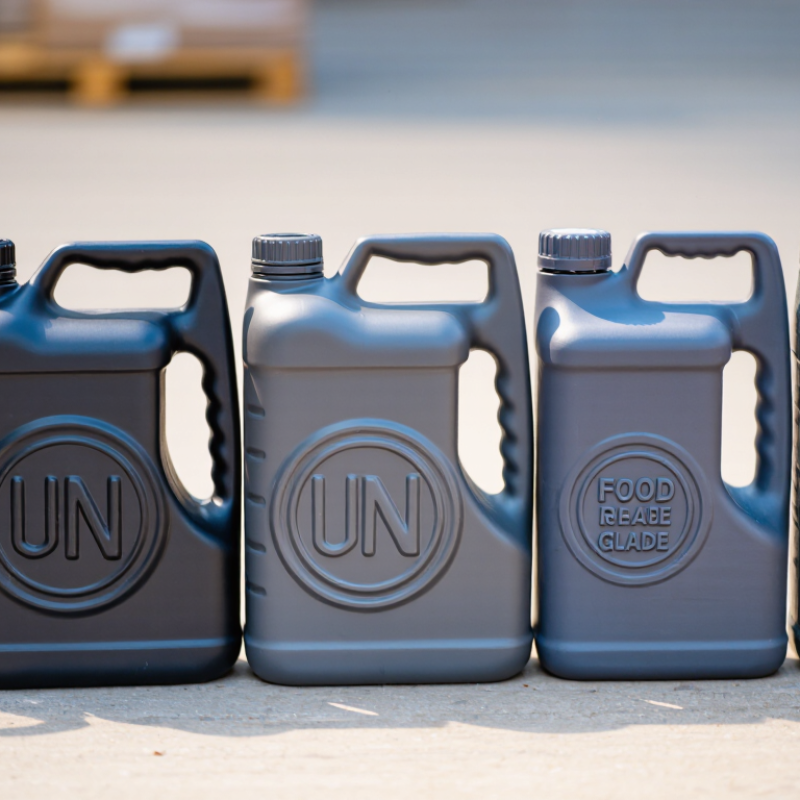
Plastic jerry cans differ mainly by resin, capacity, closure, and end use. High-density polyethylene remains the usual choice because it combines impact resistance with chemical stability. According to PlasticsEurope’s Plastics—The Fast Facts 2024, packaging represented 39.6% of European plastics demand in 2022. That scale explains HDPE’s strong supply network and competitive pricing.
For global buyers, five practical types stand out: small 1–5 litre cans for samples and household liquids; 5–10 litre utility cans for cleaning products; 10–20 litre industrial cans for oils and agricultural liquids; 20–30 litre stackable cans for logistics; and UN-performance-tested cans for regulated transport applications. Recycled HDPE can reduce virgin resin use, but its color, odor, and consistency need inspection. Multilayer or fluorinated designs may improve barrier performance, though recycling becomes less straightforward.
The OECD Global Plastics Outlook identifies packaging as the largest source of plastic waste, at about 40% of the total. Material selection therefore needs more than price comparison. Check wall thickness, handle strength, cap torque, drop resistance, stacking behavior, and leakage records. For transport applications, verify testing against relevant UN recommendations and ISO guidance. Capacity labels can also mislead; usable fill volume is lower than the brim volume. The categories overlap. That is the difficult part. Some buyers still choose by color and appearance, then discover poor seal performance during hot warehouse storage.
Small plastic jerry cans are becoming practical tools for household storage, retail display, and outdoor routines. UNEP’s 2023 Turning off the Tap report identifies packaging as the largest single-use plastic application, representing about 40% of global plastic use. That figure makes material efficiency important, even for compact containers.
The five useful 2026 types are HDPE utility cans, stackable retail cans, wide-mouth storage cans, controlled-pour cans, and lightweight outdoor cans. HDPE offers impact resistance for garages, workshops, and garden sheds. Stackable shapes save shelf space and reduce transport movement. Wide mouths simplify filling and cleaning. Controlled spouts help prevent messy pouring beside a kitchen sink or campsite table. Lightweight designs reduce carrying effort, but thin walls can deform under heat or rough handling.
Plastics Europe reported global plastics production of 413.8 million tonnes in 2023. Small containers are only a fraction of that volume, yet their closure, label, and wall design influence daily waste. Recycled-content options can reduce virgin material demand, although availability and food-contact suitability must be checked carefully. I would not claim one can fits every use. A narrow handle may hurt smaller hands, while a large cap can be difficult for children or older users. Buyers should verify leak resistance, wall thickness, cap security, and recyclability before ordering. Sometimes, the simplest design performs best.
| Rank | Jerry Can Type | Typical Capacity | Common Material | Typical Empty Weight | Approx. Overall Size | Closure and Handle Design | Best-Fit Applications | Key Buyer Considerations |
|---|---|---|---|---|---|---|---|---|
| 1 | Compact Stackable Jerry Can | 2–5 L | High-density polyethylene (HDPE), usually blow-moulded | Approximately 180–360 g | About 18–30 cm high × 12–20 cm wide × 8–14 cm deep | One top handle with a screw cap; some versions include a tamper-evident ring | Household liquids Cleaning products Retail refill packs Camping | Good use of storage space, stable on shelves, and suitable for automated or manual filling. Confirm wall thickness and cap compatibility for the intended liquid. |
| 2 | Flat-Sided Retail Jerry Can | 1–5 L | HDPE or polypropylene (PP) cap with an HDPE container body | Approximately 120–330 g | About 20–32 cm high × 11–19 cm wide × 6–11 cm deep | Integrated grip handle, narrow profile, and 28–45 mm screw-neck opening | Shelf display Home care Automotive fluids Small-batch retail | Efficient for cartons and retail shelving. A larger opening can improve filling speed, while a smaller opening may reduce spillage during pouring. |
| 3 | Pour-Spout Jerry Can | 2–5 L | HDPE body with a flexible or rigid plastic pouring spout | Approximately 220–450 g | About 22–34 cm high × 13–21 cm wide × 9–15 cm deep | Angled handle, screw cap, and separate spout or controlled-pour outlet | Gardening Lubricants Watering tasks Workshop use | Designed for cleaner transfer and better flow control. Buyers should check spout sealing, cap retention, chemical resistance, and whether the spout is supplied assembled. |
| 4 | Wide-Mouth Utility Jerry Can | 2–5 L | HDPE container with HDPE or PP closure components | Approximately 250–500 g | About 19–31 cm high × 14–22 cm wide × 10–16 cm deep | Large opening, reinforced grip, screw lid, and optional inner seal | Powders Granules Thick liquids Outdoor storage | Easy to fill, empty, and clean. The wider body can improve stability, but it may require more shelf and transport space than a narrow retail format. |
| 5 | Reinforced Outdoor Jerry Can | 3–5 L | Thicker-wall HDPE, commonly UV-stabilized for outdoor exposure | Approximately 350–700 g | About 24–36 cm high × 15–23 cm wide × 10–16 cm deep | Heavy-duty handle, secure screw cap, and optional tether or vent feature | Camping Emergency water storage Travel Outdoor equipment | Better suited to repeated handling and transport. Confirm food-contact compliance for drinking-water use and avoid assuming that every HDPE container is suitable for potable water. |
Standard 5-litre plastic jerry cans remain practical for water, food, and agricultural liquids. The WHO/UNICEF Joint Monitoring Programme reported that 2.2 billion people lacked safely managed drinking water in 2022. This keeps cleanable, tightly sealed containers commercially important. Narrow-neck HDPE jerry cans suit drinking water and household distribution. Wide-mouth designs work better for food ingredients, powders, and easier manual washing. Fit matters.
Stackable jerry cans save warehouse and transport space. Reinforced handles reduce strain during repeated filling. Vented versions help manage pressure changes when storing approved agricultural liquids, including liquid fertilizers. Translucent walls allow level checks, but sunlight can damage some contents. Buyers should request material specifications, cap compatibility, leakage tests, and food-contact declarations. A strong handle is not enough.
FAO AQUASTAT identifies agriculture as responsible for about 70% of global freshwater withdrawals. That makes reliable liquid handling especially relevant on farms. UNEP’s 2023 Turning off the Tap report projects plastic waste could nearly triple by 2060 without stronger intervention. Durable, reusable containers can reduce replacement frequency, although reuse only works with proper cleaning and inspection. A can may look clean but retain odor or residue. Testing should include drop resistance, closure torque, wall thickness, and temperature exposure. Local food-contact and agricultural packaging rules still require verification before purchase.
For global chemical and industrial transport, five 5-liter plastic jerry can types deserve careful comparison. Standard HDPE cans suit detergents, oils, and many non-aggressive liquids. UN performance-rated HDPE cans add tested resistance to drops, stacking, and internal pressure. Fluorinated HDPE cans can reduce permeation from solvents and aromatic chemicals. Barrier-layer cans offer stronger protection against oxygen and moisture. Stackable narrow-neck designs save warehouse space and control pouring.
Material choice matters. Plastics Europe reported global plastics production at about 414 million tonnes in 2023. The OECD Global Plastics Outlook also recorded 353 million tonnes of plastic waste in 2019, with only 9% recycled. These figures make lightweight design and recovery planning essential. A thinner wall may reduce resin use, but it can fail during pallet handling. That trade-off is often underestimated.
For chemical transport, buyers should verify resin compatibility, closure torque, gasket material, and documented UN testing. Check the actual filled product, not only the container catalogue. HDPE usually performs well, yet temperature, concentration, and storage time can change its behavior. A 5-liter can that survives a drop test may still deform in a hot container. It happens. Inspect handles, seams, caps, and tamper evidence before shipment. ASTM and UN transport requirements provide useful benchmarks, but local regulations and product safety data remain decisive.
2026 Top 5 Ltr Plastic Jerry Can Types for Global Buyers
UN-Certified and Custom Plastic Jerry Cans support safer, more consistent global distribution. The main five-liter types include tight-head cans, wide-mouth cans, stackable cans, barrier-layer cans, and custom molded cans. Tight-head designs suit liquids needing controlled pouring. Wide-mouth versions allow easier filling and cleaning. Stackable shapes save warehouse space. Barrier layers can improve resistance to odor, moisture, or product interaction. Custom models may include special handles, closures, colors, or graduated markings.
For UN-certified packaging, buyers should verify the exact container design, closure, material, and capacity. A certificate does not automatically cover every version. Testing may involve drop resistance, leakage control, stacking strength, and internal pressure. In practical inspections, cap torque and gasket fit often deserve more attention. Small sealing issues can become expensive shipping problems. Customization is useful, but unnecessary changes may require new testing. That detail is easy to overlook.
Tips: Request test reports, drawings, resin specifications, and closure samples. Check performance after heat, cold, vibration, and repeated handling. Confirm whether the final design matches the certified configuration. Ask for batch traceability and inspection records. Color matching can also affect production timing. Five liters sounds simple. It is not always simple.
The chart presents five commonly used nominal capacities for HDPE plastic jerry cans in international packaging applications. UN certification is determined by the complete container design, material, closure system, and successful performance testing; capacity alone does not guarantee UN approval.