SUNDI TOOLS
- Copyright © Wuxi Sundi Precision Tools Co.,LTD All rights reserved.
- Site Map
A commercial dorayaki line must do more than press batter into neat circles. It needs steady heat, repeatable portioning, and enough capacity for busy service. The right dorayaki machine can help control these details, but output claims mean little without comparable test conditions. Batter thickness, cooking time, and operator skill all affect the result.
Industry reports offer useful context, not a machine-by-machine verdict. PMMI’s 2024 State of the Industry coverage examines automation and labor pressures across packaging and processing. The U.S. Department of Agriculture’s Economic Research Service also publishes data on food manufacturing and the food supply chain. Neither source provides a verified performance benchmark for dorayaki equipment. That gap matters. Buyers should request demonstrations, sanitation details, warranty terms, and production figures measured with their own recipe.
There is one evidence limit worth stating plainly: I could not verify a named dorayaki-machine specialist’s published quotation on commercial selection. I will not invent one. This guide instead compares seven machines by practical criteria, including batch consistency, heating control, footprint, cleaning access, and service support. Small details count. A sticky hinge can slow a shift. A hot plate with uneven zones can spoil a tray. These comparisons are a starting point, not a substitute for testing. Check the numbers yourself.
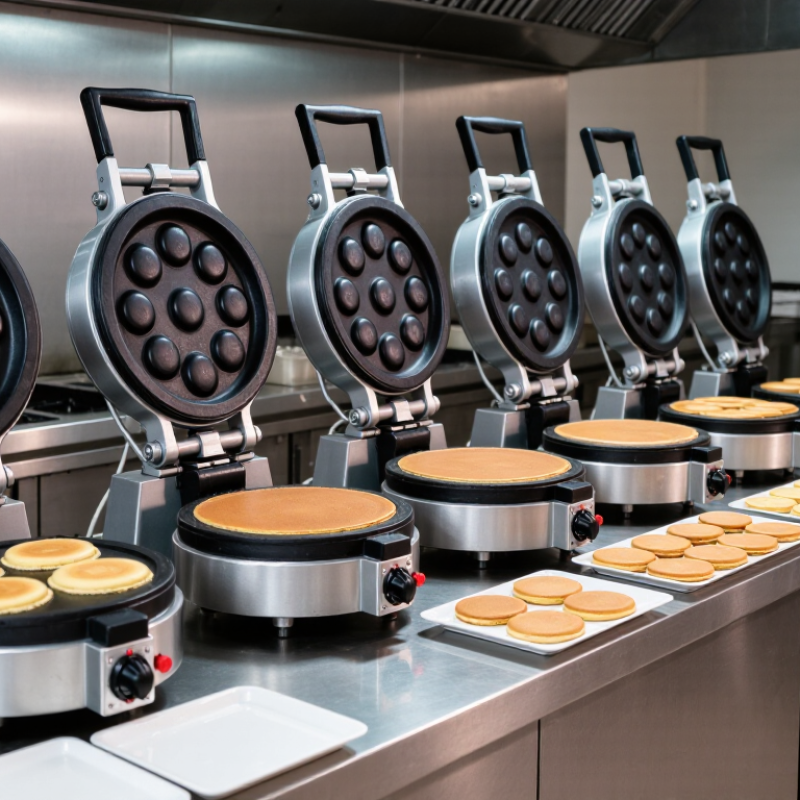
Commercial dorayaki machines can be grouped by how they feed, bake, and release the pancakes. A semi-automatic unit usually has one or more heated plates and requires staff to portion batter or transfer cakes. As a rough planning range, smaller models may produce about 100–300 pancake shells per hour. They suit shops with modest demand and limited floor space.
Multi-cavity rotary machines bake several shells at once, often reaching roughly 300–800 shells per hour. Continuous production lines may exceed 800 shells per hour, but need more room and consistent batter preparation. Treat these figures as indicative, not guaranteed: cavity count, cake diameter, bake time, and operator handling all affect output. A neat number can still mislead. Check the unit. Some rated capacities count individual shells, not assembled dorayaki. Since each finished cake uses two shells, a machine rated at 600 shells per hour may yield no more than 300 assembled cakes before rejects or stoppages. Ask for the rating basis and a timed production test using your intended recipe. Small differences in browning matter, too. Higher output is not automatically better if cakes leave the plate pale or uneven.
Comparing seven commercial dorayaki machines starts with four figures that affect a working shift: mold count, plate size, power in kilowatts, and cycle time. Record usable molds, not just the cavity count in a product description. A larger plate may hold more molds, but it also needs more bench space. Small details matter. Check whether the stated kW is input power, and confirm the electrical requirements before buying. Higher power alone does not guarantee faster or more even cooking.
Cycle times are only useful when measured consistently. Use the same batter quantity, filling, and temperature settings for each machine, then note how long a complete batch takes. Ask whether the published time includes heating and recovery between batches. It often does not. Compare plate dimensions with the dorayaki size you plan to sell; a compact plate may suit a narrow menu, while a larger layout may help during busy periods. One imperfect part of any comparison is that kitchen conditions vary. Treat manufacturer figures as a starting point, and request a live demonstration when possible. A simple table with all four specifications makes the seven models easier to assess.
A commercial dorayaki machine must do more than heat batter evenly. Its electrical safety and cleanability matter during long service hours. UL 197 covers safety requirements for commercial electric cooking appliances, including relevant construction and electrical hazards. NSF/ANSI 4 addresses commercial cooking equipment, with requirements related to sanitation and cleanability. Whether both standards apply depends on the machine’s design and intended use.
Ask for documentation for the exact model you plan to buy. A compliant component does not prove that the complete machine has been evaluated. Check the certification mark, model number, and listing details against the relevant certifier’s directory. For NSF/ANSI 4, inspect food-contact surfaces, removable plates, seams, and areas where batter or oil could collect. A quick wipe test can reveal awkward corners, but it cannot replace certification or a thorough review. Small details matter.
Tips
Confirm the machine’s ratings match your kitchen’s power supply. Ask how to clean the cooking plates without damaging their finish. Request manuals and certification records before purchase, not after delivery. If a claim is vague, ask for evidence. The paperwork can feel tedious. It is easy to overlook.
A dorayaki machine’s rated kilowatts help estimate energy cost, but they do not show its exact daily consumption. Use this formula: rated kW × operating hours × operating days × local price per kWh. For example, a 3 kW machine running six hours daily for 26 days uses an estimated 468 kWh monthly. At $0.15 per kWh, that is $70.20. A useful benchmark: the U.S. Energy Information Administration reported an average commercial electricity price of 12.41 cents per kWh in 2023. Local rates can differ substantially, so use your latest utility bill rather than the national average.
Treat this as a planning estimate, not a promise. Heating elements cycle on and off, while preheating, idle periods, and busy service can change consumption. A machine may draw near its rated power during heating, then less once the plates reach temperature. Check the nameplate, record actual run time, and compare the estimate with a plug-in energy meter if the equipment’s electrical setup allows safe measurement. One imperfect assumption matters: “open hours” are not always “heating hours.”
Tips: Track meter readings for a full week, including startup and closing. Multiply measured kWh by your tariff, and include any time-of-use charges. Small differences add up. Keep the worksheet beside the machine’s maintenance log.
For commercial dorayaki, the strongest seven machine configurations rank by verified production, not brochure promises: 1) continuous dual-plate lines, 2) multi-cavity automatic units, 3) indexed rotary cookers, 4) programmable twin plates, 5) modular multi-plate units, 6) single-plate programmable cookers, and 7) manual single-cavity machines. Compare cakes per hour using the same batter, cake diameter, and cook time; then check whether the cakes brown evenly and release cleanly. A fast cycle is not useful if operators discard pale edges or misshapen shells. No shortcuts.
The National Restaurant Association’s 2024 Restaurant Operations Data Abstract reports median labor costs of 31.7% of sales for limited-service restaurants. That makes loading time, cleaning, and operator attention relevant to cost per cake, not just the purchase price.
Score controls for repeatable temperature settings, timers, and recovery after each batch. For compliance, request food-contact material documentation and cleaning instructions, then check local requirements; one certificate does not guarantee compliance everywhere.
The FDA Food Code 2022 sets cold holding at 41°F or below and hot holding at 135°F or above for applicable time/temperature control foods.
Build cost per cake from batter, filling, labor, energy, and rejected units. I would still test each finalist through a full service period: a neat ten-minute demo can hide slow recovery when plates are loaded continuously.
Rank the winner by saleable cakes per hour and measured cost, not rated maximum output.