...

What Is Artificial Graphite and What Types Are Available?

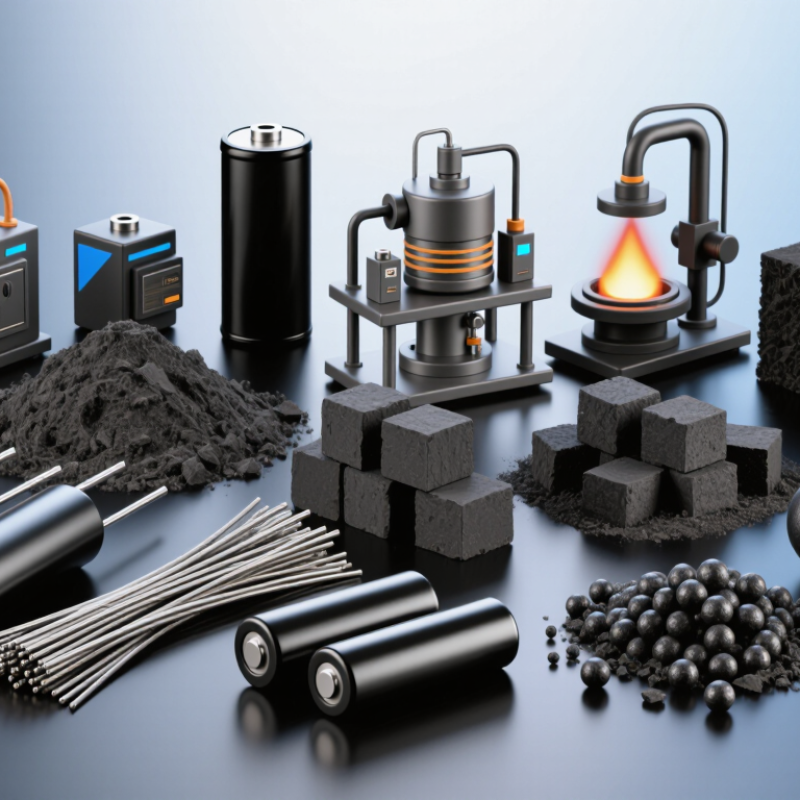
Artificial Graphite is a manufactured carbon material designed for controlled industrial performance. Unlike natural graphite, it is produced from carbon-rich feedstocks through shaping, baking, and high-temperature graphitization. The process can create consistent purity, particle size, density, and electrical conductivity. These qualities support lithium-ion battery anodes, steelmaking electrodes, refractories, lubricants, and advanced thermal components.

Dr. M. Stanley Whittingham, a leading battery-materials scientist, has stated, “The battery is a device that stores energy, but it does not create energy.” His observation highlights graphite’s practical role: it helps store and release energy within a carefully engineered system. Artificial Graphite can offer stable cycling, reliable conductivity, and predictable quality. However, performance depends on more than the label.

There are several available types. Needle coke-based graphite is valued for high conductivity and strong structural order. Petroleum coke-based grades often provide scalable production and broad industrial use. Isostatic graphite offers uniform density for demanding thermal applications. Spherical Artificial Graphite is commonly processed for battery anodes, sometimes with surface coatings that improve efficiency and durability.

The categories are useful, but not perfectly tidy. Manufacturers may use different names for similar grades. Particle shape, porosity, purity, coating, and heat-treatment temperature can change results significantly. A darker powder is not automatically a better material. Buyers should examine technical data, testing methods, and application history before choosing a grade. Small details matter. This article explains the main types, production differences, performance indicators, and practical selection considerations surrounding Artificial Graphite.
What Is Artificial Graphite and What Types Are Available?

Artificial Graphite: A Synthetic Carbon Material with Over 99.5% Carbon

Artificial graphite is a synthetic carbon material produced by heating carbon-based feedstocks to extremely high temperatures. This treatment rearranges carbon atoms into layered graphite structures. High-quality grades commonly contain over 99.5% carbon, although the exact purity depends on raw materials and processing control.

It feels different from ordinary carbon powder. Its particles may be smooth, flaky, granular, or molded into dense shapes. Needle-coke graphite often provides strong electrical conductivity and low thermal expansion. Isotropic graphite has more uniform properties in different directions, making it useful for precision components. Fine graphite powder supports conductive coatings, lubricants, and battery materials. Larger molded blocks can withstand intense heat in industrial equipment.

Purity matters.

A small amount of ash, sulfur, or metal contamination can affect conductivity and service life. Experienced users usually check carbon content, particle size, bulk density, resistivity, and ash levels before selecting a grade. Visual inspection helps too. Uneven particles or visible residue may signal inconsistent processing, but appearance alone cannot prove quality.

Artificial graphite is not automatically better in every application. That assumption is too simple. A very pure grade may still perform poorly if its particle size, porosity, or thermal expansion does not match the design. I would also avoid judging material only by its stated carbon percentage. Testing under actual temperature, pressure, and electrical conditions often reveals differences that a specification sheet misses.


What Is Artificial Graphite and What Types Are Available?

Artificial graphite is a synthetic carbon material generally refined to more than 99.5% carbon. Its properties vary according to the forming process.

Typical apparent density ranges are shown for common artificial graphite forms. Actual values depend on particle size, forming pressure, baking, and graphitization conditions.

How 2,500–3,000°C Graphitization Produces Artificial Graphite

What Is Artificial Graphite and What Types Are Available?

How 2,500–3,000°C Graphitization Produces Artificial Graphite

Artificial graphite begins with carbon-rich materials, often petroleum coke, needle coke, and pitch. These feedstocks are shaped, baked, and purified before graphitization. At 2,500–3,000°C, carbon atoms rearrange into layered graphite crystals. The furnace atmosphere must remain controlled. Oxygen can damage the structure.

This intense treatment improves electrical conductivity, thermal stability, and chemical resistance. Engineers adjust the temperature, holding time, and raw material to produce different grades. Common types include battery-grade graphite, electrode graphite, isotropic graphite, and specialty graphite. Their properties differ in density, particle size, purity, and crystal alignment.

The International Energy Agency’s Global Critical Minerals Outlook 2024 projects graphite demand from clean-energy technologies to grow about fourfold by 2030 in its stated scenario. The USGS Mineral Commodity Summaries 2025 estimated global natural graphite mine production at roughly 1.6 million metric tons in 2024. These figures show why synthetic supply matters, although artificial graphite usually requires more energy.

Tips: Check ash content, tap density, electrical resistivity, and particle distribution. Ask for furnace records when consistency matters. A lower price may hide higher energy use. The process is powerful, but not perfect. Variations between batches still deserve careful testing.

What Is Artificial Graphite and What Types Are Available? - How 2,500–3,000°C Graphitization Produces Artificial Graphite

Dimension Artificial Graphite Category or Stage Typical Conditions or Composition Key Characteristics Common Applications
Definition Artificial graphite Manufactured by heat-treating carbon-rich raw materials, usually petroleum coke, needle coke, pitch coke, or other carbon precursors, at temperatures high enough to develop a graphite crystal structure. More controllable purity, structure, density, and shape than most natural graphite products. Electrodes, refractories, thermal components, electrical parts, batteries, seals, and specialized machinery.
Main production route Coke–pitch forming route Carbon aggregate is mixed with a carbonaceous binder, formed by extrusion or pressing, baked at approximately 800–1,200°C, and then graphitized at approximately 2,500–3,000°C. Produces a shaped, electrically conductive carbon body with adjustable bulk density and anisotropy. Large electrodes, furnace parts, crucibles, blocks, and machined graphite components.
Graphitization stage High-temperature conversion At roughly 2,500–3,000°C, disordered carbon layers rearrange toward stacked graphite crystallites; volatile elements and structural defects are reduced. Higher graphitic order, lower electrical resistivity, improved thermal conductivity, and better dimensional stability. Applications requiring predictable electrical, thermal, and high-temperature performance.
Material form Shaped graphite Pressed, molded, or extruded before baking and graphitization; may be fine-grained, medium-grained, or coarse-grained. Available as blocks, rods, tubes, plates, rings, and custom-machined parts. Furnace linings, heaters, electrodes, heat shields, and structural fixtures.
Material form Granular or powder graphite Produced by graphitizing carbon particles and classifying them by particle size; the final size distribution depends on milling and screening. Useful for blending, coating, conductive formulations, and powder-based processing. Battery anodes, lubricants, conductive fillers, friction materials, and metallurgical additives.
Specialized type Isostatic graphite Fine carbon powder and binder are compacted by cold isostatic pressing before baking and graphitization; properties are designed to be relatively uniform in different directions. High homogeneity, fine grain size, low porosity, and comparatively low directional variation. Semiconductor processing, high-temperature furnaces, crucibles, molds, and precision components.
Specialized type Vibration-molded graphite Carbon mix is compacted through vibration molding, commonly producing larger sections with a comparatively coarser structure. Suitable for large dimensions; properties can vary with direction and location within the block. Large furnace components, electrodes, thermal-treatment fixtures, and industrial blocks.
Specialized type Fine-grained graphite Made from relatively small carbon particles and processed to obtain a fine and uniform microstructure. Good machinability, smoother surfaces, and improved suitability for detailed parts and tight tolerances. Molds, seals, electrodes, laboratory crucibles, and precision-machined parts.
Specialized type Expanded graphite Graphite intercalation compounds are rapidly heated, causing the graphite layers to expand into a low-density, worm-like structure. Flexible, compressible, thermally stable, and capable of forming effective sealing materials. Gaskets, packing, thermal interfaces, fire-resistant materials, and conductive sheets.
Electrical performance Graphitized carbon body Electrical resistivity varies with raw materials, grain orientation, density, porosity, and processing; typical bulk values for engineered graphite are often in the milliohm-centimeter range. Good electrical conductivity, with anisotropy possible in extruded or molded products. Electric-arc furnace electrodes, resistance heaters, electrical contacts, and current-carrying components.
Thermal performance High-temperature graphite In inert or vacuum environments, graphite can remain useful at very high temperatures; oxidation becomes significant in the presence of oxygen, especially above approximately 400–500°C. Excellent thermal-shock resistance and a low coefficient of thermal expansion compared with many metals and ceramics. Vacuum furnaces, heat-treatment fixtures, crucibles, susceptors, and thermal shields.
Purity classification Standard, high-purity, and ultra-high-purity graphite Purity is controlled through precursor selection, high-temperature treatment, purification, and contamination control. Exact limits vary by specification and application. Lower ash and metallic impurities are important where contamination can affect semiconductors, batteries, or molten materials. Semiconductor equipment, advanced batteries, analytical equipment, and high-temperature laboratory applications.
Key selection factors Application-specific grade Evaluate grain size, density, open porosity, ash content, electrical resistivity, thermal conductivity, strength, coefficient of thermal expansion, and oxidation protection. No single artificial graphite grade is optimal for every use; processing determines the balance between conductivity, strength, purity, machinability, and thermal performance. Choose the grade according to operating temperature, atmosphere, mechanical load, dimensional tolerance, chemical exposure, and required purity.

Note: Actual properties depend on raw materials, forming method, graphitization schedule, impregnation, purification, grain size, density, and test method.

Molded, Extruded, Isostatic, and Granular Artificial Graphite Types

What Is Artificial Graphite and What Types Are Available?

Artificial graphite is produced by heating carbon materials to extremely high temperatures. This process reorganizes carbon atoms into a graphite structure. Its performance depends on raw materials, forming method, grain size, density, and final heat treatment. In practical use, choosing the right grade requires more than checking electrical conductivity.

Molded artificial graphite suits larger, more complex shapes and offers balanced strength and machinability. Extruded graphite has a directional grain structure, so its properties can vary along different axes. It often works well for continuous profiles and components requiring consistent length. Isostatic graphite is pressed evenly from every direction. It provides more uniform density, strength, and thermal behavior, especially in demanding furnace environments. Granular artificial graphite is supplied as particles or powder. It may serve as a conductive additive, carbon source, filler, or raw material for customized mixtures. The particle size affects flow, packing, and final performance. That detail is easy to underestimate.

Tips: Check the application temperature, atmosphere, load, and contact conditions before selecting a type. Compare density and ash content, not only the quoted purity. For shaped parts, inspect grain direction and machining allowance. A small sample test can reveal unexpected cracking or dusting. Specifications sometimes look precise, but real processing conditions may change the result. Review them carefully.

Battery-Grade Artificial Graphite: 340–360 mAh/g Anode Capacity

What Is Artificial Graphite and What Types Are Available?

Battery-Grade Artificial Graphite: 340–360 mAh/g Anode Capacity

Artificial graphite is produced by heating carbon materials above 2,500°C. This process creates ordered graphite layers with controlled purity, particle size, and surface structure. Battery-grade products commonly deliver 340–360 mAh/g in anode testing. The theoretical graphite limit is about 372 mAh/g, so the practical gap matters.

Several types are available. Petroleum-coke-based graphite usually offers stable processing and consistent supply. Needle-coke-based graphite can provide highly oriented structures and strong rate performance. Mesophase-pitch-derived graphite supports tailored particle designs, although its manufacturing route is more demanding. Coatings may reduce surface reactions and improve first-cycle efficiency.

Performance depends on more than capacity. Electrode density, binder content, formation conditions, and test methods can change the reported result. The International Energy Agency’s Global Critical Minerals Outlook 2024 identifies graphite as a strategically important battery material, reflecting rising demand from electric mobility and storage. The U.S. Geological Survey’s Mineral Commodity Summaries 2025 also shows that graphite supply statistics require careful separation between natural and synthetic materials.

The number is useful.

A 350 mAh/g result does not guarantee superior cells. High compaction can reduce power performance, while aggressive surface treatment can increase cost. This trade-off is often underestimated. Buyers should examine full-cell data, cycle retention, expansion, impurity levels, and test protocols before judging artificial graphite quality. Industry reports sometimes compare unlike samples. That remains a weakness.

Electrode-Grade Artificial Graphite for Steelmaking and Arc Furnaces

Artificial graphite is a manufactured carbon material created by heating and treating carbon-rich raw materials. Unlike natural graphite, its structure can be engineered for specific industrial duties. Available types include electrode-grade, battery-grade, recarburizer, and thermal graphite. Each type differs in purity, particle size, density, and electrical performance.

Electrode-grade artificial graphite is designed for steelmaking and electric arc furnaces. It carries intense electrical current into the furnace through graphite electrodes. The material must withstand high temperatures, mechanical stress, and repeated thermal shocks. Low ash content helps reduce unwanted impurities in molten steel. Controlled resistivity also supports stable furnace operation and efficient energy transfer. In practice, electrode quality depends on more than purity alone. Density, machining accuracy, oxidation resistance, and joint design matter as well. No grade performs perfectly under every furnace condition.

Tips: Check resistivity, bulk density, ash, and thermal expansion before purchasing. Match electrode diameter with furnace power and operating patterns. Store electrodes indoors, away from moisture and impact. Inspect threads and joints carefully before installation. Small surface damage can become serious during heating. Test results should come from reliable laboratories, but field experience still matters. A specification sheet may look convincing, yet actual furnace behavior can differ. Keep operating records and review breakage, consumption, and voltage stability regularly.

en_USEnglish

PCD Inserts

PCBN Inserts

Solid CBN Inserts

PCD Milling Cutter

PCD Drilling Tools

PCD Reamer

Diamond Special Tool

Diamond Dressers