...

7 Best Chocolate Bar Production Lines for Global Buyers

Global buyers are investing in chocolate equipment with greater caution. A Chocolate Bar Production Line must deliver more than attractive output figures. It must control temperature, viscosity, hygiene, energy use, and product consistency across changing climates.

Grand View Research valued the global chocolate market at approximately USD 119.39 billion in 2023. Its report forecasts a 7.6% compound annual growth rate from 2024 to 2030. The International Cocoa Organization also reported intense volatility in cocoa supply and pricing during the 2023/24 season. These pressures make efficient production increasingly important. However, market estimates differ between research firms. That difference deserves attention before any purchase decision.

Ewald Notter, an award-winning chocolatier and chocolate educator, has described chocolate as “an art as much as it is a science.” His observation applies directly to industrial production. A polished bar needs accurate tempering, stable mould filling, controlled cooling, and reliable demoulding. Small temperature changes can dull the surface or weaken the snap. A beautiful machine cannot correct poor process control.

This guide reviews seven Chocolate Bar Production Line options for international buyers. The comparison considers capacity, automation, cleaning access, wrapping compatibility, energy performance, spare-parts support, and operator safety. It also examines practical details, including chocolate residue around pumps, condensation near cooling tunnels, and changeover time between mould sizes.

There is no perfect line for every factory. A high-speed system may waste capacity in a smaller plant. A flexible line may require more skilled operators. Buyers should question impressive specifications and request factory trials, validation records, and realistic production samples before committing.
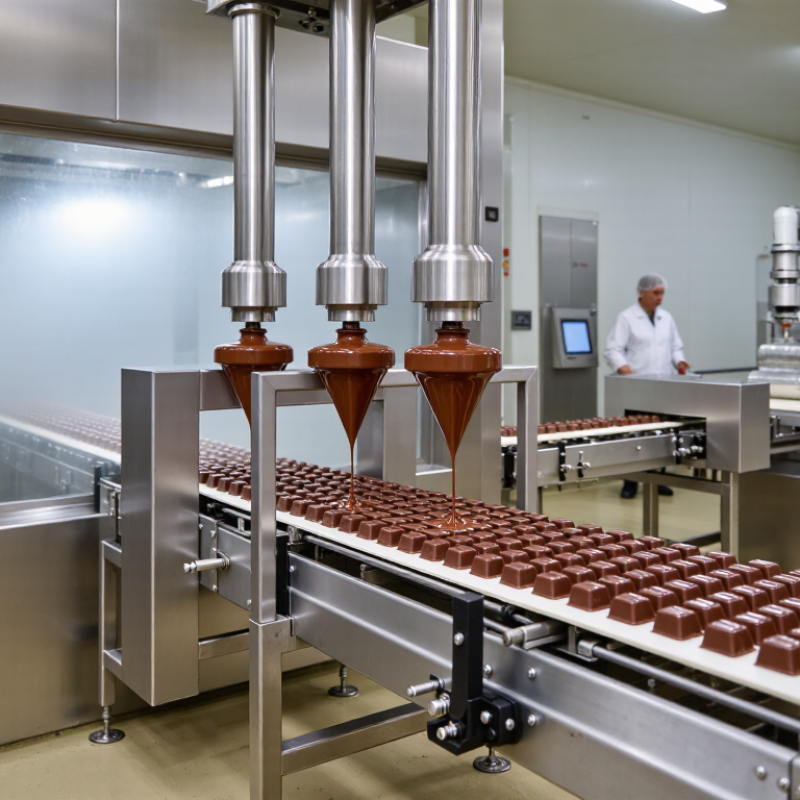
7 Best Chocolate Bar Production Lines for Global Buyers

What Defines a Chocolate Bar Production Line

What Defines a Chocolate Bar Production Line

A chocolate bar production line is more than a series of connected machines. It is a controlled process that transforms refined chocolate into consistent bars, from tempering to packaging. The core sequence usually includes melting, tempering, depositing, vibration, cooling, demoulding, inspection, and wrapping. Each stage affects texture, gloss, weight, and shelf stability.

Temperature control is central. Chocolate may require tempering accuracy within a narrow range, often around 1°C, to develop stable cocoa butter crystals. A cooling tunnel must remove heat evenly, not simply quickly. Uneven cooling can create surface marks, cracks, or dull chocolate.

According to the International Cocoa Organization’s 2023/24 report, global cocoa grindings were forecast at about 4.86 million tonnes. That volume increases pressure on manufacturers to improve yield and reduce material loss.

A reliable line also includes hygienic design, recipe control, metal detection, traceability, and easy cleaning access. Modern equipment may measure weight variation, cooling performance, and overall equipment effectiveness in real time.

However, automation does not solve every problem. A line can look impressive and still waste chocolate during changeovers. In practice, operators must inspect nozzle deposits, belt alignment, and mould temperature each shift. I would also question any specification promising zero defects. Real production includes humidity changes, ingredient variation, and occasional human error. A strong line manages these variables without hiding them.


How Chocolate Bar Production Lines Work Step by Step

Chocolate bar production begins with controlled ingredient preparation. Operators weigh cocoa mass, sugar, milk powder, and cocoa butter accurately. The mixture enters a refiner, where particle size becomes smooth and consistent. It then moves through a conche. Here, heat and mixing reduce harsh flavors and moisture.

The tempered chocolate is cooled and reheated within a narrow temperature range. This step creates stable crystals, a clean snap, and a glossy surface. Moulds receive the chocolate through a depositing machine. Vibration removes trapped air. Cooling tunnels then lower the bar temperature gradually. Finally, the bars are demoulded, inspected, wrapped, and packed. In practice, no line runs perfectly every day. A small temperature drift can cause dull surfaces or weak structure. Experienced technicians record these changes instead of guessing.

Tips: Confirm the line’s capacity with real product tests. Check cleaning access, temperature sensors, mould change time, and packaging compatibility. Ask for training records and maintenance procedures. These details often reveal more than impressive output figures. Keep samples from each batch for texture and appearance checks. A simple log can prevent repeated mistakes.

Key Features of the Seven Leading Production Line Types

7 Best Chocolate Bar Production Lines for Global Buyers

Global cocoa processing remains substantial. The International Cocoa Organization estimated 2023/24 cocoa grindings at 4.855 million tonnes. That volume raises demand for stable, hygienic, and adaptable chocolate bar production lines. A practical shortlist covers seven leading types: moulding lines create uniform solid bars with precise weight control; enrobing lines coat biscuits or centres with a continuous chocolate curtain; depositing lines handle filled bars and controlled inclusions; shell-moulding lines produce hollow centres with accurate wall thickness; extrusion lines shape soft chocolate mixtures continuously; cold-forming lines reduce thermal exposure during shaping; integrated bean-to-bar lines combine roasting, refining, conching, tempering, and moulding.

Each design solves a different production problem. Moulding systems need reliable tempering and vibration tables, because trapped air can leave visible holes. Enrobing equipment benefits from adjustable curtain width and bottoming control. Depositors require servo accuracy when fillings contain nuts, caramel, or crisp pieces. Hollow-shell systems need rapid cooling tunnels and careful demoulding. Extrusion lines suit higher-throughput recipes, but texture control can be difficult. Cold-forming systems may protect delicate ingredients, though their surface finish is not always consistent. Bean-to-bar lines offer traceability from roasted cocoa beans, but they demand more floor space, process knowledge, and cleaning discipline.

PMMI’s 2024 packaging analysis highlights automation, sanitation, and labor efficiency as continuing investment priorities. Buyers should compare output at the target bar weight, not only hourly speed. A line rated at 1,000 kilograms per hour may deliver less after changeovers, cooling delays, and cleaning. I would also test real recipes before purchasing. Catalog figures can look perfect. Factory conditions rarely are.

How to Compare Capacity, Automation, and Product Quality

Choosing among chocolate bar production lines requires more than comparing quoted output. Global buyers should examine usable capacity, automation depth, and finished product quality together. A line rated at 1,000 kilograms per hour may deliver less after changeovers, cleaning, and recipe adjustments. Ask for tested output using the same chocolate formula, mold size, and cooling conditions. Check cycle time, energy demand, floor space, and product changeover time. Rated capacity is not usable capacity.

Automation affects labor needs, consistency, and recovery after stoppages. Compare temperature sensors, recipe storage, alarm systems, and production data records. Remote diagnostics can shorten downtime, but only when technicians can access accurate fault information. A polished control screen proves little. Require a factory acceptance test with real chocolate and agreed tolerances. Confirm operator training, spare-part availability, cleaning access, and maintenance intervals. Keep the process practical.

Product quality depends heavily on tempering stability, depositing accuracy, and cooling control. Inspect gloss, snap, weight variation, edge definition, and bloom after storage. Hygiene design also matters. Look for smooth welds, food-grade contact surfaces, and drainage without hidden residue points. Packaging should protect bars from heat, moisture, and seal failure during transport. Ask for references from facilities with similar climates and recipes. Some buyers overvalue speed. That mistake becomes expensive. A slower line with stable tempering may produce fewer rejects and less rework. No comparison is perfect. Leave room for measured doubt.

7 Best Chocolate Bar Production Lines for Global Buyers

How to compare capacity, automation, and product quality across common line configurations

Indicative industry benchmarks for typical equipment configurations. Capacity is shown in finished-product kilograms per hour; automation and quality consistency are comparative scores from 0 to 100. Actual results vary with recipe, bar size, cooling time, packaging format, and operating conditions.

Factors Global Buyers Should Assess Before Purchasing

Global buyers comparing chocolate bar production lines should assess more than advertised output. A line promising 1,000 kilograms per hour may require a specific mold, recipe, and operating temperature. Ask for tested production records, not only catalog figures. Check whether the tempering unit handles dark, milk, and compound coatings consistently. Small temperature changes can create dull surfaces or fat bloom. Request sample bars made with your ingredients. Real evidence matters. I have seen buyers overlook this step, then discover their preferred filling jams the depositing system.

Hygiene and maintainability deserve equal attention. Food-contact surfaces should be easy to remove, inspect, and sanitize. Examine welds, seals, conveyors, and cooling tunnel access points. A machine that needs hours to clean can quietly reduce daily capacity. Confirm electrical standards, safety guarding, documentation, and installation requirements for the destination country. Ask how quickly technicians respond and whether critical spare parts are locally available. Service promises can sound reassuring, yet vague response times are a warning.

Energy use, factory layout, and product flexibility affect total ownership cost. Measure available floor space, ceiling height, drainage, compressed air, and stable power supply before signing a purchase agreement. Compare actual consumption per kilogram, including refrigeration and heating. Flexible lines may produce filled, layered, or inclusions bars, but extra modules increase cleaning and adjustment work. That trade-off is easy to underestimate. Require factory acceptance tests, operator training, and a clear list of excluded costs. Leave room for mistakes. Pilot trials often reveal issues that polished demonstrations hide.

7 Best Chocolate Bar Production Lines for Global Buyers - Factors Global Buyers Should Assess Before Purchasing
Line Profile Recommended Buyer Typical Product Format Indicative Capacity Bar Weight Range Core Processing Stages Temperature-Control Requirements Automation Level Typical Footprint Key Purchasing Advantages Critical Assessment Points
1. Entry-Level Moulding Line Small confectionery producers, start-ups, bakeries and regional brands Solid bars, filled bars, seasonal moulded pieces 80–250 kg/h 10–200 g Chocolate melting, storage, tempering, depositing, vibration, cooling, demoulding and manual or semi-automatic packing Tempering generally requires approximately 28–32°C for dark chocolate and approximately 27–30°C for milk or white chocolate, depending on formulation Semi-automatic Manual packing 30–70 m² Lower initial investment, simpler operation, flexible mould changes and suitable for product testing Check mould-change time, operator access, cooling stability, spare-part availability and compatibility with local electrical standards
2. Compact Automatic Moulding Line Small-to-medium factories serving supermarkets, foodservice and e-commerce channels Standard moulded chocolate bars, mini-bars and assorted tablet formats 300–600 kg/h 20–150 g Automatic dosing, tempering, mould loading, depositing, vibration, multi-zone cooling, demoulding and flow wrapping Controlled tempering and cooling are required to reduce bloom, deformation and mould-release problems Automatic forming Semi-automatic packing 70–130 m² Good balance between investment, output, product consistency and format flexibility Evaluate line synchronization, PLC language options, conveyor sanitation, film compatibility and changeover procedures
3. High-Speed Moulded Bar Line Established manufacturers requiring continuous production for domestic or export markets High-volume solid bars, filled moulded bars and multi-cavity tablet products 800–1,500 kg/h 25–250 g Continuous tempering, servo-controlled depositing, mould circulation, intensive vibration, tunnel cooling, automatic demoulding, metal detection and packing Stable room conditions and accurately controlled cooling-air temperature, humidity and velocity are essential Fully automatic Integrated inspection 150–300 m² High throughput, consistent bar weight and reduced dependence on manual labour Confirm actual output at the target recipe, energy consumption, reject handling, maintenance access and uptime guarantees
4. Enrobed Wafer and Biscuit Bar Line Buyers producing layered wafer bars, biscuits, cookies or centres coated with chocolate Enrobed wafer bars, biscuit bars, cereal bars and cream-filled centres 300–1,000 kg/h 15–100 g Centre feeding, chocolate tempering, bottoming, curtain enrobing, decorating, cooling, cutting or guillotine portioning and wrapping Chocolate viscosity, coating temperature and cooling profile must be matched to the centre's moisture and fat content Automatic coating Servo portioning 120–250 m² Supports attractive coatings, multiple centre types and premium snack-bar applications Assess coating thickness control, centre alignment, crumb management, cleaning time and the ability to handle sticky or fragile products
5. Filled Chocolate Bar Production Line Premium and specialty producers making cream, caramel, praline, fruit or nut-filled bars One-shot filled bars, shell-moulded bars and multi-layer filled tablets 250–800 kg/h 30–250 g Chocolate tempering, shell depositing, filling dosing, bottom sealing, cooling, demoulding, visual inspection and packaging Accurate tempering and filling-temperature control are required to prevent leakage, fat migration and shell cracking Recipe-controlled Automatic dosing 100–220 m² Enables higher-value products and differentiated fillings with controlled portion accuracy Verify filling-pump accuracy, allergen changeover procedures, filling particle size limits, CIP or dry-cleaning design and seal integrity
6. Premium Multi-Format Chocolate Line Contract manufacturers and exporters requiring frequent product and packaging changes Standard bars, mini-bars, gift tablets, inclusions, decorated bars and limited-edition formats 400–1,200 kg/h 10–300 g Flexible tempering, interchangeable depositing units, inclusion dosing, moulding or enrobing, cooling, inspection and multiple packing options Product-specific temperature profiles and controlled humidity are important when switching between dark, milk and white chocolate Highly automated Quick-change design 160–320 m² Broad SKU flexibility, quick format changes and suitability for premium retail programs Compare tool-change time, recipe management, maximum inclusion size, data logging, cleaning validation and packaging versatility
7. Industrial Export-Oriented Bar Line Large-scale manufacturers supplying multiple countries and high-volume retail customers Standardized bars, private-label products, filled tablets and enrobed snack bars 1,500–3,000+ kg/h 20–300 g Bulk chocolate handling, continuous tempering, high-speed moulding or enrobing, long cooling tunnel, automated demoulding, checkweighing, case packing and palletizing Factory-wide environmental control, stable cooling capacity and validated heat-management procedures are required for export consistency Fully integrated Centralized monitoring 300–700 m² High output, lower unit labour cost, strong traceability and compatibility with large distribution programs Review total cost of ownership, utility demand, commissioning support, food-safety documentation, redundancy, service response and local spare-parts stock
Note: Capacity, product-weight and footprint figures are indicative industry ranges. Actual performance depends on chocolate formulation, viscosity, inclusions, mould design, cooling conditions, packaging format, operating schedule and required quality standards.
en_USEnglish

PCD Inserts

PCBN Inserts

Solid CBN Inserts

PCD Milling Cutter

PCD Drilling Tools

PCD Reamer

Diamond Special Tool

Diamond Dressers