10 Best GRP Storage Tank Manufacturers in 2026?
Selecting a Grp Storage Tank manufacturer in 2026 takes more than comparing prices. Buyers need to assess resin systems, laminate construction, engineering support, and documented quality controls. A tank may look robust on delivery day, yet poor installation guidance or an unsuitable resin can shorten its service life.
The 2024 United Nations World Water Development Report, published by UNESCO, says global water demand has grown by about 1% annually over the past four decades. It expects a similar trend through 2050. That continuing pressure makes dependable water storage important for utilities, industry, agriculture, and buildings. ASTM D3299 covers filament-wound, glass-fiber-reinforced polyester tanks, while ASTM D4097 addresses contact-molded tanks. These standards offer useful reference points when comparing construction methods and specifications. Details matter.
No shortlist is perfect. This guide reviews 10 manufacturers using practical criteria: product range, stated standards, customization options, technical documentation, and service coverage. We also consider whether manufacturers clearly explain tank capacity, chemical compatibility, support conditions, and inspection requirements. Buyers should verify specifications against their own liquid, site conditions, and local project requirements. A polished brochure is not proof of performance. The right supplier is the one whose evidence fits the application, not simply the one with the most impressive claims.
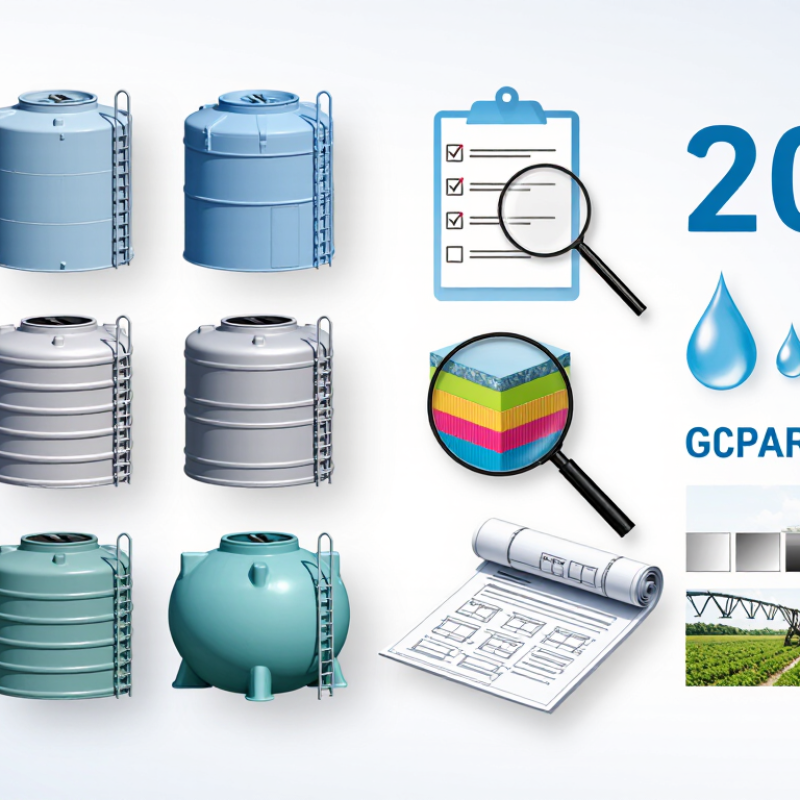
Understanding GRP Storage Tanks and Their Common Applications
GRP storage tanks are made from glass fibers embedded in a resin matrix. This construction creates a relatively light, corrosion-resistant vessel. Common uses include potable-water storage, wastewater treatment, rainwater harvesting, and industrial process-fluid storage. On site, a tank may hold treated water beside a plant, or buffer changing supply from a well. Agricultural facilities also use GRP tanks for irrigation water and other compatible liquids. That sounds simple. It isn’t. Resin type, fluid chemistry, temperature, sunlight exposure, and support conditions all affect service life.
The scale of water infrastructure needs makes dependable storage important.
The U.S. Environmental Protection Agency’s 2023 Seventh Drinking Water Infrastructure Needs Survey and Assessment estimates that the country needs $625 billion in drinking-water investment over 20 years.
This figure covers infrastructure broadly, not GRP tanks alone. It nevertheless illustrates the scale of systems that require careful storage planning. For potable-water projects, buyers should check applicable standards, including AWWA D120, and verify material compatibility with the stored liquid.
Installation details matter too: an uneven base or poorly planned access can create problems even when the tank itself is well specified. GRP is not automatically the right choice for every site.
Key Criteria for Assessing GRP Tank Manufacturers
When comparing GRP storage tank manufacturers in 2026, look beyond price and advertised capacity. Ask for laminate design details, resin type, reinforcement schedule, and documented design loads. These affect resistance to stored chemicals, temperature changes, wind, and long-term hydrostatic pressure. A neat brochure is not evidence. Request test records, inspection procedures, and references for tanks operating in similar conditions. Check whether the proposed design follows a relevant standard, such as ASTM D3299 for filament-wound tanks or ASTM D4097 for contact-molded tanks. Confirm that the standard fits the tank’s construction and service; a certificate alone cannot prove suitability.
Reliability also depends on installation and maintenance. Ask how the supplier controls panel alignment, joint sealing, and field repairs. For potable-water use, verify applicable material approvals and request cleaning and inspection guidance.
The U.S. Environmental Protection Agency’s 2023 Drinking Water Infrastructure Needs Survey estimates $625 billion in drinking-water infrastructure needs over 20 years. That figure makes serviceability and replacement planning practical selection criteria, not paperwork.
AMPP’s 2016 IMPACT study estimated corrosion costs at $2.5 trillion globally, or 3.4% of global GDP, and reported potential savings of 15–35% through corrosion-control practices.
GRP can reduce corrosion exposure, but it is not maintenance-free. Ask manufacturers to explain assumptions behind service-life claims, and compare those assumptions with your actual water chemistry, site conditions, and inspection capacity.
Ten Notable GRP Storage Tank Manufacturers in 2026
Choosing among ten notable GRP storage tank manufacturers in 2026 takes more than comparing prices. The right choice depends on the stored liquid, operating temperature, site access, and maintenance plan. Ask for resin and laminate specifications, design-load details, and documented quality checks. Useful evidence includes inspection records and clear guidance on fittings, supports, and anchoring. Small details matter.
A tank beside a coastal process line may need different UV and corrosion considerations from one installed indoors. Check whether the supplier can explain joint design, nozzle placement, and installation tolerances in plain language. Request references for projects with similar capacity and service conditions. Compare delivery scope, too: foundation interfaces, lifting points, commissioning support, and replacement-part availability can affect lifecycle costs. Fit varies. Published capacity alone is not enough; verify usable volume, cleaning access, and the assumptions behind any quoted service life. Shortlists can look reassuring, but documentation and after-sales support are not always consistent. That is where comparisons get messy.
Material context: GRP (glass-reinforced plastic) is much lighter by density than steel. Bars show representative values in kilograms per cubic metre; actual density varies with the GRP formulation and the specific material grade. This is a material comparison, not a manufacturer ranking.
Comparing Product Range, Standards, and Customization Options
When comparing the 10 best GRP storage tank manufacturers in 2026, look beyond headline capacity. Check whether each supplier offers sectional and one-piece designs, indoor and outdoor installation options, and fittings suited to your water system. A useful comparison includes panel dimensions, access covers, ladders, level indicators, and insulation choices. These details affect installation and daily maintenance.
Standards matter. Ask which design and testing standards apply to the tank, and request current documents rather than relying on a logo or brochure. For potable water, verify that the materials and any required approvals match your project location. Also compare wind, seismic, and support-load design assumptions. A tank built for a sheltered site may not suit a rooftop exposed to strong gusts.
Tips: Send every manufacturer the same brief: capacity, water type, site conditions, access limits, and connection sizes. Request a drawing showing the base, nozzle positions, and maintenance clearance. Then compare lead times, installation support, and warranty terms. Small details can change the real cost.
Customization is most valuable when it solves a measured site constraint, such as a narrow service corridor or an uneven foundation. Ask how changes affect structural calculations and delivery schedules. One caveat: a highly tailored design is not automatically better. I would still check whether replacement panels and technical support will be available years later.
Industry Trends Shaping GRP Tank Manufacturing in 2026
In 2026, GRP tank manufacturing is moving toward tighter process control and more transparent quality records. Automated filament winding can help keep wall thickness consistent, while digital monitoring can flag resin temperature or curing variations earlier. These tools matter because small production differences may affect long-term performance. Yet automation is not a substitute for experienced inspection. A tank still needs checks for laminate quality, fittings, and the conditions it will face on site.
Sustainability is also influencing design decisions. Manufacturers are looking at resin use, material waste, transport weight, and repair options across a tank’s service life. Modular sections can simplify delivery to restricted sites, such as rooftop plant rooms or remote facilities. But modularity adds joints that need careful sealing and inspection. Not every new feature improves reliability; that deserves honest scrutiny. Buyers should compare documented design limits, quality-control procedures, and maintenance guidance rather than relying on broad performance claims.
Tips: Ask for inspection records, resin and reinforcement specifications, and clear limits for temperature, liquid, and installation conditions. Check whether the proposed tank suits the actual foundation and access route. Keep maintenance practical: visible fittings and accessible inspection points can save time later. Small details matter. A neat brochure cannot replace a site-specific review.
 Skip to content



 English
 Russian
 German
 Spanish
 French
 Portuguese