SUNDI TOOLS
- Copyright © Wuxi Sundi Precision Tools Co.,LTD All rights reserved.
- Site Map
Choosing the right Mesh Sieves in 2026 is not simply a matter of selecting the smallest aperture. Global buyers must match sieve design with material behavior, testing standards, cleaning methods, and production volume. A fine stainless-steel woven wire sieve may suit laboratory powder analysis. A perforated plate sieve may perform better with heavy, abrasive granules. Nylon mesh can offer useful chemical resistance, but it may not provide the same dimensional stability as metal.
Dr. Ralph L. Rosin, a respected pioneer in particle-size analysis, stated, “The value of a test depends on the quality of its measurement.” This principle remains practical today. Buyers should check aperture tolerance, wire diameter, frame material, surface finish, and certificate traceability. ISO 3310 and ASTM E11 are common references for test sieves. However, compliance claims still require verification from the supplier. Ask for inspection records.
Small details matter.
A wet-washing sieve needs firm joints and reliable drainage. An ultrasonic-cleaning sieve needs compatible mesh and controlled vibration. In food, pharmaceutical, and chemical applications, contact materials and cleaning procedures deserve close review. No sieve is perfect. Mesh openings can deform, samples can agglomerate, and operators can overload the surface. These points are easy to overlook.
This 2026 guide compares the best types of Mesh Sieves for global buyers. It considers accuracy, durability, maintenance, customization, certification, and total ownership cost. The most expensive option may not be the best choice. The most convenient option may create unreliable results. Careful selection begins with the material, the test method, and the evidence behind the supplier’s promises.
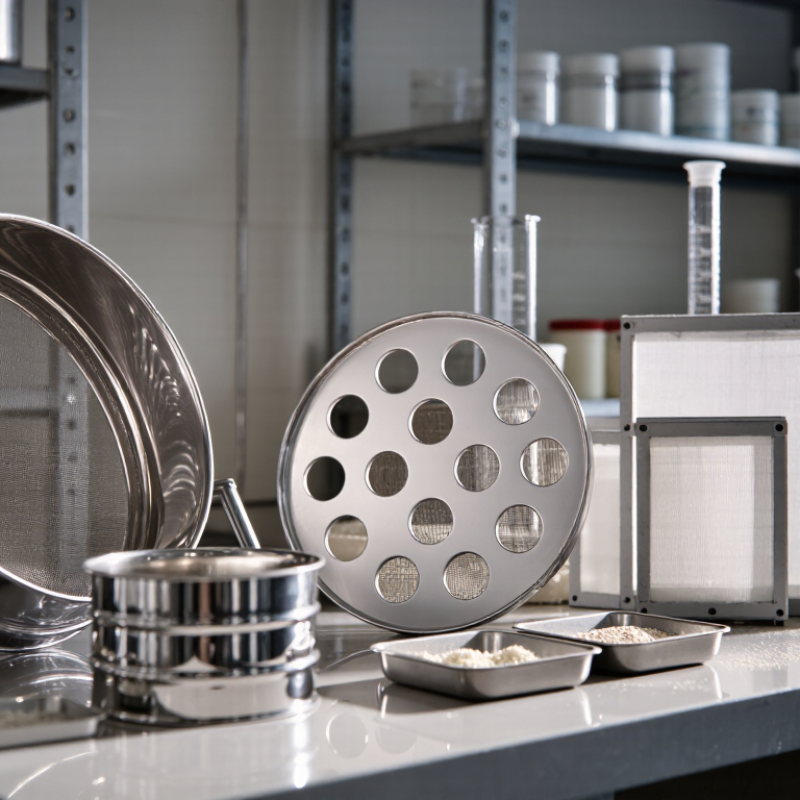
Mesh sieve selection starts with aperture, not mesh count. ASTM E11 covers nominal openings from 125 mm down to 20 µm, helping laboratories compare particle separation more consistently. Coarse sieves handle stones, granules, and mineral fragments. Fine sieves support powders, pigments, and pharmaceutical raw materials. At smaller openings, wire diameter, tension, and cleanliness become increasingly important.
A 20 µm sieve is not simply a smaller version of a 125 mm sieve. Its working area is more sensitive to blockage, sample loading, and cleaning methods. In routine testing, I have seen operators blame the sieve when excessive material caused poor separation. That assumption is often wrong. No sieve performs perfectly under careless handling. Aperture tolerance and inspection records also matter.
Confirm the nominal aperture, frame size, material, and ASTM E11 documentation before ordering. Ask for calibration or inspection results when results affect product release. Use a suitable sample mass, and avoid forcing particles through the mesh. For global purchases, check unit conversions carefully. Micrometres and millimetres are easy to confuse. It is also wise to verify whether your laboratory method requires a specific aperture sequence, because the most expensive sieve is not always the most appropriate one.
For global buyers, sieve selection should begin with the material, aperture, and required test accuracy. Wire-mesh sieves use woven metal wire cloth and are commonly assessed under ISO 3310-1. They suit powders, grains, aggregates, and many laboratory samples. Each aperture should be checked against the stated tolerance, not only the nominal size.
Perforated-plate sieves use punched openings in a metal sheet. They offer stronger resistance to rough, heavy particles, but their openings behave differently from woven wire apertures. ISO 3310-1 mainly covers test sieves made with metal wire cloth; perforated-plate sieves may fall under separate standards, such as ISO 3310-2. This detail is easy to miss. Woven-grid sieves provide regular openings and efficient separation, yet damaged wires can change results quickly. Inspect the frame, mesh tension, aperture condition, and certification before purchase.
Tips: Request the standard reference and inspection report. Confirm aperture size, tolerance, frame diameter, and material grade. For wet sieving, check corrosion resistance and cleaning limits. A short trial with the real sample is valuable. Do not trust appearance alone. Even a bright, well-finished sieve may perform poorly if its openings are inconsistent. Record test conditions, because loading, shaking time, and sample moisture can influence repeatability.
2026 Best Types of Mesh Sieves for Global Buyers?
Dry, wet, and air-jet sieving each solve different separation problems. Dry sieving suits free-flowing powders and granules, such as flour, minerals, and polymer pellets. Wet sieving helps when particles agglomerate or contain clay-like residue. Air-jet sieving is more precise for fine, cohesive powders that block mesh openings. The choice depends on moisture, particle shape, density, and target size. A larger opening is not always faster.
FAO’s Food Outlook 2024 estimated global cereal production near 2.85 billion tonnes. That volume increases pressure for stable grading and low material loss. For pharmaceutical and chemical powders, ASTM E11 and ISO 3310-1 provide useful mesh and test-sieve references. However, standards do not replace process trials. In practice, operators should test actual material, not only laboratory samples. Some powders behave differently after storage.
Tips: Match the sieve method to the feed condition. Use wet sieving for sticky particles. Use air-jet assistance below roughly 100 micrometres, after checking product sensitivity. Record feed mass, sieving time, moisture, and residue. Clean the mesh carefully. A damaged screen can create false results. Periodic verification with certified test particles improves reliability, although it adds time and cost. I have found that the “best” sieve often changes when humidity, batch size, or operator technique changes.
For global buyers, choosing a mesh sieve depends on sample behavior, testing volume, and the available laboratory frame. Manual sieves suit small batches, fragile particles, and quiet work areas. The operator controls shaking time and intensity. Results can vary, however. Two technicians may produce different separation levels.
Shaker sieves provide steady movement for 200–300 mm frames. They are practical for routine quality checks, especially when several sieves are stacked. Check the clamp, lid, receiver, and timer before operation. A loose frame can spill powder and distort results. Vibratory sieves offer stronger, more consistent motion for fine or difficult materials. They save labor but may create heat, noise, or excessive particle breakage. That matters.
Mesh selection requires more than choosing a numbered opening. Confirm the wire material, aperture tolerance, effective screening area, and certificate requirements. Inspect each mesh against light before use. Bent wires, blocked openings, and worn seals can quietly change results. Clean the sieve with a suitable brush or approved method, then dry it fully. Moisture is often overlooked. For international purchasing, request frame diameter, mesh designation, electrical specifications, and test documentation in writing. Local voltage and laboratory procedures may differ. No design is perfect for every material, and a quick trial with the real sample is often wiser than relying only on a catalog description.
| Equipment Type | Typical Frame Diameter | Typical Sieve Stack | Recommended Sample Mass | Typical Operating Principle | Approximate Operating Range | Best Applications | Key Advantages | Main Limitations | Buyer Considerations |
|---|---|---|---|---|---|---|---|---|---|
| Manual Sieve | 200–300 mm | Usually 1–5 sieves plus lid and receiver | Commonly up to about 1 kg, depending on material and aperture | Hand shaking, tapping, or circular motion | Operator-controlled; commonly 5–15 minutes per test | Basic particle-size checks, field work, low sample volumes, teaching laboratories | Lowest purchase cost; no electricity; portable; simple to clean and maintain | Operator-dependent results; lower repeatability; labor-intensive for many samples | Choose rigid frames, secure lids, corrosion-resistant mesh, and a comfortable grip or clamp system |
| Mechanical Shaker | 200–300 mm | Typically 3–8 sieves, depending on stack height and machine clearance | Often about 0.5–2 kg, subject to sieve aperture and material density | Controlled horizontal, circular, or orbital movement with intermittent tapping on some models | Typical test duration: 5–15 minutes; speed is often adjustable | Routine quality control, powders, granules, aggregates, and repeated laboratory testing | Better repeatability than hand sieving; suitable for multiple sieves; moderate operating cost | May not provide the same separation efficiency as high-energy vibratory systems for difficult materials | Check stack capacity, timer, motion type, clamping method, and compatibility with 200 mm or 300 mm frames |
| Vibratory Sieve Shaker | 200–300 mm | Usually 4–8 sieves, depending on model design and sample load | Commonly about 0.1–2 kg; fine powders may require smaller loads | Electromagnetic or motor-driven three-dimensional vibration | Typical frequency: approximately 1,500–3,000 vibrations per minute; test time often 3–15 minutes | Fine powders, pharmaceutical and food ingredients, mineral samples, ceramics, and research laboratories | Fast separation; good repeatability; effective for fine and mixed particle sizes; programmable operation on some units | Higher cost, noise, vibration transmission, and greater sensitivity to incorrect loading | Confirm amplitude control, vibration isolation, noise level, timer range, and local electrical requirements |
| Wet Sieve Shaker | 200–300 mm, with wet-sieving accessories | Usually 1–4 sieves with spray cover, drainage pan, or collection system | Often about 0.1–1 kg of dry-equivalent sample | Mechanical vibration combined with controlled water flow | Typical wet-sieving cycle: approximately 5–20 minutes | Fine cohesive powders, soils, sands, slurries, and materials that cannot be separated effectively when dry | Reduces blinding and dust; improves separation of agglomerated or water-dispersible particles | Requires water management, drying of retained fractions, and corrosion protection | Check drainage design, splash protection, wash pressure, wastewater handling, and stainless-steel wetted parts |
| Air-Jet Sieve System | Commonly 200 mm; some configurations support larger laboratory frames | Usually one sieve at a time | Typically a few grams to approximately 100 g, depending on material | Air flow disperses fine particles while vacuum removes undersize material | Typical test duration: about 1–10 minutes for fine powders | Very fine, low-density, electrostatic, or easily agglomerated powders | Minimizes manual brushing; useful for fine particles; can reduce airborne dust when properly contained | Lower batch capacity; requires a suitable vacuum arrangement; less suitable for coarse particles | Evaluate vacuum compatibility, filter efficiency, electrostatic control, cleaning procedure, and fine-mesh availability |
| Digital Analytical Sieve System | 200–300 mm, depending on the platform | Commonly 3–8 sieves with digital controls | Typically about 0.1–2 kg, based on material characteristics | Programmable vibration with electronic timing and, on some systems, amplitude control | Typical programmed cycle: 1–30 minutes | Regulated laboratories, method development, audit-ready quality control, and repeat testing | Improves method consistency; supports saved test settings; reduces operator variation | Higher initial investment; electronic components require careful cleaning and service | Check data export, calibration documentation, software language, service availability, and voltage compatibility |
2026 Best Types of Mesh Sieves for Global Buyers?
Global buyers should match mesh material with the sample, not only the purchase price. Stainless steel suits powders, granules, and repeated washing. Brass can reduce initial cost, but it may require stricter corrosion control. ASTM E11 lists standardized sieve openings, including 4.75 mm and 20 μm sizes. ISO 3310-1 covers metal wire-cloth test sieves from 125 mm down to 20 μm. These references help buyers compare quotations accurately.
Accuracy depends on aperture tolerance, wire diameter, frame stability, and inspection records. A sieve with 20 μm openings needs careful handling, because one dent can change separation results. Ask for calibration data, aperture inspection results, and material certificates. For food, chemical, and pharmaceutical applications, request suitable contact declarations and traceability documents. Certification should support the application, not decorate the quotation.
Capacity also changes the decision. A 200 mm sieve is easy to handle, while a 300 mm model processes more material but needs stronger shaking equipment. Buyers should compare working load, screening time, and cleaning labor. Cost calculations must include spare screens, freight, calibration, and rejected batches. Cheap mesh is not always economical. Sometimes, the “best” choice still fails because the buyer selected mesh size before checking particle shape. That mistake is common.