China Top Strawberry Clamshell Supplier for Global Buyers
China is a major force in global strawberry production and packaging supply. FAOSTAT identifies China among the world’s leading strawberry-producing countries. This creates a strong manufacturing base for export-ready packaging. For international buyers, the right Strawberry Clamshell must protect delicate fruit from bruising, moisture, and temperature changes. It must also support efficient filling, stacking, transport, and retail display.
Small details matter.
A practical supplier should offer PET or rPET options, secure hinged lids, ventilation, anti-fog performance, and consistent dimensions. The United Nations Environment Programme has emphasized reducing unnecessary packaging and improving material circularity. Therefore, material selection deserves more than a low unit price. Buyers should request food-contact declarations, recycled-content evidence, mold specifications, and independent quality records. Packaging should also be checked against destination-market requirements, including applicable EU, United States, and other national food-contact rules. USDA Agricultural Marketing Service guidance on fresh produce quality reinforces the importance of protecting appearance and condition throughout distribution. However, a clamshell alone cannot guarantee freshness. Cold-chain control still matters. Testing should include compression, drop, vibration, closure, and refrigerated storage trials. A supplier may provide attractive samples, yet production consistency can tell a different story. This is where careful audits and repeat testing become essential. China-based manufacturers can offer competitive tooling, scalable production, and export experience. Still, buyers should verify every claim. The best Strawberry Clamshell supplier combines measurable protection, responsible materials, stable lead times, and transparent communication. Not every design fits every berry. That limitation deserves attention.
Strawberry Clamshell Packaging: Definition and Main Features
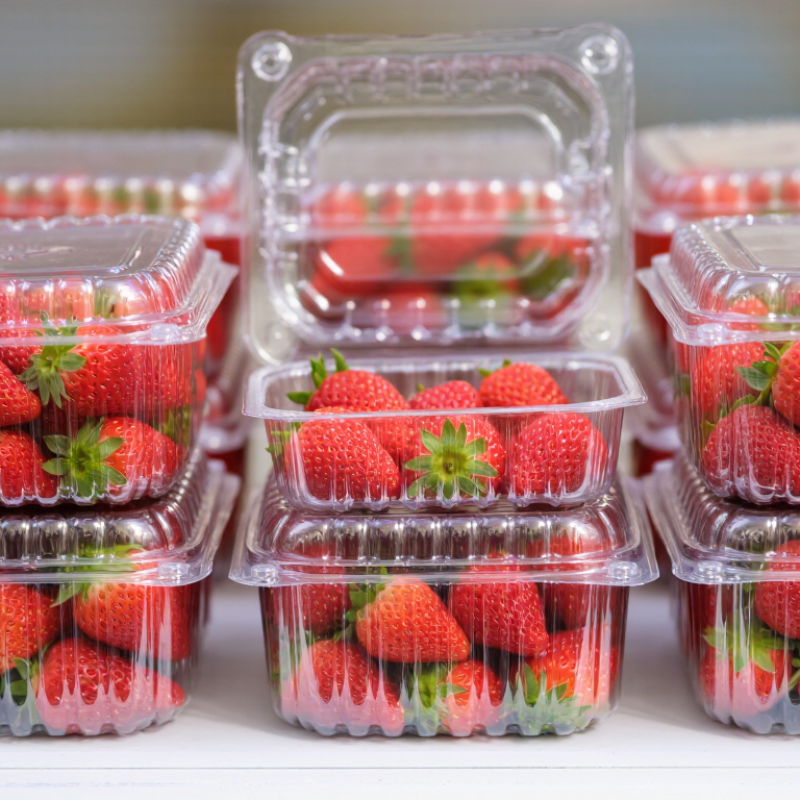
A strawberry clamshell is a clear, hinged container designed to protect fresh berries during packing, transport, display, and home storage. Its rigid walls reduce crushing, while the transparent lid lets buyers inspect color, size, and visible defects. Small ventilation openings help release moisture, but they cannot replace a reliable cold chain.
The UC Davis Postharvest Research and Information Center recommends storing strawberries near 0°C with 90–95% relative humidity. Under suitable conditions, expected storage life is usually five to seven days. This makes material quality important.
Food-grade PET offers strong clarity and impact resistance, while recycled PET can support lower-material-impact goals when supply and food-contact compliance are verified. A secure hinge and tamper-evident closure also reduce accidental opening during distribution. Still, clamshells are not perfect. Excess condensation may encourage mold, especially when berries enter the pack warm.
Tips: Ask suppliers for food-contact documents, compression-test results, ventilation specifications, and cold-chain guidance. Check whether pack dimensions match your berry size. A loose fit causes movement; an overly tight fit creates pressure marks.
FAO’s 2023 food-loss reporting shows that significant losses still occur between harvest and retail. Better packaging can limit bruising and contamination, but it cannot correct poor harvesting, delayed cooling, or weak warehouse handling. For global buyers, a dependable China-based supplier should provide trial samples, production traceability, and consistent closure performance. Test the design with real berries, not only empty cartons.
Why China Is a Leading Strawberry Clamshell Supplier
Why China Is a Leading Strawberry Clamshell Supplier
China has become a major source of strawberry clamshell packaging for international buyers. FAOSTAT production data places China among the world’s largest strawberry producers. This creates strong local demand for practical, stackable containers. Suppliers can test designs close to farms, cold-chain warehouses, and export packing stations. That experience matters.
China also offers a broad manufacturing base. PET sheet producers, mold makers, printing factories, and logistics companies often operate within connected industrial regions. This can shorten development cycles and support custom ventilation, hinged lids, and tamper-evident structures. Smithers’ 2024 packaging outlook identifies sustainability and material efficiency as major forces shaping food packaging. Chinese manufacturers are responding with thinner designs, recycled-content options, and improved nesting efficiency.
Cost is another factor. Large production runs can spread tooling and setup costs across thousands of units. However, low pricing alone should not determine supplier selection. Public trade databases usually group plastic packaging into broad HS categories, so exact strawberry clamshell export figures remain difficult to verify. That is an important limitation.
Experienced buyers should request food-contact documentation, compression-test results, migration reports, and sample measurements. Small differences in hinge strength can become serious during refrigerated transport. Some suppliers still overstate recycled content or airflow performance. Independent verification is worth the extra effort.
How Global Buyers Evaluate Clamshell Manufacturers
China Top Strawberry Clamshell Supplier for Global Buyers
Global buyers evaluate clamshell manufacturers beyond the quoted price. They inspect resin documentation, mold precision, ventilation, seal integrity, and shipment consistency. FAOSTAT lists approximately 9.6 million tonnes of strawberries worldwide in 2022. That scale makes packaging reliability commercially important. A supplier should provide food-contact declarations, batch records, and corrective-action reports. Ask for samples from three production lots. Not one sample.
Practical testing should include compression, drop, stacking, and cold-chain performance. A loaded clamshell should protect fruit without crushing soft berries. Hinge movement also matters; weak hinges can fail during packing-line handling. Buyers should compare cavity dimensions, wall thickness, and closure force against approved samples. Small variations create visible problems in retail displays. Laboratory data helps, but warehouse trials reveal more.
Sustainability claims require careful examination. UNEP’s 2023 Turning off the Tap report projects plastic waste could rise from 353 million tonnes in 2019 to nearly 1.014 billion tonnes by 2060 without stronger action. Therefore, global buyers increasingly request recycled-content evidence, material specifications, and recycling guidance. A recycled-content claim may sound convincing, yet it needs test results. No checklist is perfect. Experienced buyers also review factory hygiene, worker training, traceability, and export packing before approving a long-term supplier.
How Global Buyers Evaluate Strawberry Clamshell Manufacturers
The chart presents a normalized procurement-priority index out of 100. For global strawberry buyers, food-contact compliance, product protection, ventilation design, and supply consistency are typically evaluated before price alone.
Production, Quality Control, and Customization Options
China Top Strawberry Clamshell Supplier for Global Buyers
Reliable strawberry clamshell production begins with precise forming, clean materials, and repeatable inspection. Our production teams use food-contact PET or rPET, depending on buyer requirements and local regulations. Vent holes, hinge strength, and stackability receive attention during tooling trials. A small change in hole size can affect condensation and berry firmness.
FAO’s 2019 State of Food and Agriculture reports that 14% of food is lost between harvest and retail. Packaging cannot solve every loss, but stable clamshells can reduce crushing, contamination, and handling damage. Each batch should pass checks for wall thickness, lid closure, clarity, dimensions, and drop resistance. Samples are retained for traceability. Not every inspection is perfect; uneven cooling can still create minor warping, so corrective reviews matter.
Customization may include colors, ventilation patterns, label areas, recycled content, and carton packing plans. Global buyers often request different sizes for 125-gram, 250-gram, or 500-gram packs. CAD samples help confirm fit before mold production.
The UNEP Food Waste Index 2024 estimated 1.05 billion tonnes of food waste in 2022, showing why practical packaging choices remain important. However, excessive plastic or oversized cartons can weaken sustainability goals. A responsible supplier should discuss material weight, transport efficiency, and recycling conditions openly. Procurement teams should also request test records, material declarations, and pre-shipment samples before approval.
Shipping, Compliance, and Supplier Selection for Importers
For global buyers, a strawberry clamshell supplier must manage more than clear plastic and attractive design. Shipping performance matters because berries bruise quickly under vibration, compression, and temperature changes. The UNCTAD Review of Maritime Transport 2024 reported 2.4% growth in maritime trade during 2023, increasing pressure on ports and schedules. Importers should request carton dimensions, pallet patterns, loading photos, and tested stacking strength before placing large orders. A small vent can protect freshness. Too many vents may increase dehydration.
FAO’s 2023 food-loss data estimates that 13.2% of food is lost between harvest and retail. Packaging cannot solve every handling problem, but airflow, drainage, and secure lids reduce avoidable damage. Ask suppliers for migration testing and declarations under applicable food-contact rules, such as EU Regulation (EC) No. 1935/2004 or relevant U.S. requirements. Documents should identify resin type, additives, test methods, and production dates. Generic certificates are weak evidence.
Supplier selection needs physical verification. Compare sample consistency, hinge strength, label adhesion, and performance after cold storage. An experienced importer should also review mold maintenance, batch traceability, inspection procedures, and backup production capacity. I have learned that a perfect sample may hide inconsistent factory output. That risk deserves a written inspection plan. Price still matters, but a cheaper clamshell can create higher freight, rejection, and repacking costs.
 Skip to content



 English
 Russian
 German
 Spanish
 French
 Portuguese