How to Choose the Best Powder Mixer for Your Needs?
Choosing the best Powder Mixer is crucial for various industries. A suitable mixer impacts product quality and process efficiency. This decision is not always straightforward. There are multiple types of powder mixers available, each designed for specific applications.
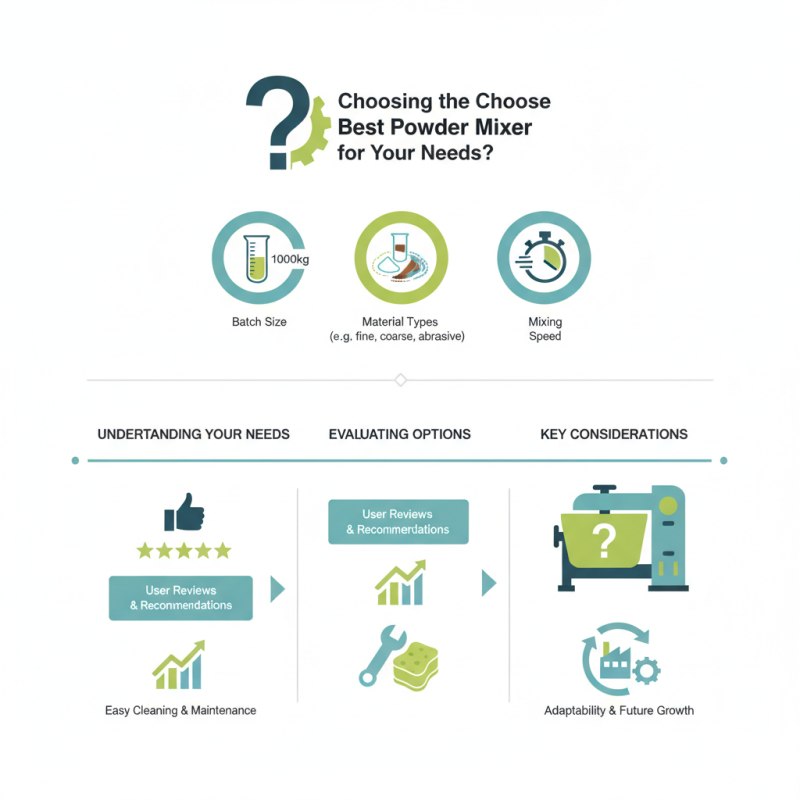
Understanding your needs is vital. Consider factors such as batch size, material types, and desired mixing speed. It's important to recognize that not all mixers perform equally. Some may excel in certain applications while failing in others.
When evaluating options, pay attention to user reviews and expert recommendations. A reliable powder mixer should have a solid track record. Look for features that enhance usability, such as easy cleaning and maintenance. A good mixer not only meets your current requirements but also adapts to future challenges.
Understanding Different Types of Powder Mixers Available in the Market
When searching for a suitable powder mixer, it's essential to understand the various types available on the market. The most common types include ribbon mixers, paddle mixers, and conical mixers. Each type has unique characteristics suited for different tasks. Ribbon mixers provide thorough blending, ideal for dry powders. Paddle mixers are excellent for more viscous materials, offering good mixing efficiency. Conical mixers, meanwhile, excel in gentle mixing processes.
Industry reports indicate that the global powder mixing equipment market is projected to witness growth. One report highlights a 5.2% CAGR from 2021 to 2026. This growth is attributed to increasing demand in industries like pharmaceuticals and food processing. The right mixer can enhance product quality, saving both time and costs.
Tip: Always consider the material being mixed. Different materials require different mixer types. Additionally, assess the mixer’s capacity. Oversized mixers may lead to ineffective blending.
Choosing the best powder mixer can seem daunting. Some mixers may not handle specific powders effectively, leading to inconsistent results. Always look into user reviews and expert recommendations to gauge performance in real-world applications. Understanding your specific needs will eliminate unnecessary errors.
Factors to Consider When Selecting a Powder Mixer for Your Application
Choosing the right powder mixer can significantly impact your production efficiency. One key factor is the type of material you are working with. Powders vary in density and flow characteristics. A mixer that works well for one type may not be suitable for another. Evaluating your material's properties is essential for optimal mixing.
Another critical consideration is the mixer capacity. Too small a mixer may lead to longer processing times. Conversely, an oversized mixer can result in wasted space and energy. It is vital to align the mixer's capacity with your production requirements. Additionally, think about the mixing process. Different applications may require gentle blending or intense energy input. Assessing your mixing needs will guide you to the right choice.
Don't overlook maintenance requirements. Some mixers need frequent cleaning and upkeep, which can be time-consuming. A less demanding model might seem appealing, but it could compromise mixing quality. Reflection on long-term operational efficiency is crucial. Each decision should connect back to your specific application for better outcomes.
Assessing Mixer Capacity and Efficiency for Your Production Needs
Assessing mixer capacity and efficiency is crucial for optimizing production. An efficient powder mixer enhances output and reduces waste. According to a recent industry report, mixers with a capacity exceeding 1,000 liters can increase efficiency by up to 30%. This statistic highlights the importance of selecting a mixer that meets your specific production volume.
When considering efficiency, pay attention to the mixing time. A well-designed mixer can reduce mixing time by as much as 50%. However, this varies with different materials. Some powders may require longer mixing times to achieve uniformity. It’s essential to test various mixers with your specific product to determine the optimal settings.
Understanding the characteristics of your materials is vital for achieving ideal results. Bulk density, particle size, and moisture content all impact the mixing process. For example, lighter powders may require more energy for effective mixing. Ensuring compatibility between your product and the mixer will ultimately lead to better efficiency. Taking time to evaluate these factors can save costs and improve output quality in the long run.
How to Choose the Best Powder Mixer for Your Needs? - Assessing Mixer Capacity and Efficiency for Your Production Needs
| Mixer Type | Capacity (Liters) | Mixing Efficiency | Power Consumption (kW) | Ideal Applications |
| Ribbon Mixer | 500 | High | 3.5 | Powdered Chemicals, Food Products |
| V-Blender | 300 | Medium | 2.0 | Pharmaceuticals, Nutraceuticals |
| Planetary Mixer | 200 | Very High | 4.0 | Cosmetics, Advanced Materials |
| Drum Mixer | 1000 | Low | 1.5 | Aggregates, Powdered Materials |
| Twin-Screw Mixer | 400 | High | 5.0 | Plastics, Compounding |
Evaluating Mixer Features and Technologies for Optimal Performance
Choosing the right powder mixer involves careful consideration of various features and technologies. A good mixer should efficiently blend different powders to achieve a consistent product. Look for mixers with adjustable speed settings. This allows for tailored mixing based on powder characteristics. Different powders may require specific mixing speeds for optimal results.
Another critical feature is the mixing mechanism itself. Some mixers use high-shear technology, while others might rely on fluidization or convection methods. Understanding these mechanisms helps in selecting a mixer that aligns with your production goals. Additionally, the right capacity is essential. A mixer that’s too large or too small can hinder performance and lead to inconsistencies.
Keep an eye on ease of cleaning and maintenance. Complex designs may trap powder residues, affecting the next batch. A mixer that is easy to dismantle simplifies this process. Reliability is crucial, so check for user reviews and case studies. Real-world performance offers insights into how a mixer can meet your needs. Error margins in mixing often arise from technological mismatches, so thorough evaluation is vital. Balancing these factors will ultimately lead to better mixing outcomes.
Budgeting for Your Powder Mixer: Cost vs. Value Analysis
When choosing a powder mixer, understanding the cost versus value is crucial. A higher price often reflects better materials and advanced technology. Durable mixers tend to offer reliable performance over time. However, not every expensive mixer ensures the best results. Evaluate the blend quality versus the price closely.
Consider your budget carefully. A cost-effective mixer may not perform as well, leading to potential issues. Low-quality mixers can cause uneven blends, affecting product integrity. Conversely, investing in a premium model can enhance consistency and save time. Researching mixer reviews is essential to gauge real-world performance.
While it’s tempting to go for lower costs, weigh the long-term benefits against initial savings. An unreliable mixer may require frequent replacements. This can lead to higher overall costs. Balancing short-term budgets with long-term value is key for sound financial decisions. Reflect on your production needs and choose wisely.
 Skip to content


 English
 Russian
  German
  Spanish
  French
  Portuguese