...

What Is a Cooled IR Camera Module and How Does It Work?

A Cooled Ir Camera Module captures infrared energy with a detector maintained below ambient temperature. This cooling reduces thermal noise and improves sensitivity, especially in the mid-wave infrared (MWIR) and long-wave infrared (LWIR) bands. In practical terms, it can reveal a faint heat signature across a dark field, through smoke, or beside a much brighter object.

According to the Yole Group’s infrared imaging market analyses, demand remains strong in defense, industrial inspection, scientific research, and gas detection. MarketsandMarkets also identifies cooled detectors as important for applications requiring high sensitivity, fast response, and precise spectral measurement. These reports point to a clear advantage. A Cooled IR Camera Module is not simply a sharper thermal camera. It is a carefully matched system involving the detector, cryocooler, optics, signal processor, and enclosure.

Prof. Michael Vollmer, a recognized infrared-imaging researcher, explains, “Every object with a temperature above absolute zero emits infrared radiation.” The module converts that radiation into measurable electrical signals. The cooler then stabilizes detector performance and suppresses unwanted noise. The result is cleaner imagery and more dependable temperature contrast. It is not perfect, though. Cooling adds size, power consumption, cost, and mechanical complexity. Designers must also consider cooldown time, vibration, calibration drift, and atmospheric absorption. That trade-off is often overlooked. Understanding how each component works makes it easier to select the right cooled architecture for demanding imaging conditions.
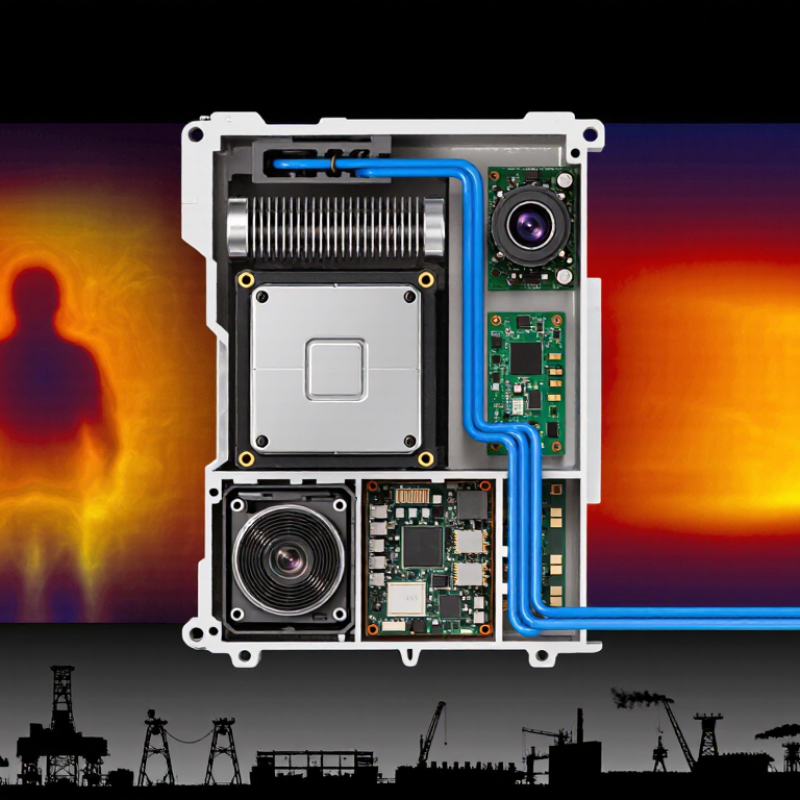
What Is a Cooled IR Camera Module and How Does It Work?

What Is a Cooled IR Camera Module?

A cooled IR camera module is an infrared imaging assembly with a detector maintained at very low temperatures. It usually combines an infrared sensor, optical window, signal electronics, and a mechanical cooler. The cooling system may use a miniature cryocooler to reduce detector temperature far below normal operating conditions.

Why does this matter? Infrared detectors generate electrical signals from heat radiation, but they also produce unwanted thermal noise. Cooling suppresses much of that noise. As a result, the module can detect smaller temperature differences and weaker infrared signals. This is especially useful in mid-wave and long-wave infrared imaging, where accurate measurements may depend on subtle heat patterns.

The detector does not work alone. Its optical path must transmit the target infrared band, while the electronics amplify and convert the signal into image data.

A sealed housing helps prevent moisture from reaching the cold sensor surface. In field testing, vibration, startup time, power demand, and cooler lifespan can affect actual performance. No detector is perfectly quiet.

It is easy to assume that cooling always creates a better image. That is not always true. Poor calibration, unstable optics, or incorrect focus can limit the final result. Engineers often compare noise, sensitivity, frame rate, and operating temperature before selecting a module for scientific inspection, aerospace measurement, or industrial monitoring.


Key Components of a Cooled Infrared Camera Module

A cooled infrared camera module uses a cryogenic detector to capture faint mid-wave or long-wave infrared radiation. Its core begins with an infrared lens, which focuses thermal energy into a detector array. The array sits inside a vacuum dewar, where insulation limits heat transfer and reduces background radiation. A cold shield surrounds the detector and blocks unwanted off-axis energy. Small details matter here.

The detector converts photons into electrical signals. A readout integrated circuit then amplifies and digitizes each pixel’s response. The cryocooler, often a miniature mechanical refrigeration unit, lowers detector temperature to improve sensitivity and reduce thermal noise. Control electronics manage timing, temperature, calibration, and image output. According to a 2024 Yole Group industry outlook, cooled infrared systems remain important in high-performance sensing because they deliver longer detection ranges and finer spectral response than many uncooled designs.

The module still depends on optics and software. Calibration tables correct pixel-to-pixel differences, while image processing improves contrast and compensates for drift. A 2024 MarketsandMarkets report projects continued growth in the global thermal imaging market, driven by aerospace, industrial inspection, and surveillance applications. Yet market forecasts are not perfect. Real performance can fall when vibration affects the cooler, or when the optical window becomes contaminated. Engineers must balance cooling speed, power consumption, size, and service life. That compromise is often underestimated.

What Is a Cooled IR Camera Module and How Does It Work?

Key Components, Typical Specifications, and Operating Functions of a Cooled Infrared Camera Module

Module Component Primary Function Typical Technical Characteristics How It Supports Infrared Imaging Important Design Considerations
Infrared Detector Array Converts incoming infrared radiation into electrical signals. Common cooled detector materials include indium antimonide (InSb), mercury cadmium telluride (MCT), and some cooled indium gallium arsenide (InGaAs) arrays. Determines the spectral response, sensitivity, spatial resolution, and measurement capability of the camera. Detector material must match the intended wavelength band, target temperature range, and application environment.
Spectral Band Defines the infrared wavelengths detected by the module. Common bands include SWIR: approximately 0.9–1.7 μm; MWIR: approximately 3–5 μm; and LWIR: approximately 8–12 μm. Controls which physical phenomena can be observed, such as high-temperature emissions, gas absorption features, or thermal radiation. Atmospheric absorption, background radiation, and application-specific target temperatures influence band selection.
Cryogenic Cooler Lowers the detector temperature to reduce thermal noise. Many cooled MWIR and LWIR detectors operate at roughly 60–100 K, depending on detector material and system design. Improves signal-to-noise ratio and enables detection of small temperature differences or weak infrared signals. Cool-down time, vibration, power consumption, operating life, and acoustic noise vary with the cooler architecture.
Cold Shield and Cold Stop Limits unwanted radiation from the camera interior and defines the detector’s optical acceptance angle. Usually maintained near the detector’s cryogenic temperature and positioned within the cooled optical assembly. Reduces stray radiation and thermal background, which helps preserve image contrast and measurement accuracy. Incorrect alignment or insufficient shielding can increase background noise and reduce dynamic range.
Infrared Optics Collects and focuses infrared radiation onto the detector array. May use materials such as germanium, silicon, zinc selenide, or other infrared-transmitting optical materials, depending on the spectral band. Determines field of view, focal length, optical throughput, spatial resolution, and image uniformity. Optics must transmit the selected infrared band and remain compatible with cryogenic temperature changes when applicable.
Readout Integrated Circuit (ROIC) Collects, integrates, and multiplexes the electrical signal from each detector pixel. Key parameters include pixel pitch, integration time, full-well capacity, frame rate, and selectable gain settings. Converts individual pixel responses into an organized electronic output for image processing. ROIC design affects dynamic range, noise performance, frame rate, windowing capability, and power consumption.
Signal Processing Electronics Amplifies, digitizes, corrects, and formats the detector output. Typical functions include analog-to-digital conversion, non-uniformity correction, bad-pixel replacement, gain control, and image formatting. Transforms raw detector data into a stable and usable infrared image or measurement output. Processing latency, bit depth, calibration storage, and output interfaces should match the host system requirements.
Temperature Monitoring and Control Monitors detector and cooler temperatures and maintains the required operating condition. Uses temperature sensors, control electronics, and feedback loops to stabilize the cryogenic detector environment. Improves image repeatability by reducing sensitivity changes caused by detector temperature drift. Temperature stability is important for radiometric applications and long-duration measurements.
Vacuum Dewar or Cryostat Provides a thermally insulated, low-pressure enclosure around the cooled detector assembly. Typically includes a sealed vacuum vessel, infrared window, internal supports, and low-thermal-conductivity materials. Reduces heat transfer and prevents atmospheric moisture from condensing on cold components. Vacuum integrity, window transmission, contamination control, and mechanical robustness affect long-term reliability.
Infrared Window Allows infrared radiation to enter the cryostat while maintaining the internal vacuum. Material and coating are selected according to the operating band, pressure requirements, and environmental conditions. Provides the optical interface between the external lens system and the cryogenic detector. Window transmission, reflection losses, coating durability, and thermal expansion must be considered.
Non-Uniformity Correction (NUC) Compensates for pixel-to-pixel response variations and drift. Uses calibration data, commonly obtained from uniform references at one or more temperature levels. Produces a more uniform image and reduces fixed-pattern noise across the detector array. Calibration may need periodic updating when operating temperature, integration time, or optical conditions change.
Typical Sensitivity Indicator Describes the module’s ability to resolve small changes in infrared signal. Cooled cameras commonly achieve NETD values in the low-millikelvin to tens-of-millikelvin range, depending on detector, optics, bandwidth, and operating mode. Lower noise-equivalent temperature difference generally allows clearer detection of small thermal contrasts. NETD is not a universal performance value; measurement conditions and test methods must be stated for valid comparison.
Digital Output Interface Transfers image data, status information, and control commands to the host system. Interfaces may include high-speed serial, Camera Link-type, GigE-type, USB-type, or application-specific digital connections. Enables real-time image acquisition, remote configuration, recording, and integration with analysis software. Bandwidth, cable length, synchronization, latency, and electromagnetic compatibility influence system integration.
Power and Control Interface Supplies electrical power and provides control signals for the detector, cooler, and processing electronics. Power requirements depend on detector size, frame rate, cooler type, electronics, and operating temperature. Coordinates start-up, cool-down, imaging, temperature regulation, fault reporting, and safe shutdown. System designers should account for peak start-up power, heat dissipation, grounding, and protection circuitry.

Note: The specifications shown are representative industry ranges or commonly used design characteristics. Actual performance depends on detector architecture, optical design, cooling method, calibration conditions, and operating mode.

How the Cooling System Enables Infrared Detection

What Is a Cooled IR Camera Module and How Does It Work?

A cooled infrared camera module uses a cryogenic cooler to lower the detector’s operating temperature. Many MWIR detectors operate near 77 K, while some LWIR designs use higher setpoints. At these temperatures, thermal noise and dark current fall sharply. The detector can then measure weaker radiation from distant, small, or low-contrast targets. That difference matters when a warm object appears against a warm background.

The cooling system usually combines a miniature Stirling engine, a cold finger, temperature sensors, and a control circuit. The cold finger transfers heat away from the focal plane. Cooling may require several minutes before measurements stabilize. It also consumes power and can introduce vibration. Engineers therefore balance sensitivity, size, acoustic noise, and service life. A lower detector temperature is not automatically better. That assumption needs checking.

The 2024 MarketsandMarkets Thermal Imaging Market report projected the global market to grow from about USD 7.6 billion in 2024 to USD 11.5 billion by 2029. This growth reflects demand for higher sensitivity in research, industrial inspection, and long-range observation. Industry detector studies also show that cooling can improve signal-to-noise performance by reducing detector-generated noise, especially during longer integration times. In practice, performance depends on more than the cooler. Optical transmission, calibration stability, atmospheric absorption, and readout electronics remain critical. Small thermal leaks can still weaken the result.

What Is a Cooled IR Camera Module and How Does It Work?

Cooling reduces detector dark current and thermal noise, allowing a cooled infrared camera to detect weaker signals with higher sensitivity. The chart shows the blackbody peak-emission wavelength calculated from Wien’s displacement law: λmax = 2898 / T, where λ is measured in micrometers and T in kelvin.

How Infrared Signals Become Thermal Images

What Is a Cooled IR Camera Module and How Does It Work?

A cooled infrared camera module converts invisible heat radiation into a measurable thermal image. Its detector sits inside a sealed cooler, often operating far below room temperature. Cooling reduces electronic noise and improves sensitivity, especially during long exposures or low-temperature measurements. The lens focuses infrared energy onto detector elements, where each element responds to radiation from a small area. An analog-to-digital converter then changes these responses into numerical values. In practical testing, even a warm hand can appear clearly against a cooler wall.

The camera processes these values through calibration and non-uniformity correction. It compares detector output with known reference temperatures, then reduces pixel-to-pixel differences. Software assigns colors or grayscale tones to temperature ranges. Bright yellow may represent hotter areas, while dark blue may indicate cooler surfaces. However, the image is not a direct photograph. Surface emissivity, reflections, distance, humidity, and atmospheric absorption can change the reading. A common mistake is trusting the brightest spot without checking the material. Thermal imaging is useful, but never perfectly simple.

Tips: Keep the optical window clean and avoid touching it. Let the cooled module stabilize before precise measurements. Set emissivity carefully for each material. Check reflections from glass, polished metal, or nearby heaters. Compare suspicious readings with a calibrated reference. Small errors matter. Temperature data should be recorded with distance and environmental conditions.

Main Applications and Performance Factors of Cooled IR Modules

What Is a Cooled IR Camera Module and How Does It Work?

Main Applications and Performance Factors of Cooled IR Modules

A cooled infrared module uses a cryogenic cooler to lower the detector’s temperature, often near 77 K. This reduces thermal noise and improves sensitivity in the 3–5 µm mid-wave infrared band. The result is clearer detection of small temperature differences, even through haze, smoke, or long viewing distances.

The 2024 MarketsandMarkets report estimated the global thermal imaging market at approximately US$6.7 billion, reflecting demand from defense, industrial inspection, aerospace, and security applications.

Performance depends on more than detector resolution. Noise-equivalent temperature difference, or NETD, indicates how finely the module can distinguish temperature changes. A lower NETD is usually better. Frame rate matters during missile tracking, gas-leak monitoring, and high-speed machine inspection. Cooling time, power consumption, vibration, and calibration stability also affect field performance. A module may deliver excellent laboratory images but struggle inside a compact airborne system.

Real installations expose compromises. Cooled systems can detect a warmer pipe joint at a distance, yet their coolers add weight, cost, and mechanical complexity. Yole Group’s infrared imaging analyses consistently identify size, weight, power, and cooling reliability as major design constraints.

That warning deserves attention.

More sensitivity is not always more useful. Engineers must match the spectral band, lens, detector pitch, and cooling architecture to the scene, not simply choose the highest specification.

en_USEnglish

PCD Inserts

PCBN Inserts

Solid CBN Inserts

PCD Milling Cutter

PCD Drilling Tools

PCD Reamer

Diamond Special Tool

Diamond Dressers