10 Decorative Sconces Buying Tips for Global Buyers
Decorative Sconces can shape a room’s atmosphere, but global buyers must weigh more than appearance. Wall space, light output, materials, installation, packaging, and destination-market requirements all affect whether a fixture works as intended. A bronze finish may look warm in a showroom, yet arrive too dark for a narrow hallway. Small details matter.
Energy performance deserves attention, too. The International Energy Agency’s 2023 buildings analysis estimates that buildings account for about 30% of global final energy consumption and 26% of energy-related emissions. These figures cover buildings broadly, not wall sconces alone, but they underline why efficient lighting choices matter. The U.S. Department of Energy reports that residential LEDs use at least 75% less energy and last up to 25 times longer than incandescent bulbs. Actual results depend on the bulb, fixture, and use.
Specs are useful. They are not the whole story. Buyers should compare dimensions, lumen output, color temperature, materials, wiring options, and replacement-bulb access. Ask suppliers for clear product images, test documentation, packaging details, and sample units when practical. Confirm that electrical specifications suit the intended market before placing a large order. And allow room for judgment: photographs rarely show glare, finish variation, or how a sconce feels beside a real bed or mirror. This guide’s ten buying tips will help global buyers ask sharper questions and make more considered choices.
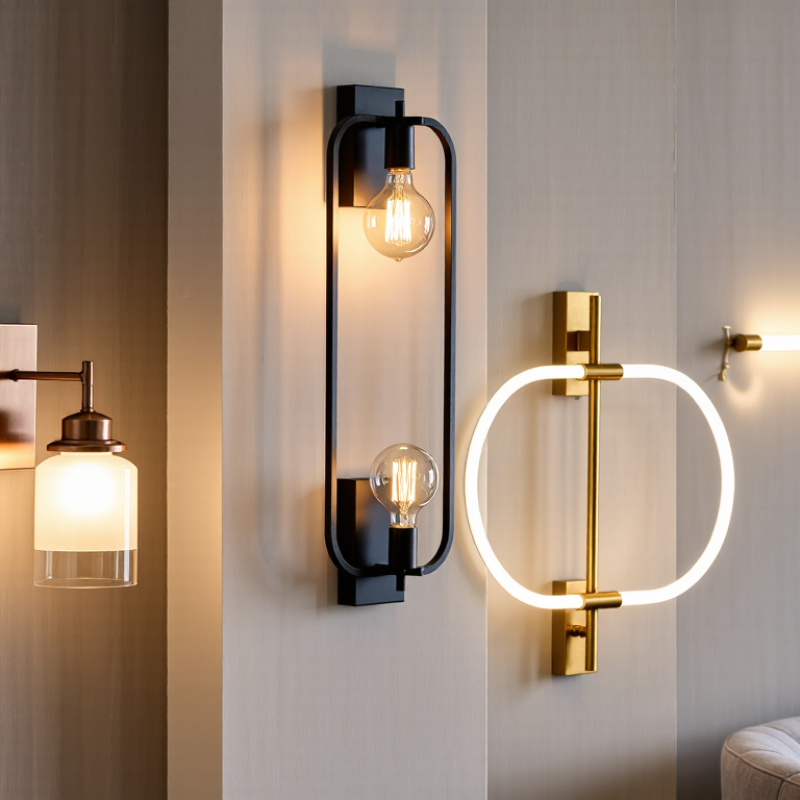
Classify Sconce Types by Mounting, Light Direction, and Room Use
Decorative sconces are easier to compare when sorted by mounting style, beam direction, and room function. A hardwired model sits close to the wall and suits planned renovations. Plug-in versions can work where wiring access is limited. Some fixtures have articulated arms that let the shade move toward a reading chair. Check the wall surface, junction-box position, and arm clearance before choosing. Small detail, big impact.
Light direction changes how a room feels. Upward-facing sconces soften a low ceiling by washing light across it. Downward beams highlight artwork or a console. Adjustable, dual-light designs offer flexibility, but exposed bulbs may cause glare from a sofa or bed. Ask for beam-angle and lumen information, not just a product photo. Photos can mislead.
Room use narrows the choice. Beside a bed, a shielded, movable fixture can support reading without lighting the whole room. In a hallway, compact fixtures with diffused output help reduce harsh patches between doors. Around a bathroom mirror, paired sconces at face height often create more even facial light than one overhead source. Confirm the fixture’s stated suitability for its intended location. These categories overlap, and that is normal. A pretty wall plate can still crowd a narrow passage, so measure its projection and leave comfortable shoulder clearance.
Decorative Sconce Buying Guide: Types, Placement & Room Use
Common planning ranges for sconce height above the finished floor. Actual placement depends on fixture size, ceiling height, furniture, and user needs; follow fixture instructions and local requirements.
How to classify sconces: Mounting is typically surface-mounted on a wall. Light direction may be upward, downward, or bidirectional. Choose bedside styles for reading, shaded or diffused styles for bathroom vanity areas, and upward or bidirectional styles for general hallway and entry lighting.
Compare Output Using Lumens, Color Temperature in Kelvins, and CRI (0–100)
Do not compare decorative sconces by wattage alone; watts describe energy use, not visible light. Check the stated lumens for the complete fixture, and ask whether the figure measures the bare lamp or light after the shade. That distinction matters: a deep opal globe may soften glare but send less light onto a hallway floor. For two models, compare lumens at the same dimming level and note beam direction. A 500-lumen upward sconce can feel gentler than a 350-lumen downlight. Numbers help, but placement still matters.
Kelvins describe appearance, not brightness. Around 2700 K usually looks warm beside wood and cream walls; 3000–3500 K reads cleaner in a tiled entry. Keep adjacent sconces near the same color temperature, or the wall may look patchy. CRI rates how faithfully light reveals colors on a 0–100 scale. For artwork, textiles, or skin near a mirror, look for CRI 90 or higher when available. Check whether the data sheet reports it consistently. High CRI does not guarantee pleasing light; a harsh beam can still flatten a face. A neat chart can fool you. Wall paint and shade tint may shift the result, so testing one fixture at night can be more revealing than another specification sheet.
Match Wet-Area Ratings: IEC 60529 IP44 Protects Against Water Splashes
An IP44 label offers a useful baseline for decorative sconces near sinks, showers, or sheltered outdoor doors. Under IEC 60529, the first “4” indicates protection against solid objects 1 mm or larger; the second “4” covers water splashing from any direction. That’s splash resistance, not waterproofing. The standard’s rating describes tested enclosure protection, not every real-world installation condition.
Check the fixture’s marked rating and installation instructions, then compare them with the actual exposure. A sconce beside a basin may face occasional droplets; one above a shower can receive repeated spray. IP44 may not be suitable for that harsher position. No jets. No immersion. Also inspect the cable entry, gasket, and wall junction: a sound enclosure cannot compensate for a poorly sealed installation. IEC 60529 is the technical reference for these IP classifications, but local placement rules can differ. A rating alone is not the whole decision. I’d treat it as a starting point, and verify the fitting’s intended location with a qualified installer.
Verify Safety Compliance Against IEC 60598-1 and UL 1598
Before approving a decorative sconce, request the exact safety standard and supporting test evidence, not a vague “compliant” claim. IEC 60598-1 sets general requirements and tests for luminaires, covering areas such as marking, construction, and electrical and thermal safety. UL 1598 addresses safety requirements for luminaires in the US market. They are not interchangeable. Confirm which standard applies to the destination and installation. Check the report’s model number, rated voltage, mounting method, and laboratory details against the product being purchased. Small mismatches matter.
The International Energy Agency’s Energy Efficiency 2023 report estimates that lighting accounts for about 15% of global electricity use. This figure covers lighting broadly, not wall sconces alone, but it makes efficient, safe operation worth checking. Ask for evidence related to temperature and abnormal-operation testing, and confirm that the specified lamp or LED driver and dimmer match the tested configuration. For UL claims, verify the product listing in the certifier’s public directory. For IEC-based claims, request the full test report and check its scope. A polished PDF can still leave gaps. In practice, buyers sometimes overlook whether the tested mounting conditions match the actual wall assembly; that deserves a second look.
Assess LED Life Claims with LM-80 Test Data and TM-21 Projections
A decorative sconce may promise 50,000 hours, but that figure needs context. Ask for the LM-80 report covering the exact LED package, module, or array used in the fixture. LM-80 records lumen maintenance under controlled drive currents and temperatures over a defined test period. It does not test the complete sconce or guarantee its service life.
TM-21 uses LM-80 results to calculate a lumen-maintenance projection. Check the reported test duration, temperature, and current against the sconce’s actual operating conditions. A projection based on a different LED configuration may not describe the product you are buying. Ask whether the stated hours refer to L70, or another remaining-light threshold, and whether the figure is a projection rather than observed test time. Small distinction. Big consequence.
Heat changes the picture. A compact metal housing, sealed shade, or warm wall cavity can affect LED operating temperature. Request thermal data for the finished fixture, not only the LED component. Also ask how the driver is rated; it may fail before the LEDs reach their projected maintenance point. Documents can look precise and still leave gaps. I would compare the report’s LED identification with the product specification, then ask the supplier to explain any mismatch in writing. That extra check is easy to skip when a sconce looks perfect in a showroom.
 Skip to content



 English
 Russian
 German
 Spanish
 French
 Portuguese