How to Choose a Black Rectangular Hollow Section?
Choosing a Black Rectangular Hollow Section involves more than matching a size on a drawing. The right choice depends on how the section will carry load, connect to other members, and perform in its intended environment. A frame supporting machinery may need different dimensions and wall thicknesses from a garden gate or interior partition. Details matter.
Start by confirming the outside width and height, wall thickness, length, and required steel grade. These affect strength, weight, fit, and fabrication. Check the product data sheet and, where required, material certificates rather than relying on appearance alone. “Black” commonly describes an uncoated or mill-finish surface; it does not, by itself, indicate corrosion protection. If the section will face moisture or outdoor exposure, consider a suitable coating system and preparation before installation.
Think through the practical details. Will the section need to be cut, drilled, welded, or joined with brackets? Are the dimensions compatible with the available fittings and workshop equipment? Small differences can cause delays. I have seen selections that looked right on paper but created avoidable fit-up work; it is an easy point to overlook. Check the drawings. For load-bearing applications, have a qualified engineer verify the design, including connections and service conditions. Confirm current product specifications with the supplier, since dimensions and tolerances can vary. A careful comparison of performance, finish, availability, and fabrication needs makes the final choice more dependable—not automatic, but informed.
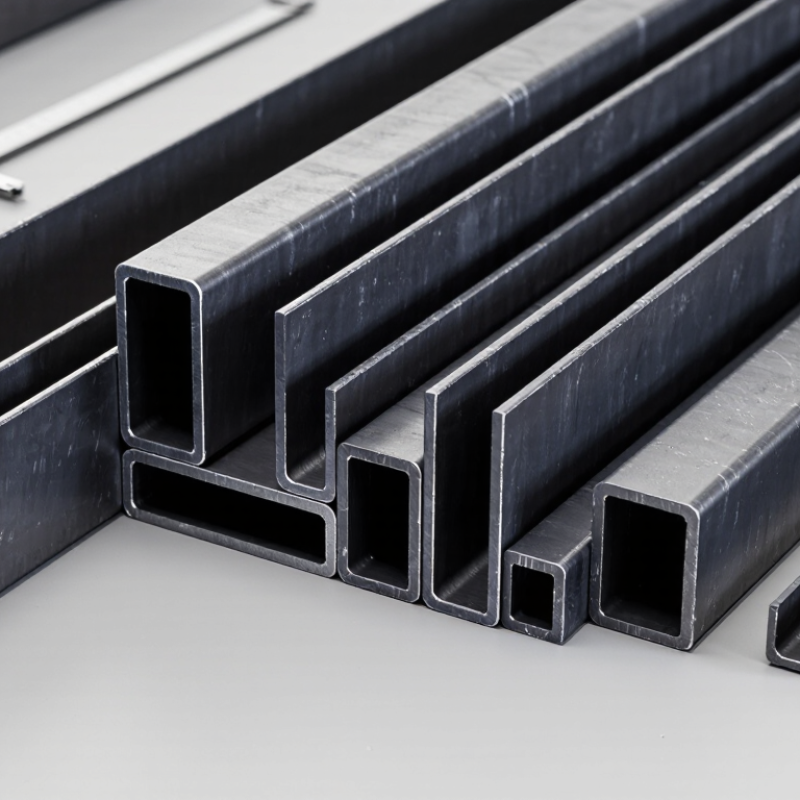
Define the Application and Structural Requirements
Before selecting a black rectangular hollow section (RHS), define what it must do. A roof beam spanning 6 metres faces different demands from a short machine frame exposed to repeated vibration. Record the clear span, support conditions, load direction, connection locations, and whether people, equipment, or cladding depend on its stiffness. Note the environment too: black mill finish is not a corrosion-protection system. Moisture trapped inside an unsealed section can be easy to overlook.
Turn those details into design checks. AISC 360-22 requires structural steel members to be assessed for strength and stability; for RHS, wall slenderness and local buckling can affect usable capacity. Material grade matters as well. ASTM A500/A500M lists a minimum yield strength of 345 MPa (50 ksi) for Grade C rectangular sections. That value is not a safe-load rating: section dimensions, unsupported length, restraint, and connection design still matter. Measure the actual wall thickness, not just the nominal size. A small difference can matter.
Ask how the section will be joined and inspected. A wide face may simplify bolting, but thin walls can need reinforcement where concentrated loads enter. For a long beam, check calculated deflection against the project’s serviceability limits; strength alone does not guarantee a floor feels firm. A drawing can look convincing and still miss a drain hole, a weld access gap, or a realistic support condition. Check those details before ordering.
Choose the Section Dimensions and Wall Thickness
Choose the outside dimensions around the load path, not appearance alone. A deeper section can improve bending stiffness when its deeper face is oriented correctly, while the shorter face affects lateral stability and connection space. Compare the required span, support points, load direction, and available clearance against a section-property table. For example, a 100 × 50 mm section behaves differently when rotated, even though its material and wall thickness stay unchanged. Check the actual orientation on the drawing.
Wall thickness affects capacity, weight, weld preparation, and local buckling resistance. AISC 360-22 specifies a design wall thickness of 0.93 times nominal thickness for HSS made to ASTM A500. Apply that factor only when the product specification and design method match; do not assume it applies to every black RHS. Small difference. Not trivial. A practical check is to compare width-to-thickness ratios and section properties against the governing design requirements, then confirm the supplier’s stated tolerances.
Do not select thickness by load alone. Thin walls may complicate connections, while unnecessarily thick walls add weight and can make fabrication less convenient. Check corner radii, since they affect usable flat face width for plates and bolts. I would still verify the mill certificate and measured dimensions before finalizing a critical order; nominal values are not a substitute for inspection. Reference: AISC Specification for Structural Steel Buildings, ANSI/AISC 360-22, Section B4.2.
How to Choose a Black Rectangular Hollow Section? — Choose the Section Dimensions and Wall Thickness
| Outside Dimensions (Width × Height) | Wall Thickness | Approx. Theoretical Mass | General Selection Guidance |
| 40 × 20 mm | 2 mm | 1.76 kg/m | Light framing, small brackets, and non-critical supports. |
| 50 × 30 mm | 2 mm | 2.39 kg/m | Light-duty frames and compact fabrication projects. |
| 60 × 40 mm | 2 mm | 3.01 kg/m | General-purpose framing where low weight is a priority. |
| 60 × 40 mm | 3 mm | 4.43 kg/m | A stiffer option for frames and supports subject to greater loads. |
| 80 × 40 mm | 3 mm | 5.37 kg/m | Useful for medium-duty frames, rails, and equipment supports. |
| 100 × 50 mm | 3 mm | 6.78 kg/m | A larger section for general structural and fabrication work. |
| 100 × 50 mm | 4 mm | 8.92 kg/m | Choose a thicker wall when added stiffness or connection strength is needed. |
| 120 × 60 mm | 4 mm | 10.80 kg/m | Suitable for heavier frames and longer spans, subject to design checks. |
| 150 × 100 mm | 5 mm | 18.84 kg/m | A substantial section for heavy-duty frames and support structures. |
| 200 × 100 mm | 6 mm | 27.13 kg/m | For large, load-bearing applications requiring professional structural assessment. |
Masses are approximate theoretical values calculated using a steel density of 7,850 kg/m³ and a simplified sharp-corner section. Actual product mass can vary with corner radii, manufacturing tolerances, and applicable product standards. Confirm section properties and design capacity for the intended loads, span, connections, and support conditions. “Black” generally refers to an uncoated or mill-finish steel surface; corrosion protection may be needed depending on the environment.
Check the Steel Grade and Applicable Standards
Before buying a black rectangular hollow section, identify its design use and governing product standard. ASTM A500/A500M covers cold-formed carbon steel structural tubing, including rectangular sections. EN 10219 covers cold-formed welded structural hollow sections, with grades such as S235JRH and S355J2H. These standards are not interchangeable. Check the drawing, purchase order, and applicable design code together. Paperwork matters.
Ask for a mill test certificate linked to the bundle’s heat number. Compare its steel grade, stated properties, dimensions, and standard edition with the order. Inspect the black surface for scale, dents, and damaged ends; mill scale can hide small defects. World Steel Association’s World Steel in Figures 2024 reports 1,892 million tonnes of crude steel production in 2023. That scale says little about an individual tube’s traceability. A neat label is not enough. Confirm the certificate and dimensional tolerances before fabrication, and do not treat a black finish as proof of grade.
Assess the Black Finish and Corrosion Protection Needs
A black rectangular hollow section may have mill scale, black oxide, or a protective paint coating. These finishes are not equivalent. Mill scale gives steel its dark, rolled appearance, but it should not be treated as dependable corrosion protection. Check the product documents and inspect cut ends, welds, and corners. I would not judge protection by color alone. Look for the coating type, specified dry-film thickness, surface preparation, and any repair instructions.
Match protection to the site. A dry indoor frame faces different risks from a coastal railing exposed to salt spray, standing water, and damaged edges. ISO 12944 classifies atmospheric corrosivity and offers a useful framework for discussing coating selection with a supplier or fabricator. The NACE International IMPACT study estimated corrosion costs at US$2.5 trillion annually, or 3.4% of global GDP, and reported potential savings of 15–35% through corrosion-control practices. Those figures are broad, not a lifespan guarantee for one section. Ask for relevant inspection records or coating test data, especially where water can collect inside the tube. Small gaps matter. Scratches happen. If the section will be welded or cut on site, confirm how exposed steel will be cleaned and recoated before installation.
How to Choose a Black Rectangular Hollow Section? Assess the Black Finish and Corrosion Protection Needs
The chart shows the upper boundary of ISO 9223 first-year atmospheric corrosion rates for uncoated carbon steel. Use the exposure category as a starting point when deciding whether a black-finish section needs additional corrosion protection.
What this means: A black or mill finish alone should not be treated as a durable corrosion-protection system. Consider the service environment, coating requirements, cut edges, and inspection needs. These category limits are classification boundaries—not a prediction of the section’s actual service life. Source: ISO 9223 atmospheric corrosivity categories for carbon steel.
Verify Product Quality, Tolerances, and Supplier Documentation
Black rectangular hollow section can look consistent while its dimensions vary. A matte black finish may hide mill scale, dents, or uneven edges. Inspect the ends and weld seam under bright light. Check for bowing, twists, and crushed corners before accepting a bundle.
ASTM A500/A500M-23 sets an outside-dimension tolerance of ±0.5% for square and rectangular tubing. On a 300 mm side, that is ±1.5 mm. The standard also allows wall thickness to be up to 10% below nominal. Measure across flats at several points, not just one end. Use a suitable thickness gauge, and record the readings against the purchase specification. Small differences matter when sections must fit tightly. They are easy to overlook.
Request a material test report showing the grade, heat number, chemical composition, and mechanical test results. If the contract calls for it, specify an EN 10204 type 3.1 inspection document. Match the heat number on the report to the bundle marking and delivery paperwork. A certificate without traceable markings is weak evidence. Compare the stated dimensions and grade with the order, and ask the supplier to explain any mismatch in writing. Documentation is useful, but it does not replace inspection.
 Skip to content



 English
 Russian
 German
 Spanish
 French
 Portuguese