Top CNC Aluminum Profile Manufacturers for Global Buyers?
Choosing a reliable Cnc Aluminum Profile manufacturer requires more than comparing catalog prices. Global buyers must examine alloy consistency, dimensional tolerance, machining capability, surface treatment, and delivery discipline. A polished website proves very little.
Grand View Research valued the global aluminum extrusion market at approximately USD 89.9 billion in 2023. Its report projects continued growth through 2030, supported by construction, transportation, electronics, and renewable-energy applications. The International Aluminium Institute also reports strong long-term demand for aluminum, especially where lightweight design and recyclability matter. These figures describe the wider market, not every CNC supplier. That difference matters.
Precision matters.
Dr. J. Gilbert Kaufman, a respected aluminum-alloy specialist, wrote, “The properties of aluminum alloys depend strongly on composition and processing.” His observation applies directly to Cnc Aluminum Profile sourcing. A profile can look perfect while hiding unstable hardness, weak corners, or inconsistent anodizing. Buyers should request mill certificates, inspection records, sample sections, and realistic tolerance data. They should also test threaded holes, cut edges, and assembled joints.
This guide evaluates leading manufacturers for global buyers. It considers engineering experience, production scale, CNC equipment, extrusion quality, finishing options, packaging, communication, and after-sales support. Certification helps, but it is not the whole answer. I may be overly cautious. Yet one failed shipment can cost more than a modest unit-price difference. A dependable supplier should make quality visible before the purchase order is signed.
What CNC Aluminum Profiles Are and Why Global Buyers Use Them
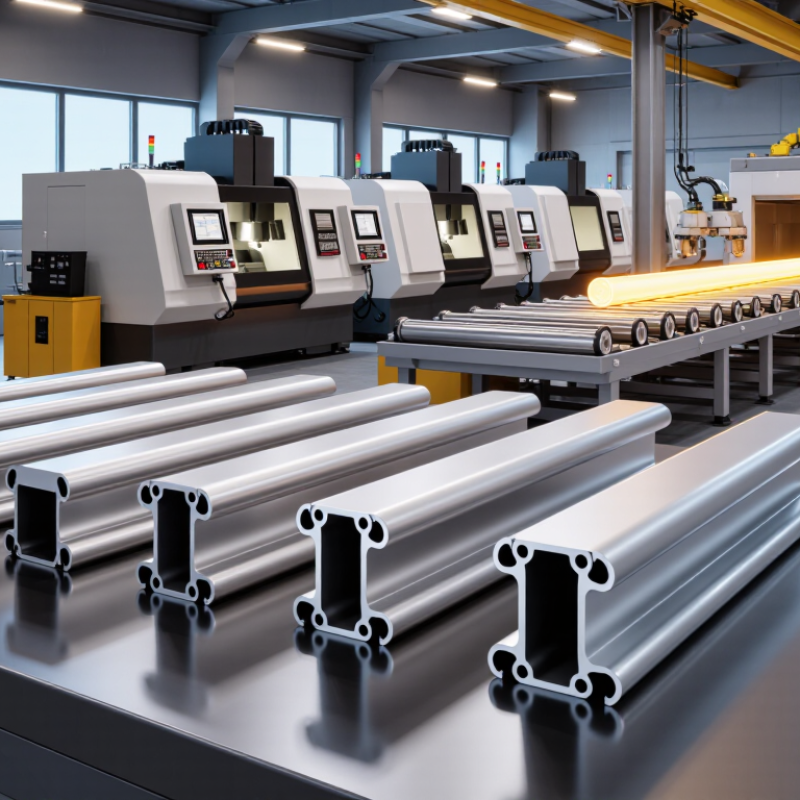
CNC aluminum profiles are aluminum sections shaped by extrusion and refined with computer-controlled cutting, drilling, and milling. They can become machine frames, protective covers, linear guides, and custom support structures. Unlike standard stock, CNC profiles follow a technical drawing with defined dimensions, hole positions, and tolerances. That detail matters when parts must connect without forced adjustment.
Global buyers choose them for their light weight, corrosion resistance, and reliable repeatability. Aluminum also helps reduce handling effort during assembly. A well-made profile should have clean edges, stable dimensions, and a consistent anodized or powder-coated surface. Ask manufacturers about alloy selection, machining accuracy, inspection methods, and packaging. Request sample parts when the design is sensitive. A profile may look perfect in a photograph, yet fail when a bearing plate is misaligned. I have seen small drawing errors create expensive delays. That risk deserves honest review.
Tips: Share 2D drawings, 3D files, alloy requirements, surface finish, and annual quantity. Confirm metric units and tolerance standards before production. Check flatness, hole depth, thread quality, and corner squareness in inspection reports. Protect finished surfaces with separators and reinforced cartons. One overlooked detail can affect the entire assembly. Recheck it.
How to Evaluate CNC Aluminum Profile Manufacturers
Top CNC Aluminum Profile Manufacturers for Global Buyers?
Choosing a CNC aluminum profile manufacturer requires more than comparing prices. A polished website proves little. Request machined samples from the same alloy, profile size, and drawing revision used in production. Check hole positions, edge finish, flatness, and visible tool marks with calibrated equipment. Ask for inspection reports, material certificates, and batch traceability.
Experience appears in the questions a manufacturer asks. A capable engineering team will review wall thickness, clamping points, tolerances, and surface treatment before quoting. They may suggest a design change that reduces vibration or prevents distortion. That advice can save money, but buyers should challenge unsupported claims. Ask for tolerance data from similar projects, not general promises. Short answers are useful.
Production reliability also needs evidence. Review machine capacity, quality-control stages, packaging methods, and realistic lead times. A factory should explain how it handles rejected parts, drawing changes, and repeat orders. Confirm whether final inspection records match your required format. Video tours help, yet they cannot replace independent checks or a controlled trial order. I have seen inexpensive samples hide inconsistent batches, so a small pilot run is worth considering. It may feel slower, but it exposes weak communication early. Global buyers should also verify export documents, protective packaging, and communication coverage across time zones. Mistakes still happen. The strongest manufacturers disclose them quickly and document the correction.
Leading CNC Aluminum Profile Manufacturers by Market and Capability
Global buyers need more than a supplier directory. They need manufacturers matched to market demands and production capability. North American projects often prioritize fast communication, stable tolerances, and responsive replacement support. European buyers may require detailed technical files, surface consistency, and documented quality controls. Asian markets can favor flexible volumes, competitive pricing, and rapid tooling adjustments. These differences affect every quotation.
Experienced CNC aluminum profile manufacturers usually offer multi-axis machining, precision cutting, drilling, tapping, and custom finishing. Strong facilities also control extrusion sourcing, fixture design, inspection, and protective packaging. Ask for sample reports, dimensional records, and clear tolerance ranges. I once reviewed a supplier with impressive equipment but weak packaging. Several profiles arrived with visible scratches. Capability is not only machine capacity; it includes process discipline. Still, no factory performs perfectly every time.
Tips: Compare suppliers by market fit, not price alone. Request a trial order before committing to volume. Check how they handle design changes, rejected parts, and delivery delays. Verify whether inspection tools match your required accuracy. A supplier may claim tight tolerances, yet practical results can vary between batches. Keep communication records, because small assumptions often become costly production problems.
Sourcing, Pricing, Logistics, and Compliance for International Orders
Reliable CNC aluminum profile sourcing starts with a measurable specification. State the alloy, temper, dimensions, surface finish, tolerance, and annual volume. Request sample parts, inspection records, and material certificates before approving mass production. A capable manufacturer should explain machining limits, fixture design, and likely distortion. Vague promises are warning signs.
Tips: Compare quotations on the same basis. Include tooling, programming, packaging, inspection, and replacement policies. Ask whether prices use EXW, FOB, or DDP terms. A cheaper unit price may hide expensive tooling or destination charges. I have seen buyers overlook packaging, then receive scratched profiles after long sea routes. That mistake is avoidable.
International logistics needs practical planning. Confirm the HS code, carton dimensions, pallet weight, lead time, and insurance responsibility. Use moisture-resistant wrapping and separators for finished surfaces. Compliance checks should cover restricted substances, labeling, export documents, and destination-market requirements. Ask for test reports tied to the actual production batch, not generic files. Requirements differ by country, and assumptions can fail. Independent inspection is useful for large orders, although it adds time and cost. The best supplier is not always the lowest-priced one. Reliability usually appears in documentation, communication, and corrective action.
 Skip to content



 English
 Russian
 German
 Spanish
 French
 Portuguese