What is Strong Base Anion Resin and Its Applications?
strong base anion resin plays a crucial role in various industries. This specialized resin is essential for removing anions from solutions. It is widely used in water treatment processes, where the removal of unwanted substances is necessary.
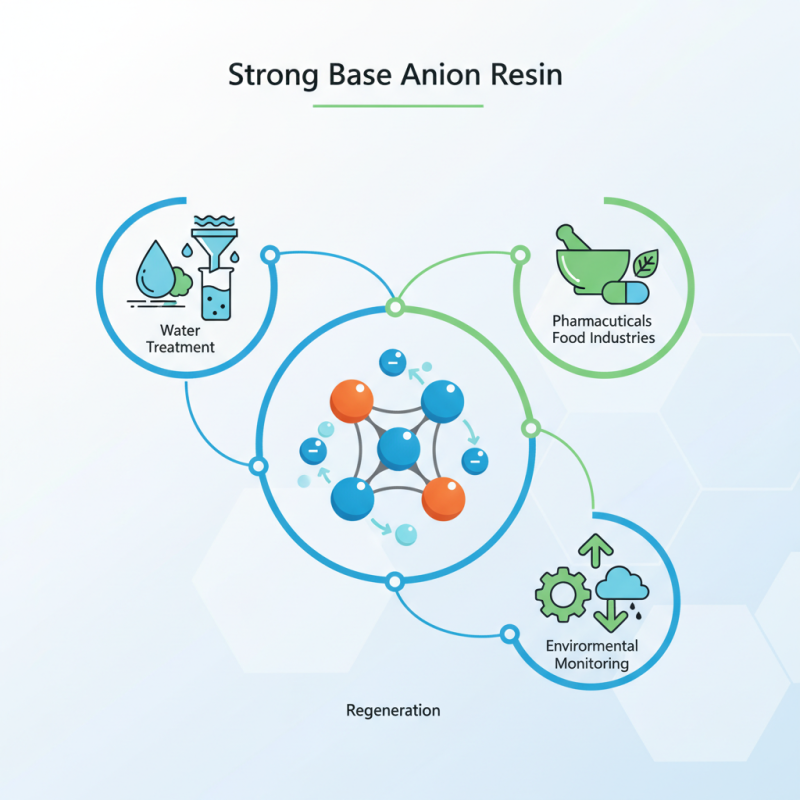
The effectiveness of strong base anion resin lies in its ability to exchange ions efficiently. This feature makes it suitable for applications in pharmaceuticals and food industries. However, users must consider the resin's limitations and the specific conditions of use. Sometimes, its regeneration may require careful attention to achieve optimal performance.
Despite its advantages, the use of strong base anion resin can lead to challenges. Environmental factors may affect its efficiency. Therefore, continuous monitoring of its performance is necessary. Users must be mindful of these aspects to ensure effectiveness in their applications.
What is Strong Base Anion Resin?
Strong Base Anion Resin is a specialized ion-exchange material. It plays a critical role in water purification and various industrial processes. Unlike weak base resins, strong base anion resins are engineered to handle higher pH levels. This makes them particularly effective in removing contaminants like nitrate and sulfate.
The resin consists of a large surface area. It contains quaternary ammonium functional groups. These groups have a high affinity for negatively charged ions, facilitating efficient exchange. A report by the Water Quality Association indicates that strong base anion resins can remove up to 95% of certain contaminants. However, not every application yields the same efficiency.
Applications range from municipal water treatment to pharmaceutical manufacturing. Some reports suggest that the efficiency of these resins can vary significantly depending on specific water chemistry. Inconsistent ion profiles can lead to unexpected outcomes, creating challenges in operational settings. The ability to regenerate these resins is also not without limits. Failure to optimize regeneration processes can result in reduced lifespan and efficacy. This creates a continuous need for reassessment and improvement in how these materials are utilized.
What is Strong Base Anion Resin and Its Applications?
| Property | Description |
| Material Composition | Typically made from polystyrene-divinylbenzene copolymer. |
| Charge Type | Positively charged, helps in the exchange of anions. |
| Regeneration Process | Regenerated using strong bases like sodium hydroxide. |
| Common Applications | Water treatment, waste treatment, and chemical processing. |
| Advantages | High capacity for anion removal and effective in a wide pH range. |
| Limitations | Sensitive to organic solvents and may require specific conditions for optimal performance. |
| Performance Indicators | Exchange capacity, flow rate, and resistance to fouling. |
Chemical Composition and Properties of Strong Base Anion Resins
Strong Base Anion Resins are key materials in water purification. Their chemical composition typically includes a polyacrylic backbone with quaternary ammonium functional groups. These resins are highly efficient in removing anions such as sulfate, nitrate, and phosphate from water. Recent industry reports indicate that anion resins can reduce sulfate levels by over 90% in municipal water systems.
The properties of Strong Base Anion Resins are critical for their performance. They generally have a higher exchange capacity compared to weak base resins. This means they can handle large volumes of water while maintaining high purity. However, some challenges exist. For example, the swelling of resin beads can affect flow rates. Proper maintenance is essential to mitigate this issue.
Applications of these resins extend beyond water treatment. They are also used in the food industry for sugar decolorization and in pharmaceuticals for drug purification. Despite their effectiveness, the environmental impact of disposal is a concern. As industries strive for sustainability, finding eco-friendly disposal methods is vital for the future.
Industrial Applications of Strong Base Anion Resins in Water Treatment
Strong base anion resins play a crucial role in industrial water treatment. These resins effectively remove anions like sulfate, nitrate, and phosphate from water. Their strong binding capacity allows for the efficient purification of various water sources. Many industries rely on them to ensure clean water for operations.
In wastewater treatment, strong base anion resins can capture harmful substances. They are especially useful in treating effluents from chemical plants. The resins help in reducing the overall contaminant load. However, they sometimes require regeneration, which can lead to downtime. This can frustrate operations, as it affects efficiency.
Power plants also utilize these resins. They help in producing deionized water for steam generation. Clean water is essential to prevent scaling in heating systems. Despite their effectiveness, these resins have limitations. They may not be suitable for all types of contaminants, requiring careful evaluation. Continuous improvements and research could address these challenges.
Role of Strong Base Anion Resin in Pharmaceutical Manufacturing
Strong base anion resins play a critical role in pharmaceutical manufacturing. These resins are essential for purifying water used in drug formulation. They efficiently remove unwanted ion contaminants, ensuring the final product meets stringent quality standards. According to a recent market report, the demand for water purification systems in pharmaceuticals is expected to grow at 7% annually.
Pharmaceutical companies aim for high-purity products. Strong base anion resins help achieve this by selectively capturing impurities. They are particularly effective in removing sulfate and chloride ions. With 95% ion-exchange capacity, companies can optimize their purification processes. However, improper choice or maintenance of these resins can lead to inefficiencies or contamination. Regular assessment is necessary to maintain performance.
**Tip:** Always monitor resin performance. Regular testing can highlight potential issues before they affect production. Understanding your resin's operating limits is vital.
As technology evolves, so does resin performance. New formulations are emerging, but they must be evaluated. Changes can introduce unclear variables. Manufacturers must stay informed about the latest advancements. It’s crucial to ensure the selected resin aligns with specific production requirements.
Applications of Strong Base Anion Resin in Pharmaceutical Manufacturing
Performance Comparison: Strong Base vs. Weak Base Anion Resins
Strong base anion resins are essential in water treatment and chemical processing. They effectively remove negatively charged ions, improving water quality. These resins perform well under varying pH levels. Recent industry reports show that strong base resins can remove up to 98% of sulfate ions from water sources. This efficiency is crucial for industries like pharmaceuticals and power generation.
In contrast, weak base anion resins provide different benefits. They are better suited for specific applications, especially in acidic environments. However, their ion exchange capacity is lower. Reports indicate that these resins typically achieve only 50-70% removal efficiency for certain contaminants. The choice between strong and weak base resins often depends on the specific requirements of an application, such as ion concentration and operational costs.
Some users find that strong base resins may exhibit unexpected swelling or lower performance with certain organic contaminants. This inconsistency can affect long-term reliability. On the other hand, while weak base resins might be more stable under certain conditions, their lower capacity can lead to higher operational costs in the long term. Understanding these nuances is vital for optimizing ion exchange processes.
 Skip to content

 English
 Russian
  German
  Spanish
  French
  Portuguese