Top 12V 3A AC Adapter Suppliers for Global Buyers
The global demand for compact power conversion continues to expand across networking, smart-home, medical, industrial, and consumer electronics. MarketsandMarkets estimates that the global power supply market will grow from approximately USD 31.9 billion in 2023 to USD 43.4 billion by 2028. This growth reflects wider equipment deployment, stricter efficiency expectations, and rising replacement demand. For global buyers, selecting an Ac Adapter 12v 3a requires more than comparing unit prices.
A dependable adapter should deliver stable 12-volt output at 3 amps under realistic operating conditions. Buyers should examine efficiency, no-load power consumption, thermal performance, ripple, connector specifications, and protection features. IEC 62368-1 remains an important safety reference for many information and communication technology products. Regional approvals, including UL, CE, UKCA, or PSE, may also affect market acceptance. However, certification marks alone do not prove consistent production quality.
This guide reviews twelve suppliers serving international buyers. It considers manufacturing experience, documented testing, customization capability, minimum order quantities, lead times, and after-sales support. Data from Grand View Research and Fortune Business Insights indicates continued growth in power supply and adapter applications, but published market figures vary by scope and methodology. That limitation matters. No supplier ranking is permanently perfect.
A factory may provide excellent samples yet struggle with batch consistency. Another may offer strong certifications but weak communication. Therefore, buyers should request current test reports, sample units, factory audit evidence, and clear warranty terms. Practical verification remains essential, especially when adapters power equipment continuously. The best choice balances electrical reliability, compliance readiness, supply stability, and total landed cost.
What Is a 12V 3A AC Adapter and How Does It Work?
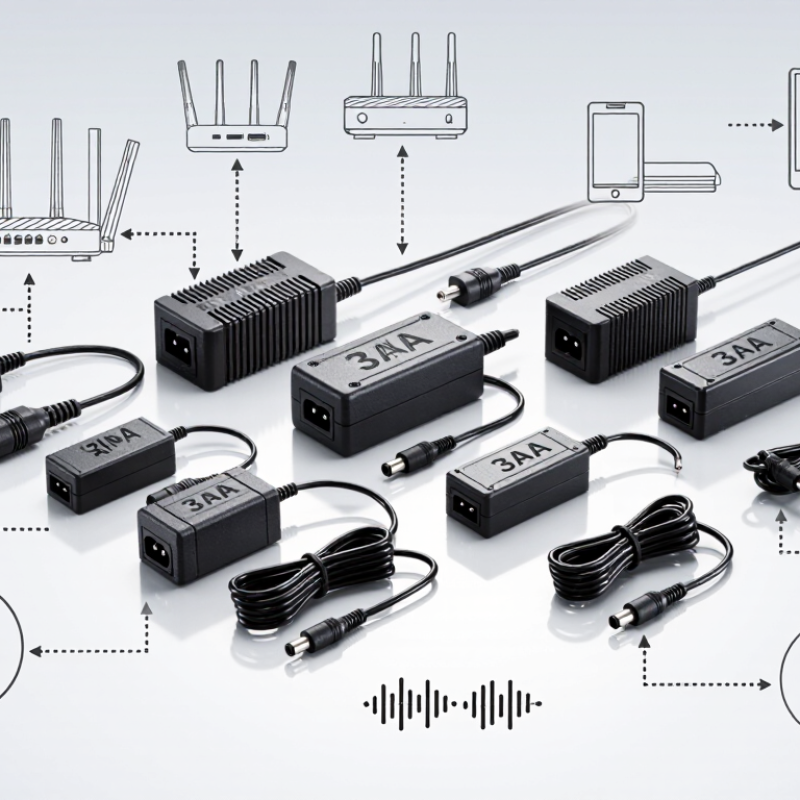
A 12V 3A AC adapter converts household AC power into regulated 12-volt DC power. The “3A” rating means it can supply up to 3 amps continuously. Its maximum output is about 36 watts. It should not be treated as a promise that every device will draw 3 amps.
Inside the adapter, a transformer or switching circuit changes the incoming voltage. A rectifier converts AC into pulsing DC. Filtering reduces electrical ripple, while a regulation circuit keeps the output near 12 volts. Protection components may limit overheating, short circuits, and excessive current. The plug’s polarity matters. A reversed connection can damage sensitive equipment.
In practical checks, I compare the adapter label with the device’s voltage, current, connector size, and polarity symbol. The current rating may be equal to or higher than the device requirement. Never guess.
A simple load test can reveal unstable voltage, unusual heat, or audible noise. Those signs deserve attention. The label alone is not enough. I have seen specifications look convincing while the connector fit poorly. Buyers should request test reports, efficiency data, insulation details, and samples from suppliers. Operating temperature also matters, especially inside a crowded enclosure. A 12V 3A adapter may work well on a workbench but perform differently in a hot installation. Supplier consistency needs repeated inspection, not one successful sample.
Key Specifications to Check Before Choosing a Supplier
Selecting a 12V 3A AC adapter starts with the output label. Its rated power is 36 watts, but that figure alone proves little. Check voltage tolerance, ripple, load regulation, and continuous output capability. A reliable supplier should provide test curves, not only a polished datasheet. Ask whether the adapter delivers 3A at 40°C ambient temperature. Heat changes performance quickly.
Efficiency and standby power deserve careful attention. The European Commission’s Regulation (EU) 2019/1782 limits no-load consumption for many external supplies below 49W to 0.10W. Its requirements also include minimum active-mode efficiency. DOE Level VI adds similar efficiency controls in the United States. Request recent test reports, efficiency readings at 25%, 50%, 75%, and 100% load, plus thermal results. Numbers without test conditions can mislead.
Safety documentation should match the target market. IEC 62368-1 testing, insulation ratings, dielectric-strength results, EMC records, and protection against overcurrent and short circuits are important checkpoints.
Confirm plug dimensions, polarity, cable gauge, and connector retention before ordering samples. In practice, a connector that fits loosely can create intermittent faults.
I have seen procurement teams overlook this detail. It is a small failure with expensive consequences.
Also examine minimum order quantity, traceability, warranty terms, and production consistency. A supplier may meet one sample’s specifications, yet drift during mass production. That risk deserves a second review.
How to Evaluate 12V 3A AC Adapter Manufacturers
Evaluating 12V 3A AC adapter manufacturers starts with technical clarity. Request a complete datasheet, not only a product photograph. It should state input range, output tolerance, ripple, efficiency, and no-load power. Check whether 12V and 3A are continuous ratings. Some suppliers present peak performance as normal capacity. That difference can damage your design.
Ask for samples from the current production batch. Test the adapter at light, medium, and full load. Measure voltage after several hours. Watch the case temperature near the transformer and cable joint. Listen for coil noise. Small details matter. A polished sample is not enough. Request safety reports, factory test records, and traceable batch numbers. Documents should match the exact model, plug type, and revision.
Supplier reliability also depends on communication. Ask about minimum order quantities, lead times, replacement procedures, and packaging tests. Confirm whether the cable length and connector remain consistent in mass production. A low quotation may hide weak insulation or unstable components. I would challenge unclear answers, even when the factory looks experienced. No checklist catches every weakness. Keep written specifications, approve a pre-production sample, and inspect the first shipment against measured results. Mistakes still happen, but vague expectations make them harder to correct.
Top 12V 3A AC Adapter Suppliers for Global Buyers
How to Evaluate 12V 3A AC Adapter Manufacturers
This benchmark shows the theoretical DC output power available from a regulated 12V adapter as load current increases to its rated 3A capacity. The values are calculated using P = V × I, giving a maximum rated output of 36W. When evaluating manufacturers, buyers should also verify voltage regulation, ripple and noise, overload protection, thermal performance, efficiency, safety certifications, input range, and consistency across production batches.
Top Supplier Profiles for Global Commercial Buyers
Top 12V 3A AC Adapter Suppliers for Global Buyers
For global commercial buyers, the strongest 12V 3A adapter suppliers combine stable output, clear documentation, and repeatable production. Experienced suppliers should provide load-test records, insulation results, efficiency data, and traceable batch numbers. Their product teams can explain plug options, input ranges, cable lengths, and operating temperatures without vague claims. That matters during procurement reviews.
A reliable supplier profile includes controlled assembly lines, incoming component checks, and final testing for every unit. Look for suppliers that support samples before larger orders. They should also discuss minimum order quantities, production capacity, packaging, and realistic lead times. Fast replies help, but technical accuracy matters more. A polished catalog proves little by itself.
Commercial buyers should compare suppliers by evidence, not promises. Ask for current compliance documents suitable for the destination market. Confirm whether test reports match the exact adapter model and revision. Some suppliers offer lower prices, yet use inconsistent cables or weaker strain relief. That risk may appear only after months of field use. No supplier is perfect. Even capable manufacturers can miss a labeling detail or underestimate seasonal demand. Careful buyers keep written specifications, approve a sample, and review corrective actions when results differ. A dependable partnership grows through transparent records, practical communication, and steady quality checks.
International Sourcing, Compliance, and Quality Considerations
Top 12V 3A AC Adapter Suppliers for Global Buyers
International Sourcing, Compliance, and Quality Considerations
A 12V 3A adapter delivers up to 36 watts, so buyers should verify output stability under full load. Request test data for voltage deviation, ripple, temperature rise, and startup performance. A label is not enough. IEC 62368-1 safety evidence, EMC test reports, and traceable production records provide stronger assurance. The IEA 4E Standby Power Annex reports that standby consumption can represent 5–10% of residential electricity use in some markets. Low no-load consumption therefore matters during supplier evaluation.
Regulatory acceptance changes by destination. The European Union’s Ecodesign Regulation 2019/1782 addresses external power supply efficiency and no-load performance. U.S. Department of Energy Level VI requirements also assess these points. Ask suppliers for current declarations, laboratory reports, and model-specific evidence. Do not treat a CE marking alone as complete compliance proof. It is not a substitute for technical documentation. Country-specific plug standards, input voltage ranges, and import labeling require separate checks.
Factory quality deserves equal attention. A capable supplier should show incoming inspection records, burn-in procedures, and calibration intervals. Sample ten units, not one. Measure them after several hours at 36 watts. Look for hot housings, audible buzzing, loose plugs, or unstable output. Some suppliers provide excellent samples but inconsistent later batches. That is an uncomfortable risk. Purchase agreements should define component changes, retesting duties, warranty handling, and audit access. Supplier rankings can help, but documented performance is more reliable than polished presentations.
 Skip to content


 English
 Russian
  German
  Spanish
  French
  Portuguese