SUNDI TOOLS
- Copyright © Wuxi Sundi Precision Tools Co.,LTD All rights reserved.
- Site Map
Choosing the right packaging in 2026 requires more than attractive green branding. Global buyers need pouches that protect products, perform reliably, and meet local environmental requirements. This guide examines the leading Biodegrade Pouches for food, cosmetics, supplements, and everyday retail goods.
Practical evaluation starts with the material structure. A pouch may use kraft paper, PLA film, cellulose, or certified compostable laminates. Each option behaves differently under heat, moisture, oxygen, and pressure. Imagine a coffee pouch stored in a humid warehouse. Weak seals can fail before the product reaches the shelf. Strong barrier performance matters.
Certification deserves careful attention. Buyers should request current documentation, test reports, migration data, and clear disposal instructions. “Biodegradable” does not always mean home compostable. Some materials require controlled industrial facilities, which are unavailable in many regions. Local labeling rules also vary. Check them.
Reliable suppliers should explain resin sources, production controls, minimum order quantities, and quality inspection procedures. Samples should be tested with the actual product, filling equipment, and transport conditions. A pouch that works in a showroom may wrinkle, leak, or lose its seal during shipment.
There is no perfect solution.
Cost, shelf life, appearance, and end-of-life performance can conflict. Even experienced buyers may overlook ink compatibility or zipper durability. This overview addresses those practical gaps, compares important specifications, and highlights questions worth asking before signing a global supply agreement. Sustainable packaging should be measurable, not merely persuasive.
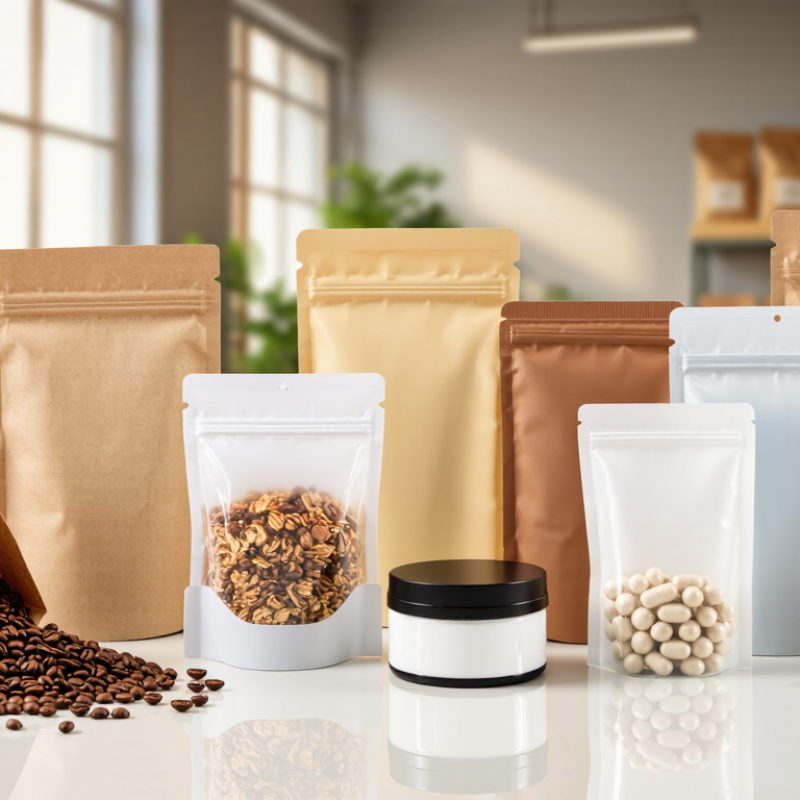
Global buyers are watching biodegradable pouches more closely in 2026. The market baseline is already substantial. European Bioplastics and the Nova Institute reported 2.18 million tonnes of global bioplastics production capacity in 2023. Their forecast reaches about 7.43 million tonnes by 2028. Packaging remains the largest application, representing roughly 43% of total capacity.
That scale changes purchasing decisions. A pouch is not only a film and zipper. Buyers should check the polymer source, barrier layer, seal strength, and disposal route. A pouch may be biodegradable under controlled conditions, but not in a household compost bin. This distinction still causes confusion. Sometimes, the label sounds greener than the actual waste system.
For food, personal care, and dry goods, practical testing matters. Examine oxygen transmission, moisture resistance, puncture performance, and heat-seal stability. Test filled samples, not empty film. A warm warehouse, long ocean shipment, or rough pallet can expose weak seals quickly. Recent packaging assessments from the Sustainable Packaging Coalition also stress clear end-of-life communication and verified claims. Certification evidence should match the destination market and the exact pouch structure. Data sheets help, but they do not replace production trials. The uncomfortable point is simple: capacity is growing faster than buyer understanding.
In 2026, biodegradable pouches will depend less on slogans and more on material structure. European Bioplastics reported that global bioplastics production capacity may rise from 2.18 million tonnes in 2023 to 7.43 million tonnes by 2028. Packaging remains the largest application, accounting for about 46% of capacity. Yet biodegradation is not automatic. A pouch needs the right environment, temperature, humidity, and processing time.
PLA offers clear appearance, stiffness, and useful printability. It suits dry foods and light-duty packaging, but it can become brittle under heat or repeated folding. PBAT adds flexibility and tear resistance. In practice, PLA-PBAT blends often create a more balanced film, although industrial composting conditions may still be necessary. Testing against EN 13432 or ASTM D6400 provides stronger evidence than a material label alone. Very few shortcuts exist.
Cellulose films provide a paper-like touch and can support high-quality graphics. Their moisture barrier may require a thin compostable coating. Paper pouches offer strong consumer familiarity, but laminated structures can complicate recycling and composting. The Confederation of European Paper Industries has repeatedly highlighted how coatings, adhesives, and food residue influence paper recovery rates. That detail is easy to overlook. Buyers should request full-layer specifications, migration data, barrier results, and third-party certification. A pouch can look sustainable and still perform poorly after disposal. Supplier claims deserve testing, not trust.
2026 Top Biodegradable Pouches for Global Buyers?
A pouch is not compostable merely because it feels like paper. ASTM D6400 evaluates the finished plastic item under controlled industrial composting conditions. Its key threshold is at least 90% biodegradation within 180 days, measured against a cellulose reference. That clock matters.
Testing also examines physical disintegration, compost quality, and possible ecological toxicity. A pouch may pass its film test but fail after adding inks, adhesives, zippers, or barrier coatings. Buyers should request reports for the complete pouch, not only its resin. The test environment is important, too. ASTM D6400 does not promise breakdown in a backyard compost bin, soil, ocean water, or landfill.
Real-world handling remains imperfect. Many regions lack industrial composting collection. The Bio-based Industries Consortium and European Bioplastics reported global bioplastics production capacity at approximately 2.47 million tonnes in 2024, with further growth projected through 2029. More material does not automatically mean better disposal. Check the testing laboratory, sample construction, certification scope, and required composting temperature. Ask for dates.
A missing detail can change the result. A glossy pouch may hide a non-compostable layer. For global buyers, ASTM D6400 evidence should be treated as a technical checkpoint, not a marketing shortcut. The honest question is simple: what happens after use?
| Pouch Format / Material Concept | Typical Structure | Suitable Applications | Industrial Compostability | Home Compostability | Typical Barrier Level | Buyer Verification Points |
|---|---|---|---|---|---|---|
| Paper-Based Stand-Up Pouch | Paper outer layer with a certified compostable polymer lining | Dry foods, bakery items, tea, powders and lightweight snacks | Usually achievable | Not automatically | Low to medium | Confirm coating, adhesive, ink and zipper compliance; paper content alone does not prove compostability. |
| Cellulose-Film Flat Pouch | Regenerated cellulose film with compostable sealant or paper support | Fresh produce, bakery goods, dry snacks and gift packaging | Often achievable | Depends on full construction | Low to medium | Check whether the film is uncoated or coated and request finished-pouch testing rather than film-only data. |
| Compostable Polymer Pillow Pouch | Certified compostable polyester or starch-blend film, printed on the approved side | Dry snacks, confectionery, single-use food portions and sachets | Potentially achievable | Usually not demonstrated | Medium | Validate oxygen and moisture transmission rates for the intended shelf life; polymer type alone is insufficient evidence. |
| Compostable Flat-Bottom Pouch | Multi-layer compostable film with reinforced gussets and a compostable closure system | Coffee alternatives, pet treats, dry foods and higher-volume products | Potentially achievable | Rarely demonstrated | Medium to high | Closures, valves, zippers, labels and adhesives must be included in the compliance review. |
| Compostable Spout Pouch | Compostable flexible film with a separate spout and cap designed for compostable systems | Sauces, purees, beverages and personal-care refills | Requires full-pack testing | Generally unverified | Medium | The spout and cap can determine certification status; confirm food-contact suitability and seal integrity. |
| Compostable Sachet | Single-web compostable film or paper-polymer laminate with heat-sealed edges | Condiments, seasonings, cosmetics and hospitality portions | Potentially achievable | Depends on construction | Low to medium | Review sealant chemistry, ink coverage, residual solvents and performance after filling and storage. |
| Compostable Produce Bag Pouch | Certified compostable film with optional perforations and printed disposal instructions | Fruit, vegetables, bakery products and food-service items | Common target | Only with specific approval | Low | Confirm puncture strength, produce-contact requirements and the disposal pathway available in the destination market. |
For 2026 biodegradable pouches, barrier data matters more than the word “compostable.” Smithers’ 2024 sustainable flexible-packaging review highlights a persistent trade-off: renewable films often need coatings or multilayer structures for stronger protection. For oxygen-sensitive snacks, buyers commonly screen for OTR below 1 cc/m²/day. Moisture-sensitive powders may require WVTR below 1 g/m²/day. These figures are useful benchmarks, not universal guarantees.
Test conditions must be stated clearly. OTR and WVTR can change sharply with temperature and humidity. Request ISO 15105 OTR and ISO 15106 WVTR results at defined conditions, such as 23°C and 50% relative humidity. Seal strength also deserves attention. ASTM F88 testing can reveal weak edges, while practical targets often fall near 10–20 N/15 mm, depending on filling conditions. A strong seal is not always a reliable seal. Contamination, folding, and sealing temperature still matter.
Shelf-life evidence should connect barrier results with real product data. Use water activity, oxygen exposure, seal integrity, and sensory checks at planned intervals. Accelerated aging can shorten development time, but it may exaggerate failure mechanisms. Real-time validation remains necessary. One uncomfortable lesson is common: a pouch can pass laboratory barrier testing yet fail after transport. Ask for batch-level results, not only a single impressive certificate.
Global buyers should verify compliance before comparing pouch prices or appearance. EN 13432 covers industrial compostability, not general biodegradation in nature. A compliant pouch needs evidence for disintegration, biodegradation, heavy-metal limits, and compost safety. Check whether the certificate covers the complete pouch, including ink, adhesive, zipper, and coating. A film certificate alone may be insufficient.
The EU PPWR adds broader packaging duties, including material reduction, recyclability requirements, labeling rules, and producer responsibilities. Its practical impact can vary by product type and market timing. Do not treat “biodegradable” as a universal legal claim. Review the target country, packaging format, and disposal route. Label verification should compare the printed artwork with the approved certificate scope. Disposal wording must be clear and locally understandable. Small icons can create large misunderstandings.
Tips: Request the latest test reports, certificate number, full material structure, and batch traceability. Ask for production samples, not only digital artwork. Check translations and recycling or composting instructions before approval. A useful warning: paperwork may look complete while the factory quietly changes an adhesive or coating. My checklist is not flawless, so independent testing remains worthwhile. Keep claim records, artwork versions, and supplier declarations together for audits.