...

What Are the Top Custom O-Ring Kit Manufacturers?

Choosing the right Custom O-Ring Kit Manufacturer requires more than comparing prices or catalog size. Sealing performance depends on compound selection, dimensional control, surface finish, and storage conditions. Parker’s O-Ring Handbook, ORD 5700, explains how temperature, pressure, fluid compatibility, and gland design influence seal reliability. These factors should guide any serious manufacturer comparison.

Industry research supports this technical focus. Grand View Research’s Industrial Seals Market report identifies automotive, aerospace, energy, and industrial equipment as major demand sectors. MarketsandMarkets’ Seals Market analysis also highlights predictive maintenance, specialized materials, and reliable sealing systems as continuing industry priorities. However, market reports often combine different seal categories. Their figures are useful directionally, not as absolute proof of supplier quality.

The leading manufacturers usually provide more than molded rubber rings. They offer custom kit design, documented material grades, inspection records, and application support. Look for compliance with ISO 3601, relevant ASTM material standards, and clear batch traceability. A practical supplier should also explain why EPDM, FKM, NBR, silicone, or another compound fits the service environment.

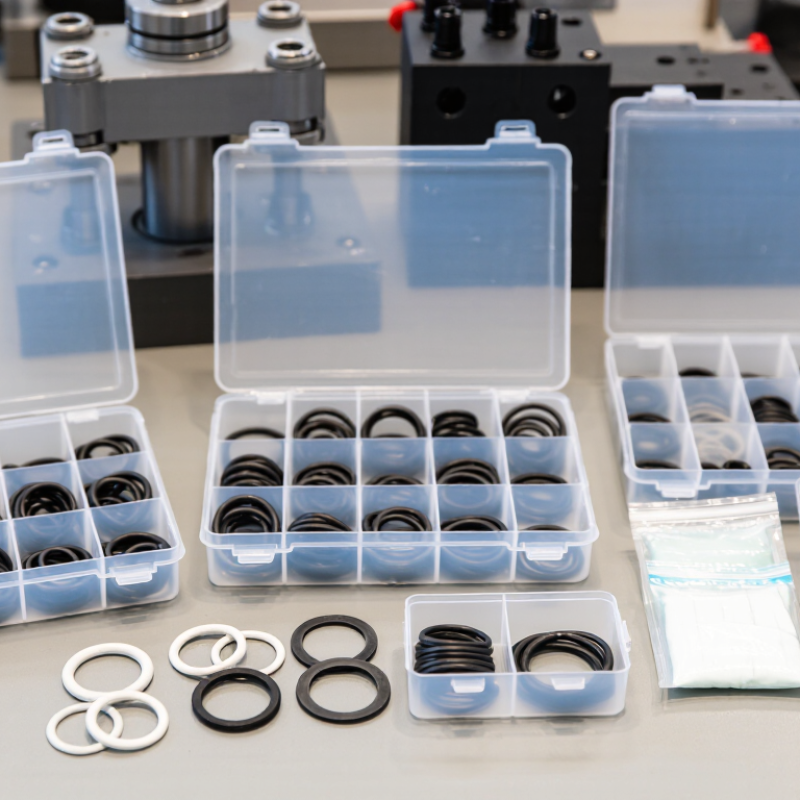
Details matter. A kit for a hydraulic manifold may need several sizes, backup rings, labeled compartments, and contamination-resistant packaging. A food-processing application may require different documentation and elastomer controls. No ranking is perfectly universal. Supplier performance can change by region, production volume, and application complexity. The strongest comparison therefore combines published capabilities, engineering evidence, customer experience, and independent verification. Reliability is demonstrated, not simply claimed.
What Are the Top Custom O-Ring Kit Manufacturers?

What Is a Custom O-Ring Kit Manufacturer?

What Is a Custom O-Ring Kit Manufacturer?

A custom O-ring kit manufacturer designs, produces, and packs sealing components for a defined application. It does more than supply standard rings. Engineers review groove dimensions, pressure, temperature, chemical exposure, and installation conditions. They may select nitrile, silicone, fluorocarbon, or ethylene propylene compounds. Material choice matters. A mismatched elastomer can swell, crack, or lose compression.

The manufacturer usually converts drawings into part numbers, then builds kits with varied sizes, backup rings, lubricants, and identification labels. Quality systems should connect production records with inspection results. ISO 3601 provides recognized dimensional and tolerance requirements for O-rings. ASTM D2000 also helps classify rubber performance. These references make supplier comparisons more reliable. A 2024 Grand View Research report estimated the global industrial seals market at over 14 billion U.S. dollars, with continued growth expected through the decade. That growth increases demand for dependable customization, not merely larger inventories.

Experience is visible in practical details. A capable manufacturer checks flash, surface defects, hardness, and compression before shipment. It should provide material certificates and traceability. It should also explain testing limits plainly. Some suppliers promise every solution. That claim deserves caution. Real applications often contain incomplete drawings or changing temperatures. I have found that a short prototype run can reveal problems that paperwork misses. The best evaluation therefore considers engineering support, repeatability, emergency replenishment, and honest communication alongside price. Often, the smallest label prevents the largest mistake.

Which Materials and Specifications Do Manufacturers Offer?

Custom O-ring kit manufacturers typically offer several elastomer materials for different working conditions. Nitrile rubber suits mineral oils, hydraulic fluids, and general maintenance tasks. Fluorocarbon rubber handles higher temperatures and many aggressive chemicals. EPDM performs well with water, steam, and selected cleaning solutions. Silicone remains flexible in cold environments, but it may resist abrasion poorly. Material choice matters.

Manufacturers also provide specifications beyond material names. Buyers can request inside diameter, cross-section, hardness, color, and dimensional tolerance. Hardness is commonly measured in Shore A, often ranging from 70 to 90 for industrial sealing work. Temperature ratings should match real operating cycles, not only catalog limits. Chemical compatibility charts help, but they cannot replace application testing. A seal exposed to pressure spikes may need a backup ring or a tighter extrusion gap.

Reliable suppliers should provide batch identification, inspection records, and clear packaging labels. Kits may contain metric, imperial, or application-specific sizes. Some manufacturers sort parts into labeled compartments, which saves time during field repairs. I once found that a seemingly correct kit had inconsistent labeling, so verification still mattered. Calipers, groove measurements, and a small material check can prevent costly mistakes. Specifications can look complete on paper. They may still miss installation damage, storage aging, or an unusual fluid mixture.

How Do Manufacturers Design and Assemble O-Ring Kits?

Custom O-ring kit manufacturers begin with service conditions, not a color chart. Engineers record pressure, temperature, fluid type, motion, groove dimensions, and installation space. Material selection then follows standards such as ISO 3601 and ASTM D2000. Common options include nitrile, fluorocarbon, silicone, and ethylene-propylene rubber. Each has different resistance to heat, chemicals, compression set, and swelling.

Small details matter. A design team calculates squeeze, stretch, cross-section tolerance, and possible extrusion gaps. Backup rings may be added for high-pressure applications. According to Grand View Research, the global industrial seals market was valued at approximately USD 14.8 billion in 2023, with projected growth near 4.8% annually through 2030. That expansion increases demand for traceable, application-specific kits. Still, growth does not guarantee quality.

Assembly usually starts with visual inspection under controlled lighting. Technicians remove flash, dust, and damaged parts before sorting by size and compound. Compatible lubricant may be applied sparingly. It must not contaminate the working fluid. Kits are then counted, sealed, labeled, and linked to batch records. Dimensional checks and sample leak tests help verify consistency. The process sounds simple. It is not always. A perfectly sorted kit can fail when packaging compresses soft rings or when a label omits storage limits. Experienced manufacturers review these weak points, because the first design is rarely flawless.

What Quality Standards and Testing Methods Are Used?

Custom O-ring kit manufacturers should follow recognized standards, not rely on visual inspection alone. ISO 3601 helps control O-ring dimensions, tolerances, and acceptance criteria. ASTM D2000 supports material classification and performance evaluation. These references create a common technical language for engineers and quality teams.

Testing usually begins with dimensional measurement. Technicians check inner diameter, cross-section, and surface condition using calibrated gauges or optical equipment.

Hardness testing confirms the intended Shore A range. Tensile strength and elongation tests reveal whether the elastomer can handle installation stress.

Compression set testing is also important. It shows how well the seal recovers after long-term compression.

Pressure and leakage tests can expose tiny defects that a clean surface may hide. Heat, fluid, and ozone aging tests provide further evidence of service performance.

Still, laboratory results may not perfectly represent every application.

Tips: Request material certificates, batch traceability, inspection records, and sample test reports. Ask whether testing uses production parts or separate samples. Check storage conditions, packaging, and shelf-life controls. A reliable manufacturer should explain failed tests clearly, not only display successful results.

How Can Buyers Compare and Select the Best Manufacturer?

What Are the Top Custom O-Ring Kit Manufacturers?

Buyers should compare process control, not attractive catalogs. A reliable manufacturer explains compound selection, tooling, tolerances, and inspection methods. Ask for batch traceability, material certificates, and dimensional reports for every shipment. ISO 3601 guidance helps evaluate sealing dimensions, while ASTM D2000 supports consistent rubber classification. The ISO Survey 2022 recorded 1,265,216 ISO 9001 certificates worldwide. Certification matters, but its scope must include the actual production site.

Request samples made with the proposed compound and tooling. Check compression set, hardness, tensile strength, and chemical compatibility under realistic temperatures. A kit for hydraulic equipment may need different elastomers than one used near fuel or steam. Suppliers should provide test conditions, not only pass or fail results. Short lead times sound useful. They can hide weak inventory planning. Compare quoted tooling costs, minimum order quantities, replenishment times, and replacement-part policies.

Experienced buyers also inspect packaging and labeling. Each compartment should identify size, compound, batch number, and storage guidance. Review nonconformance records and corrective-action examples where possible. The 2023 ASQ Manufacturing Outlook highlighted continuing pressure from supply-chain disruption and quality risks, making contingency planning commercially important. Do not trust a polished certificate alone. Visit the facility, if the order is critical. I would also score communication during sampling, because slow answers often become slower problem-solving later. A small pilot order can reveal more than a long presentation.

en_USEnglish

PCD Inserts

PCBN Inserts

Solid CBN Inserts

PCD Milling Cutter

PCD Drilling Tools

PCD Reamer

Diamond Special Tool

Diamond Dressers