SUNDI TOOLS
- Copyright © Wuxi Sundi Precision Tools Co.,LTD All rights reserved.
- Site Map
In 2026, Profiled Aluminium remains a practical choice for projects that need low weight, repeatable dimensions, and adaptable shapes. But “top” does not mean one profile suits every job. T-slot sections are common in machine frames, workstations, and guards because their grooves accept brackets and fasteners. Architectural profiles serve windows, doors, façades, and interior trims, where appearance and weather exposure matter. Heat-sink profiles use fins to release heat from electronic equipment. Solar mounting sections and structural profiles support panels, platforms, and equipment frames. Each has a different purpose. Small details matter.
This guide compares the main profile types by design, typical use, and selection factors. Wall thickness, alloy, temper, cross-section, and finish can affect strength, corrosion resistance, machining, and cost. For example, a deep-fin heat sink may suit a compact device, while a T-slot frame can make assembly changes easier. These are practical tendencies, not guarantees; actual performance depends on dimensions, loads, environment, and manufacturing quality. A profile can look robust yet deflect more than expected. That deserves checking. We also consider custom extrusions, which can reduce part count but may need dedicated tooling and higher upfront costs. No profile is universally best. The aim is to help buyers and designers compare options carefully, ask suppliers for relevant specifications, and choose a section that fits the real operating conditions.
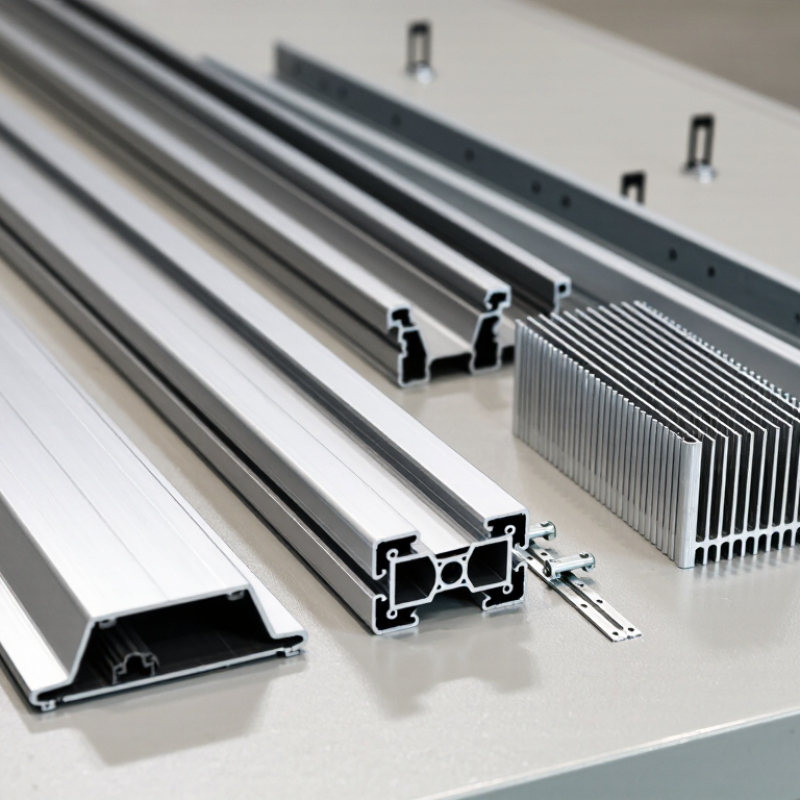
Common structural shapes of profiled aluminium include T-slot profiles, angles, channels, beams, and hollow sections. T-slot profiles have grooves for brackets and sliding nuts, making them useful for adjustable frames and machine guards. Angle sections reinforce corners. Channels support panels or guide moving parts. I-beams and H-beams suit applications needing strength along a defined axis, while square and rectangular tubes offer enclosed, tidy frame members.
The right shape depends on load direction, span, wall thickness, and connection method. A hollow section may resist twisting better than a flat bar, but joint design still matters. Small details matter. The International Aluminium Institute reported approximately 70.6 million tonnes of global primary aluminium production in 2023. This indicates the scale of aluminium supply, not the output or market share of any particular profile type. Buyers should therefore check supplier drawings and engineering data for the specific extrusion.
Tips: Match the profile to the load, then inspect slot dimensions, corner radii, and wall thickness. Check how fasteners sit in the groove before ordering a full run. Fit is not strength. I would not assume that a heavier section is always better; unnecessary material can add cost without solving the actual loading problem.
Profiled aluminium comes in shapes designed for different loads, connections, and finishes. T-slot profiles are widely used for machine frames, workbenches, and adjustable guards. Their grooves accept fasteners, making layout changes relatively simple. Check slot dimensions and wall thickness before pairing components. A frame can look sturdy yet flex under vibration.
U-channel and L-angle profiles suit edge protection, brackets, and light supports. Square and rectangular hollow sections provide a cleaner appearance and useful stiffness in partitions or equipment frames. Round tubes are often chosen for handrails and curved assemblies. Each shape has limits. Thin walls may dent, while heavier sections can add cost and weight.
Heat-sink profiles use fins to increase surface area and help transfer heat away from components. Architectural profiles, including window and façade sections, are shaped around glazing, drainage, and weather sealing. These details deserve careful review. A profile that fits visually may not suit the assembly. For 2026 projects, compare alloy, temper, tolerances, finish, and intended load with the supplier’s technical data. I would not call one type universally best; the right choice depends on the connection and service conditions.
Profiled aluminium designs differ less by appearance than by the job their cross-sections perform. T-slot profiles have grooves that accept nuts, brackets, and panels, making them useful for adjustable machine frames and workstations. Assembly is straightforward. But exposed slots can collect dust, and joints may loosen if fasteners are poorly selected.
Structural profiles use thicker walls or reinforced ribs to resist bending under load. They suit guards, supports, and equipment frames, where stiffness matters more than a clean decorative edge. A small change in wall thickness can affect both weight and rigidity. It is tempting to choose the heaviest section, though that may add cost without solving the real load problem. Check span, connections, and expected forces before specifying one.
Heat-sink profiles use fins to increase surface area and release heat from electronic components. Fin spacing and airflow both matter; a dense design can perform poorly when air cannot move through it. Architectural profiles, by contrast, often prioritize visible lines, drainage, and consistent finishes for doors or façades. Appearance still has limits. A slim section may need careful support, and finish samples can look different under daylight. Comparing drawings with a physical sample is a practical step, not a perfect guarantee.
How aluminium profile designs differ in function
The chart compares defining cross-section forms, not strength or performance ratings. “Yes” indicates a characteristic geometry: T-slot profiles provide integral mounting grooves, channels have a U-shaped section, angle profiles have an L-shaped section, I-beams have an I-shaped section, and rectangular hollow sections enclose a cavity. Actual designs vary by specification.
Industries and Applications for Each Profile Type
T-slot profiles are common in automation, machine guards, workstations, and adjustable display frames. Their grooves accept connectors, brackets, and panels, so teams can change a layout without welding. They suit factories where equipment moves or production lines need frequent updates. Solid bars and flat profiles serve a different purpose. They are often machined into brackets, rails, heat sinks, and precision parts. Check dimensions and alloy specifications against the load and machining needs; a profile that looks sturdy may still bend under repeated stress.
Hollow rectangular and square profiles appear in furniture frames, transport equipment, and building interiors. Their enclosed shape can provide useful stiffness without the weight of a solid section.
Angles and channels are practical for edge supports, shelving, cable routes, and light-duty frames. They are easy to fit, but connections can loosen if the design ignores vibration or uneven loads. Details matter.
Tips: Match the profile to its real working conditions, not just its appearance. Note span, load, moisture, and whether parts will be cut or joined on site. For outdoor use, ask about finish durability and drainage. A small test assembly can reveal awkward access or alignment issues before a full installation. Even careful selection has limits; actual performance depends on the alloy, wall thickness, connectors, and workmanship.
What Are the Top Types of Profiled Aluminium in 2026?
How to Choose the Right Aluminium Profile for a Project
Choosing an aluminium profile starts with the job it must do. T-slot profiles suit adjustable frames and workstations. Structural profiles support heavier loads, while heat-sink profiles help move heat away from components. For doors and façades, architectural profiles offer a clean finish but require careful attention to weather sealing. Match the profile’s alloy, temper, wall thickness, and load rating to the project—not just its shape.
Check the manufacturer’s technical data for tolerances, maximum span, and connection details. A slim extrusion may look tidy, but it can flex across a long unsupported run. The International Aluminium Institute estimates that about 75% of all aluminium ever produced remains in use. That makes recycled content worth asking about, but request project-specific documentation rather than assuming every profile has the same environmental impact. A small oversight here can create costly rework.
Tips: Sketch the frame, mark its loads, and measure each span before choosing. Ask for a sample. Check whether brackets, fasteners, and finishes are compatible, too. I’d still leave room to revise the design after a physical fit test; drawings do not always reveal awkward access or assembly issues.
| Profile Type | Typical Materials or Alloys | Common Applications | Key Advantages | Selection Considerations | Best Fit When… |
|---|---|---|---|---|---|
| T-slot modular profile | Commonly 6063-series aluminium; temper and strength depend on the supplier and profile design. | Machine frames, workstations, guards, test rigs, and adjustable fixtures. | Slot-based connections allow components to be repositioned or added without extensive machining. | Check slot dimensions, connector compatibility, load direction, span, deflection, and joint stiffness. | The structure may need frequent adjustment, assembly, or later expansion. |
| Architectural profile | Often 6063-series alloys, selected for extrusion detail and surface finishing. | Window and door frames, curtain-wall components, trims, and interior partitions. | Can combine complex cross-sections with anodized or coated finishes and a clean appearance. | Evaluate the complete system for weather sealing, drainage, thermal performance, corrosion exposure, and applicable building requirements. | Appearance, finish options, and integration with glazing or building components are important. |
| Structural or heavy-duty profile | Often 6061-series alloys for strength-oriented applications; exact properties depend on temper and section design. | Machine supports, brackets, frames, platforms, and load-bearing components. | Can provide a strong, relatively lightweight structural member and may be machined or joined as required. | Confirm alloy and temper, section properties, connection design, fatigue demands, and engineering loads; do not infer capacity from appearance alone. | Strength and stiffness calculations are central to the design. |
| Heat-sink profile | Commonly 6063-series aluminium; alloy, fin geometry, and manufacturing method affect thermal performance. | LED lighting, power electronics, control equipment, and other thermal-management assemblies. | Fins increase exposed surface area, while aluminium conducts heat and is relatively light. | Assess heat load, airflow, mounting orientation, contact resistance, fin spacing, and operating temperature. | Passive heat dissipation is needed and the available space can accommodate the required surface area. |
| Solar mounting profile | Commonly extruded aluminium alloys used for mounting rails and clamps; alloy, temper, and finish vary by system. | Photovoltaic module rails, roof attachments, and ground-mount structures. | Light weight and corrosion resistance can simplify handling and support outdoor use. | Check wind and snow loads, span, roof or ground attachment, galvanic compatibility, drainage, and local structural requirements. | A lightweight, corrosion-resistant mounting member is needed for an exposed installation. |
| Enclosure and panel profile | Often 6063-series aluminium; other alloys may be specified according to strength, machining, or fabrication needs. | Equipment housings, instrument panels, cabinet frames, covers, and electronic enclosures. | Can integrate grooves, mounting features, and panel-retaining details into one extruded section. | Specify panel thickness, sealing method, access needs, ventilation, electromagnetic shielding requirements, and finish. | Equipment needs a durable housing with integrated mounting or panel features. |
| Custom-engineered extrusion | Alloy and temper selected to suit strength, corrosion, formability, finish, and extrusion constraints. | Purpose-built parts for transport, machinery, consumer products, and industrial assemblies. | Cross-section can be tailored to combine several functions and reduce part count or secondary assembly. | Review minimum wall thickness, uniformity, tolerances, die feasibility, production volume, finishing, and tooling cost with the extruder. | Standard sections cannot meet the geometry or functional requirements efficiently. |
Selection note: Alloy and temper names indicate material condition, not a guaranteed design capacity. Verify mechanical properties, dimensions, tolerances, finish, and structural performance for the specific product and project conditions.