SUNDI TOOLS
- Copyright © Wuxi Sundi Precision Tools Co.,LTD All rights reserved.
- Site Map
A Tokimec Equivalent Pump is a replacement pump designed to match the function and key specifications of a particular Tokimec pump. The term does not guarantee a universal, direct-fit substitute. Compatibility depends on the exact model and the machine around it. A pump that looks right on a workbench may have a different shaft, port layout, rotation, or mounting pattern.
That label can sound simpler than it is. Before choosing a replacement, compare the original nameplate with the supplier’s technical data. Check displacement, operating pressure, speed range, fluid requirements, and control type. Even small differences can affect heat, noise, or response in the hydraulic system. A part number alone is not enough.
For example, a technician replacing a pump in an industrial unit should confirm that the new pump’s ports align with the existing hoses and that its shaft suits the drive. Then verify performance requirements against the equipment manual. Ask the supplier for a model cross-reference and dimensional drawing, not just a verbal assurance. If documentation is incomplete, pause and have a qualified hydraulic specialist review the match. It may take longer. That is usually safer than guessing.
This guide explains what “equivalent” means, which specifications matter, and how to assess a candidate pump. It also considers where substitutions can fall short. Model details and product availability vary, so confirm every selection with current manufacturer or supplier information before installation.
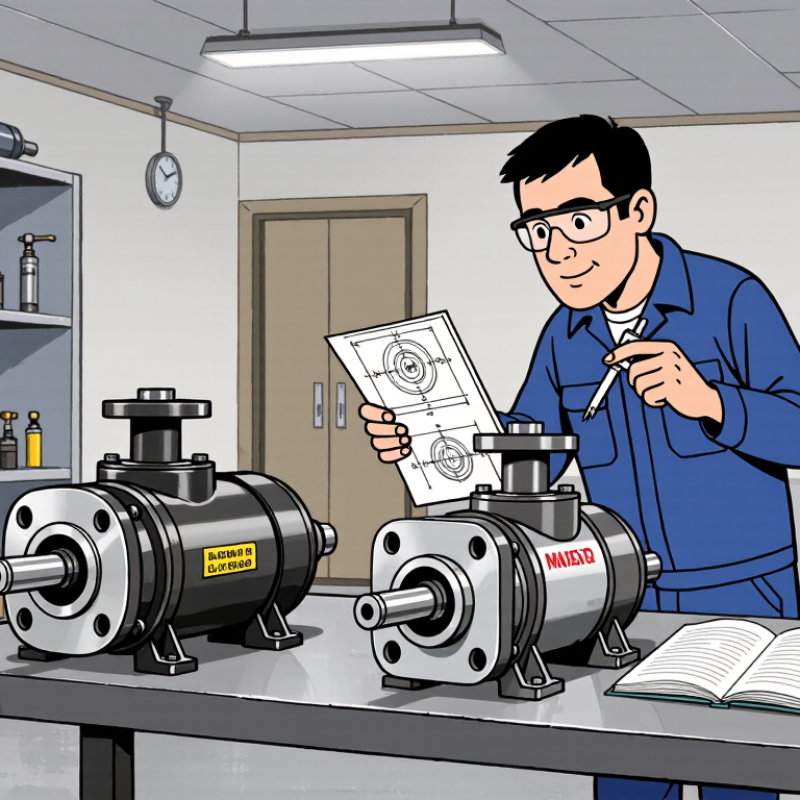
An “equivalent pump” usually means a replacement designed to perform a similar hydraulic job, not a guaranteed identical unit. It should match the original pump’s key operating requirements, including displacement, rated pressure, speed range, rotation direction, and mounting pattern. Port locations and shaft dimensions matter, too. Small differences can turn installation into a costly adjustment.
Fit is not enough.
Check the machine’s service manual and pump nameplate before comparing models. Then review the performance curve at the actual oil viscosity and operating temperature, not just the headline flow rating. A pump may fit the mounting plate yet deliver too little flow at working speed. Or it may create excess heat. Confirm fluid compatibility, control type, drain requirements, and relief-valve settings with a qualified hydraulic technician. A close match on paper can still behave differently under load; real machines are rarely as tidy as a catalog table. When information is missing, measure the installed unit and verify system limits rather than guessing. An equivalent is a decision based on evidence, not a label.
A hydraulic equivalent pump works by converting shaft rotation into fluid flow. In an axial-piston design, a rotating cylinder block carries pistons across an angled swash plate. As each piston retracts, its chamber draws in oil; as it advances, the chamber pushes oil into the outlet. Changing the swash-plate angle changes displacement and flow. Pressure, however, depends on the load and system controls—not on the pump alone. Small changes matter. A U.S. Department of Energy pump-system sourcebook reports that pumping systems account for nearly 20% of global electricity demand, underscoring why correct sizing and control matter.
When comparing a replacement, check displacement, rated pressure, rotation, shaft and port dimensions, and control type. Also confirm the fluid, operating temperature, and expected duty cycle. A unit may fit the mounting face yet behave poorly if its control response differs. That shortcut is tempting, but it can mislead. Match the hydraulic circuit, not just the catalog numbers.
Tips: Before installation, record pressure and flow under real operating conditions. Inspect the inlet line for restrictions and the oil for contamination. Start at low load, then check for unusual noise, heat, or pressure swings. Small leaks or air bubbles can distort early readings, so allow the system to stabilize before judging performance.
A compatible hydraulic pump is not chosen by appearance alone. Start with displacement, usually stated in cubic centimetres per revolution, and compare it with the original unit. This value affects flow at a given shaft speed. Check the required operating pressure and peak pressure separately; a pump that matches flow may still be undersized for the load. Small details matter.
Confirm rotation direction from the shaft end, not from a diagram viewed casually. Then compare shaft diameter, key or spline dimensions, mounting flange, and port locations. Even a few millimetres of mismatch can make installation difficult. Measure twice. Verify whether the system uses a fixed- or variable-displacement pump, and identify its control arrangement before ordering.
Fluid type, viscosity, and operating temperature also influence compatibility. A pump designed for one fluid range may wear quickly if the oil is too thin or too cold. Check inlet conditions and case-drain requirements, where applicable, against the machine’s plumbing. A catalog match can still be wrong. Record the machine model, pump markings, and measured dimensions, then confirm them against a technical datasheet or a qualified hydraulic technician. Some older equipment has been modified, so the original specification may not tell the whole story.
| Specification | What to Check | Compatibility Guidance |
|---|---|---|
| Pump design | Fixed- or variable-displacement; vane, gear, or piston design | Confirm the replacement suits the circuit’s control method and duty. A different design is not automatically interchangeable. |
| Displacement | Pump volume per revolution, usually stated in cm³/rev | Match the original displacement or verify that the resulting flow meets the system requirement. |
| Flow rate | Required delivery in L/min at the operating speed | For theoretical flow: displacement (cm³/rev) × speed (rpm) ÷ 1,000 = L/min. Account for volumetric efficiency when estimating actual flow. |
| Pressure rating | Continuous and intermittent or peak pressure, typically in MPa or bar | The replacement’s ratings must meet or exceed the application’s specified pressures. Do not use a peak rating as a continuous rating. |
| Operating speed | Minimum and maximum permissible shaft speeds, in rpm | Check the full motor speed range, including start-up conditions, against the pump’s rated limits. |
| Rotation direction | Clockwise, counterclockwise, or reversible; confirm the viewing reference | Compare the specified direction when viewed from the shaft end. Incorrect rotation can prevent proper operation or damage the pump. |
| Mounting and shaft | Mounting style, bolt pattern, pilot diameter, shaft type, diameter, and length | Check dimensioned drawings and coupling engagement. Similar-looking pumps may have incompatible mounting or shaft dimensions. |
| Port connections | Inlet and outlet locations, port size, thread type, and sealing method | Match the hydraulic connections and verify that inlet plumbing is suitable for the pump’s flow and suction requirements. |
| Control configuration | Pressure, flow, load-sensing, or other control arrangement, where applicable | For controlled or variable-displacement units, verify the control type, settings, and hydraulic connections—not only the pump’s main ports. |
| Hydraulic fluid | Fluid type, viscosity range, temperature range, and cleanliness requirements | Confirm the pump is rated for the system fluid and operating conditions, and follow the equipment manufacturer’s filtration requirements. |
| Installation envelope | Overall dimensions, clearance, weight, and service access | Check the available space and ensure the replacement can be installed without stressing pipes, couplings, or mounting surfaces. |
Compatibility note: “Equivalent” means the pump matches the required hydraulic performance, mechanical interfaces, and operating conditions. Confirm the original pump’s full model specifications and the replacement’s technical drawing before purchase or installation.
Equivalent hydraulic pumps are grouped by design, not appearance. Vane pumps suit steady flow and moderate pressure, while piston pumps handle higher pressures and variable output. Gear pumps are simpler, often fixed-displacement choices. These categories help narrow a search, but they do not prove a direct fit.
Check displacement, rated pressure, shaft rotation, mounting dimensions, and port positions before comparing models. Small differences matter. A shaft that looks correct may have the wrong keyway, and a reversed port layout can complicate installation. Also compare control type: a pressure-compensated pump cannot automatically replace a basic fixed-displacement unit. Measure carefully.
Real systems add another layer. Oil temperature, viscosity, operating speed, and duty cycle affect performance and service life. A pump rated for the same pressure may still deliver too much flow at the machine’s normal speed. That mismatch can create heat or noisy operation.
Not every catalog detail is easy to verify, either; unclear drawings deserve a second look. Confirm specifications with a qualified hydraulic technician, then test pressure, flow, and leakage under controlled operating conditions.
Selecting an equivalent hydraulic pump means matching its operating envelope, not just its appearance. Record the original pump’s displacement, rated pressure, flow, rotation direction, shaft dimensions, mounting pattern, and port locations. Then check the fluid type, viscosity, temperature, and control method. Small differences matter. A pump may bolt into place yet deliver the wrong flow or rotate incorrectly, causing noise, excess heat, or component wear.
Verify the candidate against the machine’s actual duty cycle, including startup pressure and peak demand. Compare curves at the required speed, not just catalog maximum ratings, and confirm compatibility with the existing motor and relief valve. The U.S. Department of Energy’s Improving Pumping System Performance sourcebook reports that system improvements can offer energy savings of 20 to 50 percent in many cases. That is a system-level opportunity, not a promise from a pump swap. The Hydraulic Institute’s Pump Life Cycle Costs guide also emphasizes evaluating energy and maintenance alongside purchase price. A careful test matters. Before installation, confirm dimensions from drawings, inspect the shaft and ports, and ask the supplier for written performance data. A catalog match can still be wrong; field conditions often reveal details the old paperwork missed.
Compare calculated flow rates for common displacement sizes before verifying a replacement pump’s full operating and mechanical specifications.
How to use: The lines show theoretical flow calculated as displacement × speed ÷ 1,000. Actual flow is lower due to volumetric losses. Use the chart as a screening aid, then verify required pressure, speed range, rotation, shaft and mounting dimensions, port arrangement, and fluid compatibility.