Why Choose a Lantern Festival Manufacturer?
Choosing a lantern festival manufacturer can shape the look, reliability, and practical setup of an event. A skilled partner can turn a rough theme into lanterns with clear colors, consistent sizing, and details visitors notice up close. Think of a glowing archway, hand-painted patterns, or a row of lanterns reflected across a pond. Small choices matter.
A capable manufacturer should explain materials, construction methods, customization options, and production timelines in plain language. Ask how samples are reviewed, how color differences are handled, and what checks take place before shipment. Requesting photos, specifications, and a written quote can make comparisons more useful. Experience matters, but clear evidence matters too. Look closely.
The right supplier may also help coordinate packaging and delivery, especially when an installation includes many pieces or custom shapes. Discuss weather exposure and the intended display location before confirming materials. Requirements can differ between indoor venues and outdoor spaces, so avoid relying on assumptions. A lantern that looks beautiful in a studio may behave differently in wind or damp air.
This guide explores why event planners work with a lantern festival manufacturer, what questions to ask, and how to assess quality before placing an order. No supplier is perfect. Even a detailed plan can miss a practical issue, such as how lantern frames fit through a venue entrance. Careful communication helps catch those gaps early and supports a more dependable festival display.
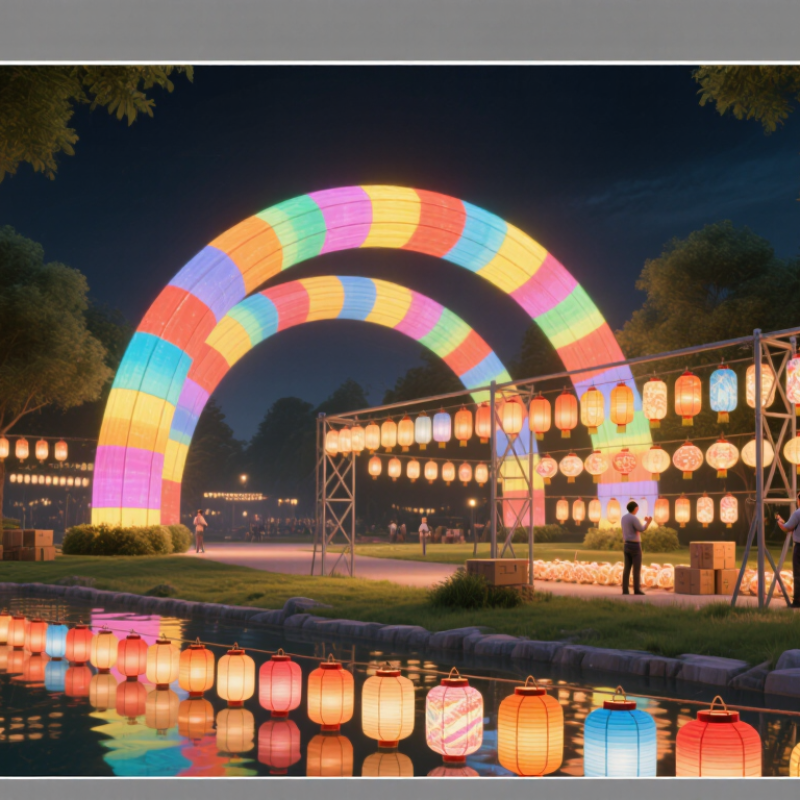
What a Lantern Festival Manufacturer Provides: Design, Fabrication, and Installation
A lantern festival manufacturer turns an artistic idea into a workable site plan. Designers map visitor routes, sightlines, power access, and weather exposure before drawing lanterns. A paper-and-wire sample can reveal awkward proportions early. Small details matter. Yet a mock-up cannot predict every gust or crowd movement, so plans need room for adjustment.
Fabrication covers frames, coverings, lighting, and connection points. Materials must suit the lantern’s size and display conditions, not just look good in a studio. The U.S. Department of Energy’s Energy Saver guidance says LEDs use at least 75% less energy and last up to 25 times longer than incandescent lighting. That makes LED selection a practical design decision, especially across a large installation. Still, energy use depends on the full lighting setup.
Installation brings the design to life. Crews assemble sections, secure supports, test circuits, and check viewing angles after dark. The Events Industry Council’s 2023 Global Economic Significance of Business Events report estimated that business events generated $1.6 trillion in direct spending in 2019. It underlines the scale of event operations, though a lantern festival has its own demands. A manufacturer coordinating design, fabrication, and installation can reduce handoff gaps, but clear site information from organizers remains essential.
Why Choose a Lantern Festival Manufacturer?
Design, fabrication, and installation are connected stages of a custom lantern project.
This example planning schedule shows how project work may be organized. Actual durations vary with the number and complexity of lanterns, approvals, and site conditions.
Structural Safety: Wind-Load Design Under ASCE 7
A lantern’s beauty depends on more than its color and shape. Its frame, fabric, joints, and anchors must work together when wind pushes against it. A qualified manufacturer treats wind resistance as a design input, not a last-minute adjustment.
ASCE 7 provides methods for determining wind loads, but the correct design depends on the site and the project. Engineers consider factors such as wind speed, exposure, structure height, and surrounding terrain. They also assess how air moves through or presses against lantern surfaces.
Small gaps matter. A mostly solid fabric panel can catch more wind than its delicate appearance suggests.
Ask how the load travels from the lantern frame into its supports and ground anchors.
Request project-specific calculations and drawings, and confirm which edition of ASCE 7 and local requirements apply. Installation must match the engineered details; a strong frame cannot compensate for loose connections or shallow anchorage.
In practice, site conditions can change, and a drawing may not capture every obstacle. That deserves a second look, especially where gusts funnel between buildings.
Weatherproofing: What IEC 60529’s IP65 Rating Means
Why Choose a Lantern Festival Manufacturer?
Weatherproofing: What IEC 60529’s IP65 Rating Means
Outdoor lanterns face more than rain. Dust can settle inside seams, while water may reach cable entries and connectors. IEC 60529 defines IP65 as dust-tight protection and protection against water jets from any direction. In the standard’s IPX5 test, water flows through a 6.3 mm nozzle at 12.5 litres per minute. That is a controlled test, not a promise that a lantern can withstand immersion or every cleaning method.
For festival installations, inspect the whole assembly, not just the housing. Ask whether the rating covers the finished lantern, including its cable glands, joints, and power connections. A small gap around a cable can become the weak point. The rating also says nothing about UV exposure, wind resistance, or long-term material ageing. It is useful evidence, but not the whole weatherproofing story.
Tips: Request the test documentation for the exact model and configuration. Check seals before installation, keep connectors raised from standing water, and avoid pressure-washing unless the manufacturer permits it. Even good sealing can be compromised during assembly.
| Why Choose a Lantern Festival Manufacturer? — Weatherproofing: What IEC 60529’s IP65 Rating Means |
| Data Dimension | What IP65 Means | What to Check for Festival Lanterns |
| IP code structure | Under IEC 60529, the first digit describes protection against access to hazardous parts and solid foreign objects; the second describes protection against water. | Ask which complete lantern assembly or electrical enclosure the rating applies to, rather than assuming every component or installation is covered. |
| First digit: 6 | “6” indicates dust-tight protection: dust must not enter the enclosure during the applicable test. | Confirm that covers, cable entries, seams, and access panels are included in the tested configuration. |
| Second digit: 5 | “5” indicates protection against water jets from any direction under the IEC 60529 test. It does not mean the enclosure is suitable for immersion. | For outdoor displays, check that the rating matches the expected exposure, such as rain or cleaning with water jets. Do not treat IP65 as an immersion rating. |
| Water-jet test conditions | The IPX5 test uses a 6.3 mm nozzle and a water flow rate of 12.5 L/min ±5%. The test lasts at least 3 minutes, with the duration adjusted to the enclosure’s surface area. | Request test documentation that identifies the tested product configuration and applicable standard edition. |
| Connectors and cables | An IP rating applies to the tested enclosure arrangement; it does not automatically establish the rating of separately supplied or differently fitted parts. | Check whether connected cables, plugs, glands, and caps must be fitted or secured in a particular way to maintain the claimed protection. |
| Installation and maintenance | Damage, incorrect assembly, or opened enclosures can affect the protection achieved in use. | Use the specified installation method, inspect seals and closures, and follow the supplier’s cleaning and maintenance instructions. |
| Evidence to request | A rating claim should be supported by documentation for the relevant product and test configuration. | Ask for an applicable test report or certificate, product identification, installation conditions, and any stated limitations. |
| Practical takeaway | IP65 means dust-tight and protected against water jets under specified test conditions; it is not a guarantee against every weather condition or water exposure. | Choose a manufacturer that can clearly explain the tested configuration, provide supporting documentation, and give practical guidance for outdoor installation. |
Fire and Lighting Performance: NFPA 701 Tests and 25,000-Hour LED Ratings
Why Choose a Lantern Festival Manufacturer?
Fire and lighting performance begins with materials and honest test records. For fabric or film components, ask whether the exact material was tested to NFPA 701, Standard Methods of Fire Tests for Flame Propagation of Textiles and Films. NFPA 701 evaluates flame propagation; it is not a blanket certification of a finished lantern. Construction details matter. Coatings, backing, and material substitutions may make a test report less relevant to the product delivered. Request the report and check that its specimen matches the lantern’s actual materials. That detail is easy to miss.
A 25,000-hour LED rating sounds precise, but it is an estimate, not a promise of failure-free operation. At eight hours nightly, it represents roughly 8.5 years of use. The U.S. Department of Energy’s LED Luminaire Lifetime guidance explains that lifetime estimates rely on lumen-maintenance data; gradual dimming and sudden component failure are different issues. Ask how the rating was established and how heat is managed around the LED and driver. A hot, crowded lantern can challenge that assumption. Even careful documentation cannot predict every installation condition, so the rating deserves a closer look.
 Skip to content



 English
 Russian
 German
 Spanish
 French
 Portuguese