SUNDI TOOLS
- Copyright © Wuxi Sundi Precision Tools Co.,LTD All rights reserved.
- Site Map
A kitchen faucet is handled dozens of times each day. It rinses vegetables, fills pots, and sends water across the sink. That daily contact makes material choice more than a style decision. A Stainless Steel Kitchen Faucet can offer a clean, durable finish, but its performance depends on construction, installation, and care—not appearance alone.
The World Stainless Association reported 58.4 million tonnes of stainless-steel production worldwide in 2023, in its Stainless Steel in Figures 2024 report. That scale reflects the material’s broad use, though it does not prove that every faucet is equally durable. Look for clear product specifications, a dependable warranty, and relevant certifications. NSF/ANSI/CAN 61 addresses health effects of materials that contact drinking water; NSF/ANSI 372 addresses lead content. Check the faucet’s actual certification rather than assuming its finish tells the whole story.
There is a trade-off. Fingerprints and water spots may show on polished surfaces, while brushed finishes can conceal them better. As plumbing expert Richard Trethewey advises, “Choose a faucet for the daily work it must handle, not just the finish you notice in the showroom.” Consider your sink depth, handle clearance, spray needs, and cleaning routine before choosing. A beautiful faucet can still feel awkward beside a deep stockpot. Small details matter.
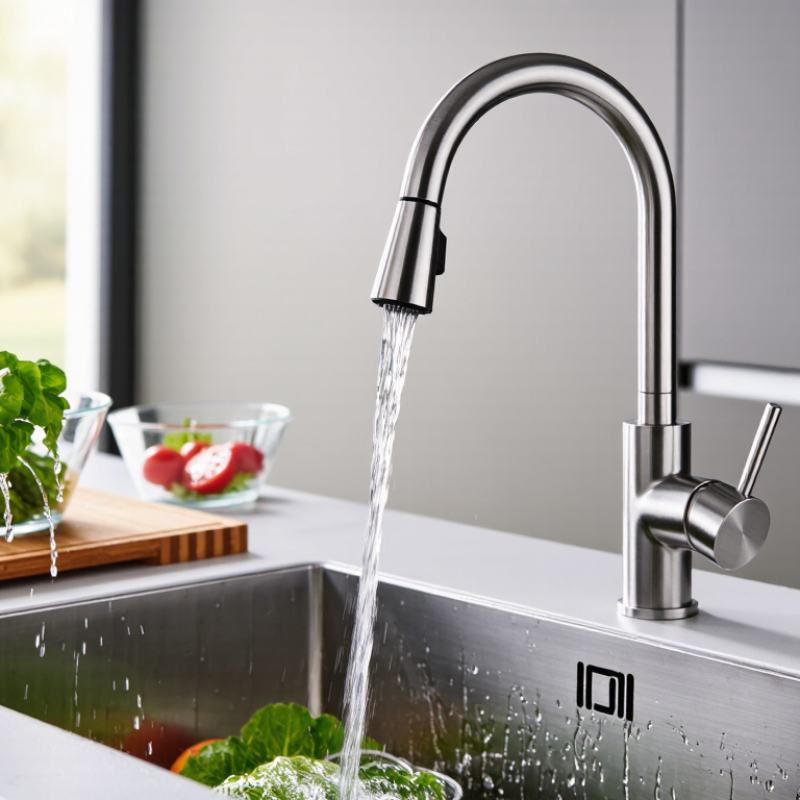
Why Choose a Stainless Steel Kitchen Faucet?
Stainless Steel Faucet Materials and Construction
A stainless steel kitchen faucet is more than a shiny shell. Its durability depends on the alloy, wall thickness, and how the body is formed. Many models use stainless steel for the outer body, while internal parts may include brass, polymer, or ceramic. Check product specifications rather than assuming every component is stainless. Grade 304 is commonly valued for corrosion resistance, though water chemistry and cleaning habits still matter. Not rust-proof.
Construction details affect daily use. A well-fitted ceramic cartridge helps control water flow and temperature, while sound seals reduce the chance of drips around the handle. Look closely at the spout base, joints, and pull-down hose connection; these are practical places to notice looseness or wear. A heavier body can feel reassuring, but weight alone does not prove better workmanship. That distinction is easy to miss.
Surface finishes also deserve attention. Brushed steel can soften fingerprints, while polished surfaces show water spots more clearly. Rinse away salty or acidic residue and dry the faucet when convenient, especially near the sink edge. Stainless steel resists corrosion, but harsh cleaners can still dull its finish. I would compare material disclosures and cartridge details before choosing; product descriptions sometimes leave these points frustratingly vague.
A stainless steel kitchen faucet handles the damp rhythm of a busy sink: splashes, wet hands, and the occasional puddle around its base. Its chromium-rich surface forms a thin protective layer that helps resist corrosion. This is useful near soap bottles and dish racks, where moisture lingers. But “stainless” does not mean stain-proof. Hard water can leave pale mineral rings, and harsh cleaners may dull the finish. Wipe the faucet with a soft cloth. Small habit, visible difference.
Heat is part of daily use, too. Stainless steel generally tolerates normal hot tap water without warping or peeling like some surface coatings can. The faucet’s seals and internal parts still matter, so follow the maker’s temperature guidance. A brushed surface can soften the look of fingerprints, though it will not hide every scratch. A metal pan handle or rough scrubber can leave marks. That is easy to forget during cleanup. Choose a faucet with solid construction and a finish suited to your routine, then use gentle care; even durable steel can show wear over time.
A stainless steel kitchen faucet is practical, but its clean appearance depends on small daily habits. The handle, aerator, and base collect fingerprints, food splashes, and moisture. These areas deserve attention, especially after handling raw ingredients. Stainless steel is not self-sanitizing, so clean it as you would other frequently touched kitchen surfaces. A smooth finish can make wiping easier, but dirt still gathers around seams.
For routine care, use warm water, mild dish soap, and a soft cloth. Wipe along the visible grain when possible, then rinse and dry with a clean towel. Drying matters: it helps prevent water spots and mineral marks, particularly in hard-water areas. Avoid rough scouring pads and harsh cleaners, which can dull or scratch the finish. It is tempting to clean only the shiny front; the faucet base and underside of the spout are easy to miss. Check them regularly. Not glamorous, but useful.
Tips: Wipe the handle and spout after messy cooking. For stubborn deposits, hold a damp, soapy cloth against the area briefly, then rinse and dry. Clean the aerator according to its instructions if flow weakens. Do not force it; small parts can be damaged, and a slow stream may have another cause. A simple weekly check is often enough.
Why Choose a Stainless Steel Kitchen Faucet?
Styles, Finishes, and Kitchen Compatibility
A stainless steel faucet suits many kitchens because its cool, neutral tone works beside stone, tile, and wood. The finish can feel crisp in a modern room or quietly practical in a traditional one. Houzz’s 2024 U.S. Kitchen Trends Study surveyed 3,437 homeowners updating their kitchens. That scale is a useful reminder: faucet choices sit within a larger mix of cabinets, counters, and fixtures. Still, there is no rule that every metal must match. A stainless faucet can pair with dark cabinet pulls, though the contrast may look sharper than expected.
Shape matters as much as color. A high-arc spout gives tall pots room to pass underneath; a compact profile may suit a narrow sink or low window. Brushed stainless tends to soften fingerprints and water spots, while polished finishes reflect more light. Check the sink’s number of mounting holes and the faucet’s reach before buying. A beautiful faucet that splashes onto the counter is a poor fit. It happens.
Tips: Hold finish samples beside your sink and cabinet hardware in daylight. Check the faucet’s reach against the center of the drain, and measure clearance below shelves. If your kitchen mixes metals, repeat one finish elsewhere so the contrast feels intentional—not accidental.
| Faucet Style | Typical Design | Common Stainless Steel Finishes | Kitchen Compatibility | Practical Considerations |
|---|---|---|---|---|
| Pull-down | A high-arc spout with a spray head that pulls downward into the sink. | Brushed stainless steel; polished stainless steel; matte or satin stainless-look finishes. | Works well with many single-bowl and double-bowl sinks. Check spout reach and clearance beneath cabinets. | The retractable hose is useful for rinsing dishes and reaching different areas of the basin. Hose design and docking method vary by model. |
| Pull-out | A spray head pulls outward from a lower or more compact spout. | Brushed or satin stainless steel; polished stainless steel. | Often suits smaller sinks or kitchens with limited overhead clearance. Confirm hose reach and sink dimensions. | Its lower profile can be practical where a tall spout would interfere with cabinets or shelves. |
| High-arc, fixed spout | A tall curved spout without a pull-down or pull-out spray head. | Brushed, satin, or polished stainless steel. | Pairs with sinks that have enough vertical clearance and sufficient basin depth to manage splashing. | The open space beneath the spout can help when filling tall pots. Measure the faucet height and spout reach before buying. |
| Single-handle | One lever controls water flow and temperature. | Commonly available in brushed or polished stainless finishes. | Many models fit a single-hole installation; some include a deck plate for covering additional holes. Verify the required hole layout. | Allows one-handed adjustment. The handle position and clearance from a backsplash can affect usability. |
| Two-handle | Separate handles control hot and cold water. | Brushed, satin, or polished stainless steel, depending on the model. | Often requires three mounting holes, though exact layouts vary. Match the faucet to the sink or countertop holes. | Offers separate controls for hot and cold water. Check handle spacing and available counter space. |
| Bridge | A traditional design with visible connections between the handles and spout. | Polished or brushed stainless steel, depending on the design. | Requires a compatible mounting layout and enough space for the faucet body and handles. | Its distinctive profile suits many classic or farmhouse-style kitchens, but its overall size should be checked against the sink. |
| Wall-mounted | The faucet attaches to plumbing connections in the wall rather than the sink deck or countertop. | Brushed or polished stainless steel finishes may be available. | Requires compatible wall plumbing and careful alignment with the sink. It is generally not a direct replacement for a deck-mounted faucet. | Leaves the countertop clear, but installation depends on the location of in-wall plumbing and may require plumbing work. |
Before choosing a stainless steel kitchen faucet, check what is actually stainless steel. The body, spray head, and visible finish may use different materials. Ask for the alloy grade and care instructions; “stainless” does not mean stain-proof. A polished surface can also show water spots, especially near a hard-water sink. Looks matter. So does upkeep.
Match the faucet to your sink and daily tasks. Measure the mounting holes, deck thickness, and clearance beneath cabinets before ordering. Check whether the spout reaches the center of the basin, and whether its handle clears a backsplash. Flow matters, too. The U.S. EPA’s WaterSense specification sets a 1.5-gallon-per-minute limit for labeled bathroom faucets, compared with the 2.2-gallon federal maximum. That data is for bathroom faucets, not kitchen models, so compare kitchen flow rates separately and consider your home’s water pressure.
For drinking-water contact, look for independent certification to NSF/ANSI/CAN 61 and NSF/ANSI 372, which address health effects and lead content. Verify that the listing covers the faucet’s wetted components, not just one part. The EPA estimates household leaks waste nearly 10,000 gallons of water each year. A slow drip is easy to dismiss, but it can signal a worn cartridge or poor installation. I would not choose by shine alone. A comfortable handle and replaceable parts may matter more after years of use.