SUNDI TOOLS
- Copyright © Wuxi Sundi Precision Tools Co.,LTD All rights reserved.
- Site Map
Mig Welding is popular because it combines a steady wire feed with a relatively straightforward process. Instead of stopping repeatedly to replace a short electrode, the welder guides a continuous wire toward the joint. This can help maintain a consistent pace on suitable projects. The process is often called gas metal arc welding, or GMAW, and it is common in fabrication shops, repair work, and vehicle manufacturing. For a beginner, the controls may feel more approachable than those of some other welding methods. But approachable does not mean effortless. Wire speed, voltage, travel angle, and stick-out all affect the finished bead.
A clean, well-adjusted setup can produce smooth welds with little slag to remove. That saves time during finishing. Mig Welding also works with several metals and thicknesses, provided the machine, wire, and shielding gas are matched to the job. The practical appeal is clear: load the wire, set the machine, and make a test weld. Then inspect it. A shiny bead is not proof of a strong joint, and poor preparation can undermine even a skilled operator’s work. Wind can disturb shielding gas outdoors, while thin sheet metal can burn through if settings or technique are unsuitable. These limits matter. MIG welding is popular not because it solves every welding problem, but because it offers a useful balance of speed, control, and accessibility for many everyday applications.
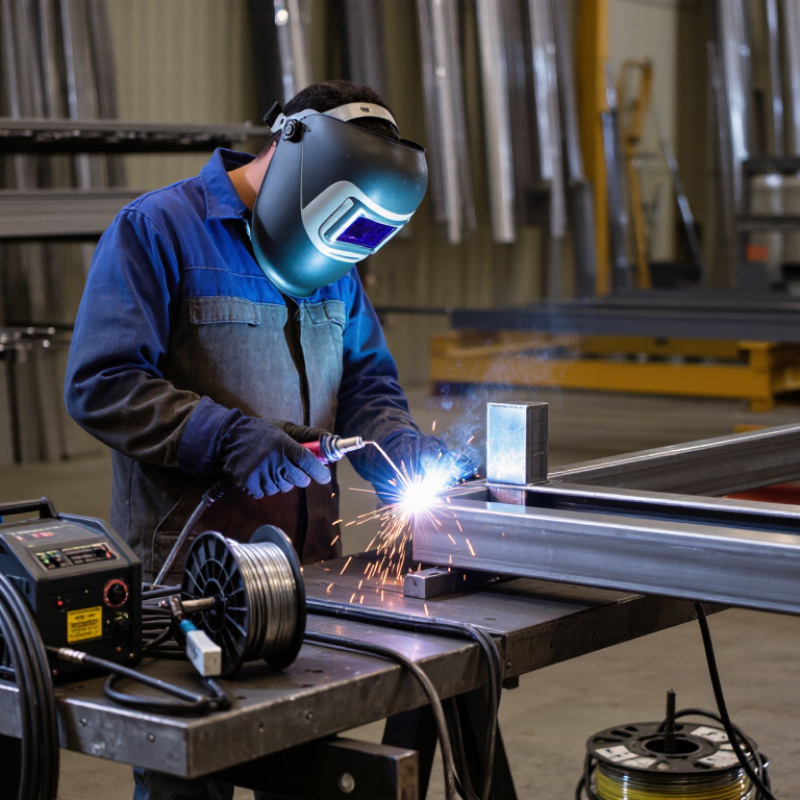
MIG welding, technically a form of gas metal arc welding, feeds a consumable wire through a welding gun. When the trigger is pressed, the wire advances and an electric arc forms between its tip and the workpiece. The arc melts both the wire and the edges of the metal, creating a molten pool that cools into a joint. A shielding gas flows from the gun nozzle to reduce contamination from the surrounding air. Though the name means “metal inert gas,” many common setups use mixed or active gases; “MIG” is often used as a general term.
The operator guides the gun along the joint while adjusting wire speed and voltage to suit the material and thickness. A steady crackle can be a useful clue, but appearance and sound alone cannot confirm a sound weld. Too much wire speed may make the wire push against the metal; excessive voltage can produce a broad, unstable arc. Small details matter. Clean, dry metal helps the arc behave more consistently, while drafts can disturb the gas shield and cause pores in the bead. Proper eye protection and ventilation are essential. The process can feel forgiving, yet thin sheet metal can still burn through quickly. I’ve found that a short practice bead on scrap often reveals more than another turn of a control knob.
MIG welding feels approachable because a spool feeds filler wire through the gun while the operator guides the torch. The wire keeps coming, so there is no need to stop often and replace a short electrode. A trigger starts the feed, and shielding gas helps protect the molten weld pool. The basic rhythm is easy to grasp. On a clean steel plate, a beginner can watch the bead form and adjust hand movement in real time. That feedback helps. It also makes practice less mysterious.
A few controls still need attention. Voltage and wire-feed speed affect how the arc behaves, and poor settings can cause spatter or an uneven bead. Too much distance between the gun and the workpiece can make the weld less consistent. Moving too quickly may leave a narrow, weak-looking line; moving too slowly can pile up metal. Easy to begin, not effortless. Even experienced welders check the joint, material thickness, and setup before making a pass. Good ventilation and proper eye and skin protection matter, too. A useful first exercise is running short beads on scrap steel, then comparing their width and shape under steady lighting. My own practice beads were rarely uniform at first. That is a useful reminder to slow down and observe.
MIG welding uses a continuously fed wire electrode, so the welder does not need to stop frequently to replace a rod. The chart shows representative shielding-gas mixtures used for different MIG welding applications. The appropriate mixture depends on the material, transfer mode, and job requirements.
MIG welding’s productivity advantage begins with wire that keeps feeding while the arc is on. The operator does not pause to replace short electrodes, so suitable production runs can have fewer interruptions and more consistent weld lengths. Less stopping helps. It also reduces repeated arc starts, though fit-up and cleaning still take time. In a shop, this can mean completing a long seam without setting down the torch every few minutes.
Consumable use matters, too. The Welding Institute’s technical guidance places typical deposition efficiency at about 90–98% for MIG/MAG, compared with roughly 60–70% for manual metal arc welding. Deposition efficiency measures how much consumed electrode becomes deposited weld metal; it is not a direct measure of total job speed. The AWS Welding Handbook describes gas metal arc welding as a continuously fed electrode process, but actual output still depends on joint access, wire size, settings, and operator skill. Continuous feed is not magic. A poorly tuned arc can create spatter, rework, and wasted wire, and a brief pause to correct the setup may save time later.
MIG welding is useful because it adapts to many everyday fabrication tasks. A steady wire feed helps create long, even seams without stopping to replace a rod after every short pass. In a repair shop, that can mean joining a cracked steel bracket, building a storage rack, or patching a workbench frame. Small details matter. The wire, shielding gas, and settings must suit the metal. Stainless steel and aluminum need different preparation and adjustment than mild steel.
Its versatility shows up in varied workspaces, too. A clean indoor shop suits MIG welding well, from auto-body panels to equipment frames and small production runs. On thin sheet metal, careful control helps limit burn-through. For thicker parts, multiple passes may be needed. Outdoors, wind can disturb the shielding gas and weaken the weld, so MIG is not always the easiest choice. Not everywhere.
The process can also support repeatable work: a welder can use similar settings and torch movement across several matching pieces. That helps when making gates, carts, or brackets in batches. Still, a fast wire feed does not guarantee a sound joint. Rust, paint, poor fit-up, or rushed travel can leave defects that look minor at first. I sometimes find setup takes longer than expected, especially when switching materials. That trade-off is easy to overlook. A short test weld on scrap can reveal whether the settings and technique are working before the finished part is joined.
| Use or Advantage | Where It Is Useful | Why MIG Welding Fits | Important Consideration |
|---|---|---|---|
| Fast, continuous welding | Production work, metal fabrication, and repeated joints | A continuously fed wire electrode reduces the need to stop and replace a stick electrode after it is consumed. | Actual productivity depends on joint preparation, setup, operator skill, and the welding position. |
| Accessible learning curve | Training, home workshops, and general repair | The wire-feed process is relatively straightforward to operate, making it approachable for many beginners. | Good results still require practice, suitable settings, and proper safety equipment. |
| Versatility across common metals | Fabrication and repair involving mild steel, stainless steel, or aluminum | With compatible wire, shielding gas, and equipment settings, MIG processes can weld several commonly used metals. | Each metal requires appropriate consumables and settings; aluminum often needs a suitable wire-feeding setup. |
| Automotive and equipment repair | Vehicle bodywork, brackets, frames, and machinery components | The process is commonly used for steel fabrication and repair, and can be adapted to different joint types and part sizes. | Thin panels can burn through if heat input and travel speed are not controlled; safety-critical repairs may require qualified procedures. |
| Clean, efficient operation | Indoor workshops and jobs where reduced post-weld cleanup is useful | MIG welding generally produces no slag that must be chipped away, although spatter and fumes can still occur. | Use effective ventilation and protective equipment; the process is not free of fumes or spatter. |
| Adaptable to different project scales | Small repairs, custom projects, and larger fabrication jobs | MIG equipment and wire choices are available for a range of tasks, from light-duty work to industrial applications. | The power source, wire, shielding gas, and duty cycle must suit the material and workload. |
| Convenient for indoor work | Workshops and sheltered fabrication areas | Shielding gas protects the weld pool from atmospheric contamination when the setup and environment are suitable. | Wind can disturb the shielding gas, so outdoor work may require shelter or a different welding process. |
MIG (gas metal arc) welding is popular because its continuous wire feed, broad material compatibility, and adaptable equipment suit many workshop and fabrication tasks. The best process depends on the material, joint, location, and required weld quality.
MIG welding is popular because it can produce clean, consistent welds with less setup than some other processes. A wire feeds continuously through the gun, so there are fewer pauses to replace filler material. For a small workshop, that can mean more finished parts in a day. The equipment is also relatively easy to learn, though steady hands and practice still matter. It is not effortless.
Cost and working conditions shape the choice. A basic setup may be affordable, but the total cost includes shielding gas, wire, protective gear, and a suitable power supply. Gas cylinders need storage space, and wind can disturb the shielding gas outdoors. That makes MIG less reliable in breezy or cramped locations. Thin sheet metal can also burn through if heat and travel speed are poorly controlled. I have seen beginners focus on speed and overlook fit-up; gaps often make the result worse, not faster.
Tips: Clean rust, paint, and oil from the joint before welding. Check the wire feed and gas flow, then test settings on scrap of similar thickness. If the work is outdoors, consider whether wind protection is practical. A quick test weld can save material—and frustration.