...

Why Are Produce Clamshells Important for Global Buyers?

Produce Clamshells are no longer simple plastic containers. For global buyers, they influence food safety, shelf life, transport efficiency, retail presentation, and waste reduction. That responsibility becomes clearer against global supply-chain data. The FAO estimates that 14% of food is lost between harvest and retail, while UNEP reported 1.05 billion tonnes of food waste in 2022. Better packaging cannot solve every loss, but it can reduce bruising, contamination risks, moisture damage, and premature deterioration.

The details matter. A vented clamshell can help strawberries breathe during refrigerated transport. A secure hinge can prevent berries from spilling across a distribution pallet. Clear visibility also lets buyers inspect mold, condensation, and fruit condition before purchase. Trevor Suslow, a produce-safety specialist associated with UC Davis, emphasizes: “Packaging supports safety; it does not replace sanitation, cooling, or careful handling.” That warning deserves attention. Produce Clamshells work only within a disciplined cold chain.

Industry reports reinforce this practical view. The PMMI report, Fresh Produce Packaging Trends, identifies convenience, product protection, automation, and sustainability as major market priorities. Meanwhile, the Ellen MacArthur Foundation continues to encourage packaging systems designed for circularity and material efficiency. Yet global buyers face an uncomfortable trade-off. Thinner materials may reduce resin use, but they can also increase damage. Recycled content may improve sustainability, but supply consistency and food-contact compliance still require verification. A clamshell is useful, not perfect. Its value depends on measured performance, responsible materials, and honest communication throughout the supply chain.
Why Are Produce Clamshells Important for Global Buyers?

What Produce Clamshells Are and How They Work

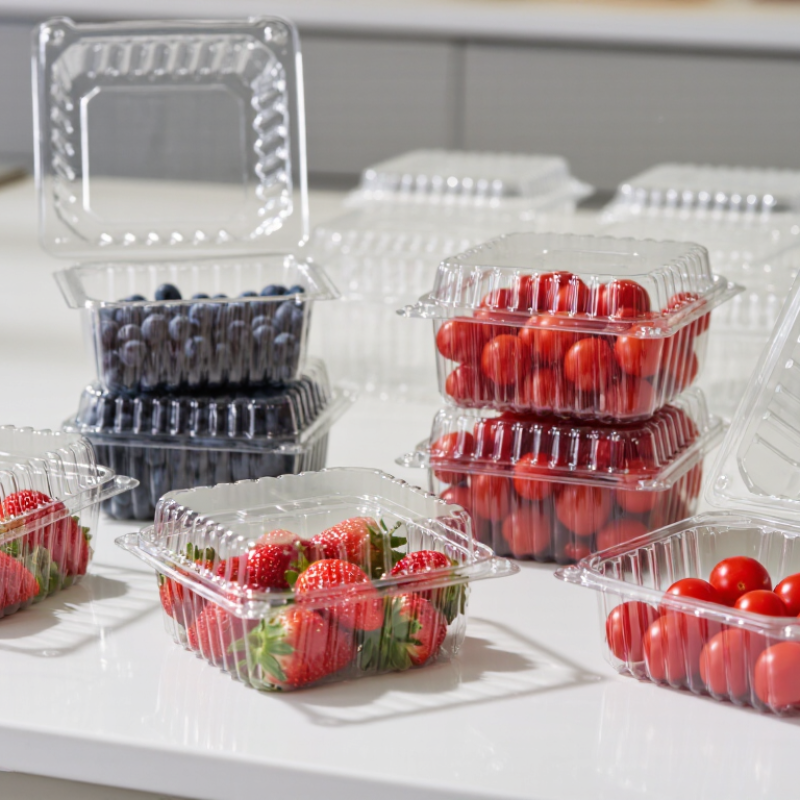
Produce clamshells are hinged containers made from clear plastic or fiber-based materials. They hold berries, grapes, tomatoes, and delicate leafy produce. Their rigid walls reduce crushing during stacking and transport. The clear lid also lets buyers inspect color, size, and visible defects without opening the pack.

Small vents help manage moisture. Too much condensation can accelerate mold. Too little humidity can dry the product. Packaging specialists must match vent design with produce type, cooling speed, and shipment length. The Food and Agriculture Organization reported that 13.2% of food was lost between harvest and retail in 2021. A well-designed clamshell may reduce handling damage, but it cannot correct poor harvesting or weak cold-chain control. It is not a magic fix.

Tips: Global buyers should request compression, drop, seal, and ventilation data. Check whether the pack survives pallet stacking and repeated temperature changes. Confirm food-contact compliance for each destination market. Also review end-of-life options. The United Nations Environment Programme reported 1.05 billion tonnes of food waste in 2022, including retail and household losses. Packaging can protect food, yet excessive material may create another burden. A practical specification should balance product protection, shelf visibility, recyclability, and total pack weight. Field feedback matters. Sometimes the “best” clamshell fails in humid warehouses.


Why Are Produce Clamshells Important for Global Buyers?

What Produce Clamshells Are and How They Work

Produce clamshells are rigid, transparent containers designed to protect fresh fruits and vegetables during handling, transport, display, and retail sale. Their structure helps reduce crushing and abrasion, while ventilation openings can support airflow and moisture management. For global buyers, this can improve product visibility, handling consistency, and shelf presentation.

The chart provides the global food-loss and food-waste context in which protective produce packaging is used. Packaging is only one factor among refrigeration, logistics, harvesting, and inventory management. Sources: FAO, “The State of Food and Agriculture 2019”; UNEP, “Food Waste Index Report 2024.”

Why Global Buyers Choose Clamshell Packaging

Why Global Buyers Choose Clamshell Packaging

Global buyers choose clamshell packaging because it protects fresh produce during long, complex supply routes. A clear container lets purchasers inspect color, size, and surface quality before opening it. That visibility can reduce handling and support faster quality checks at distribution centers.

Clamshells also help keep berries, tomatoes, and small fruits organized on shelves. Secure hinges and snap closures can limit crushing during stacking and transport.

Ventilation holes may release excess moisture, which helps reduce condensation inside the pack. However, ventilation must match the produce. Too much airflow can cause dehydration. Too little can create a damp environment. This detail is easy to overlook.

Tips:

Buyers should test the package with real produce and realistic shipping conditions. Check closure strength, stack stability, label space, and ease of opening. A barcode should remain readable after refrigeration and handling. Ask suppliers about material consistency and recycling guidance for the target market.

Local requirements can differ. Do not assume one format fits every country.

Clamshells are useful, but they are not perfect. Some packs use more material than simpler options, and poorly designed hinges can frustrate workers. A practical evaluation should balance protection, visibility, cost, shelf presentation, and end-of-life handling. Small trials often reveal problems that product samples cannot.

Key Materials and Design Features of Produce Clamshells

Produce clamshells protect berries, grapes, tomatoes, and other delicate foods during global transport. Their value depends on material selection and practical design, not appearance alone. Clear PET offers strong visibility and impact resistance. Recycled PET can reduce virgin plastic use, but its quality may vary. Buyers should request documented material specifications and test results.

Some markets also consider polypropylene or compostable polymers. These options require careful evaluation. Local recovery systems may not accept every material. A technically attractive package can still create disposal problems. That weakness deserves attention.

Ventilation holes help release heat and moisture after harvest. However, oversized openings may increase dehydration or allow contamination. Hinges should survive repeated handling without splitting. Secure closures reduce accidental opening during loading and retail display. Smooth edges protect workers and prevent damage to nearby packages. Stackable corners improve pallet stability, while a shallow base can reduce crushing. A clear label area supports traceability without hiding the produce.

Condensation remains a common problem.

In practice, buyers should test clamshells with real produce, cold storage, vibration, and humidity changes. Empty-package testing is not enough. I have found that small design changes can affect airflow and product loss. Still, no clamshell solves every supply-chain issue. Excessive material may improve strength but increase weight and cost. Minimal material may look efficient but fail under pressure. Reliable sourcing requires balancing protection, recyclability, shelf visibility, and actual transport conditions.

Why Are Produce Clamshells Important for Global Buyers? - Key Materials and Design Features of Produce Clamshells

Evaluation Dimension Common Material or Feature Typical Technical Information Value for Global Buyers
Main container material PET (polyethylene terephthalate) Clear, lightweight, rigid, and commonly used for fresh berries, grapes, tomatoes, and cut produce Provides product visibility and helps buyers assess appearance without opening the package
Alternative material Polypropylene (PP) Good moisture resistance and higher temperature tolerance than many conventional plastics Useful when packaging may experience warmer filling, storage, or transport conditions
Recycled content Post-consumer recycled PET (rPET), where permitted Can reduce reliance on virgin resin; food-contact use depends on applicable regulatory approval and supply-chain controls Supports recycled-content targets while requiring documentation for food-contact compliance
Lid and base construction Hinged one-piece design or separate lid-and-base design Hinged formats reduce loose components; separate parts can offer more configuration flexibility Helps buyers balance packing-line efficiency, consumer convenience, and logistics requirements
Ventilation Vented lid or strategically positioned air openings Allows heat, moisture, and respiration gases to escape; opening size and location depend on the crop Can help reduce condensation and slow quality deterioration when matched to produce needs
Closure security Snap-lock tabs, interlocking edges, or tamper-evident features Maintains closure during handling and can provide visible evidence of opening Reduces spillage, product loss, and handling concerns across international distribution
Product protection Ribbed walls, reinforced corners, and a raised internal platform Improves crush resistance and limits direct contact between produce and accumulated moisture Helps reduce bruising and physical damage during stacking, palletizing, and transport
Stackability Nestable base and top-load-bearing geometry Designed to align securely and distribute vertical loads across the package structure Improves pallet utilization and lowers the risk of package collapse in transit
Moisture management Drainage channels, raised feet, and controlled ventilation Moves condensation away from produce and supports airflow around the package May help maintain visual quality and reduce conditions associated with decay
Material efficiency Lightweight wall sections with targeted reinforcement Uses material where structural strength is needed while limiting unnecessary weight Can reduce packaging weight, freight impact, and material consumption per unit
Recyclability Mono-material plastic construction with minimal non-plastic attachments Simplifies sorting and recycling compared with packages made from permanently bonded mixed materials Supports end-of-life processing, subject to local collection and recycling infrastructure
Food-contact suitability Food-grade resin and controlled manufacturing process Must comply with the food-contact rules applicable in the destination market Reduces import and compliance risks for buyers serving different regions
Labeling and traceability Flat label panel, barcode area, and lot-code location Provides space for origin, variety, weight, date, handling, and traceability information Supports retail communication, inventory control, and rapid product recall procedures
Buyer note: Actual performance depends on produce type, package dimensions, film thickness, ventilation pattern, cold-chain conditions, and the regulations of the destination market.

How Clamshells Protect Freshness During International Shipping

Why Are Produce Clamshells Important for Global Buyers?

How Clamshells Protect Freshness During International Shipping

Fresh produce can lose quality quickly during international shipping. A well-designed clamshell creates a firm barrier around berries, tomatoes, and delicate vegetables. It limits crushing when cartons are stacked and handled across several transport stages.

Airflow matters. Small ventilation openings help release heat and moisture from the package. This can reduce condensation, which often encourages mold and softening. However, ventilation must match the produce. Excessive airflow may cause dehydration during long ocean or air shipments.

In export packing work, buyers often inspect clamshells for clear visibility, secure hinges, and consistent dimensions. These details support faster quality checks at warehouses and retail facilities. Transparent packaging also helps identify bruised fruit without opening every container. Cold chain still matters. A clamshell cannot correct poor temperature control, delayed customs handling, or careless pallet loading.

A perfect clamshell does not exist. Stronger plastic may improve protection but increase material use. Larger vents may improve airflow but expose produce to drying. Global buyers should test packaging with real routes, seasonal temperatures, vibration, and stacking conditions. Small changes can matter, such as adding corner support or adjusting the lid fit. The best choice protects freshness without creating unnecessary waste or hidden transport risks.

Important Buying Standards for Produce Clamshells

Global produce buyers need clamshells that protect quality, not merely attractive packaging. The FAO estimates that 14% of food is lost between harvest and wholesale. Packaging standards therefore deserve commercial attention. A clamshell should resist crushing, close securely, and maintain product visibility during repeated handling.

Material selection comes first. Buyers should request food-contact compliance documents, resin identification, and migration-test records. Recycled content can support sustainability goals, but it must not weaken hygiene or structural performance. Vent openings should reduce condensation without exposing berries to contamination. The closure should remain secure after pallet movement, yet open without damaging fingernails. Small details matter.

The UNEP Food Waste Index Report 2024 reported 1.05 billion tonnes of food waste in 2022. Better packaging cannot solve every loss, but poor packaging can accelerate bruising and spoilage. Buyers should compare compression strength, drop-test results, temperature performance, and stack stability. USDA produce inspection guidance also highlights condition, quality, and handling consistency as practical evaluation points. Ask for test conditions, not impressive claims.

Clarity is not proof.

Dimensions must match existing crates and automated lines. Traceability codes should remain readable after refrigeration and condensation. A perfect specification is unlikely. Some designs still overuse plastic, while lighter packs may fail under pressure. Buyers should review real shipment data, seasonal fruit sizes, and warehouse handling before approving large volumes. That step is slower, but usually more reliable.

en_USEnglish

PCD Inserts

PCBN Inserts

Solid CBN Inserts

PCD Milling Cutter

PCD Drilling Tools

PCD Reamer

Diamond Special Tool

Diamond Dressers