SUNDI TOOLS
- Copyright © Wuxi Sundi Precision Tools Co.,LTD All rights reserved.
- Site Map
 Skip to content
A Hydraulic Hose Pressure Tester turns an invisible risk into measurable evidence. It helps technicians verify whether a hose assembly can withstand its rated working pressure before installation or after repair. A failed hose may release oil violently, damage nearby components, and stop production without warning. Testing is not a paperwork exercise. It is a controlled check beside the workbench.
Industry reports support the need for stronger hose reliability practices. Grand View Research’s hydraulic hose market analysis identifies construction, mining, agriculture, and manufacturing as major demand sectors. These environments expose hoses to pressure spikes, vibration, abrasion, heat, and frequent bending. MarketsandMarkets also describes replacement demand and preventive maintenance as important market drivers. However, market growth does not prove equipment safety. Testing quality still depends on procedures, calibration, and technician judgment.
Brendan Casey, a hydraulic systems consultant and author, states, “The number one cause of hydraulic system failure is contamination.” That warning applies during pressure testing too. Dirty couplings can damage seals or distort results. A qualified operator should inspect fittings, confirm the hose rating, secure the assembly, and record pressure, duration, and test-medium details. ISO 6605 provides recognized test methods for hydraulic fluid power hose assemblies. The standard offers structure, not magic.
A clear gauge matters.
In practice, technicians may still overlook small leaks around crimp sleeves. They may also test too quickly. That is where this guide needs reflection: a tester cannot repair poor assembly or replace experience. Used correctly, it provides traceable evidence, supports preventive maintenance, and helps organizations make safer, better-informed decisions.
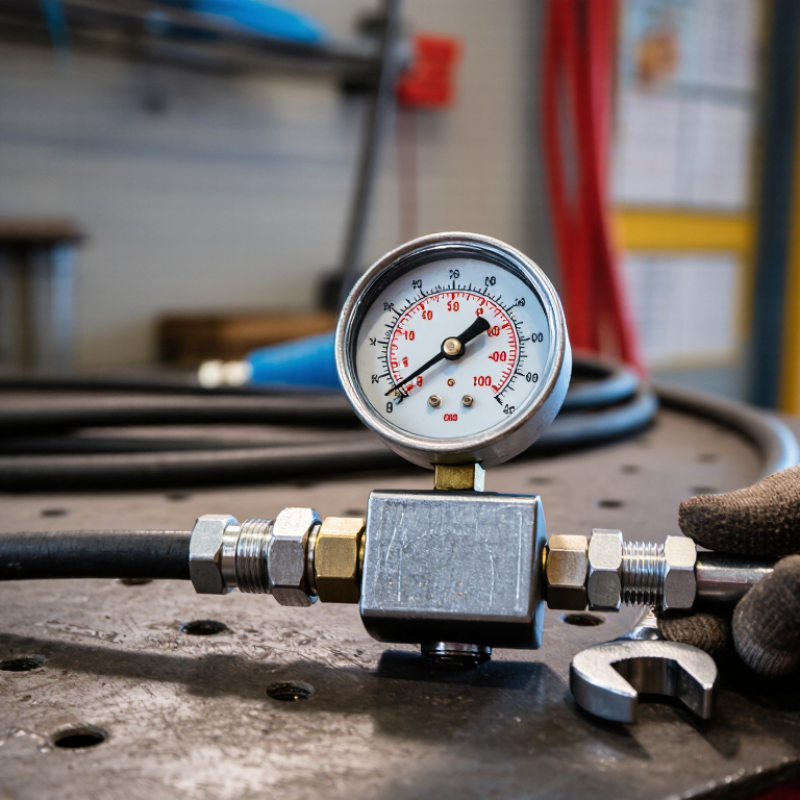
A hydraulic hose pressure tester is a diagnostic tool for checking whether a hose assembly can handle its rated working pressure. It connects to the hose or test circuit and applies controlled hydraulic pressure. A gauge then shows how the assembly responds. Technicians can watch for pressure loss, sweating, bulging, or sudden leakage. These signs often reveal damage that a visual inspection misses.
The tester is useful after hose replacement, during scheduled maintenance, or before equipment returns to service. It helps confirm crimp quality, fitting security, and hose condition under realistic pressure. In practical maintenance work, clean connections matter greatly. Dirt can create false leaks or damage the tester. Pressure readings are not the whole story. Temperature, hose age, and fluid compatibility also affect performance. A tester cannot repair a weak assembly.
Tips: Use the correct test pressure and compatible adapters. Inspect the hose before testing. Keep people away from the hose path. Increase pressure slowly. Record the reading, test date, and observed condition. Never rely on a gauge with unknown accuracy. Small oversights can matter.
A careful test can prevent unplanned downtime and reduce the risk of fluid injection injuries. However, testing should follow the hose maker’s specifications and site procedures. If the result seems unusual, stop and investigate rather than repeating pressure blindly. That hesitation is sometimes the safest decision.
| Data Dimension | Typical Specification or Result | Why It Matters | Practical Testing Guidance |
|---|---|---|---|
| Primary Function | Applies controlled hydraulic pressure to a hose assembly and checks for leakage, deformation, or failure. | Confirms whether the assembled hose is suitable for service before it is installed or returned to operation. | Test the complete assembly, including the hose, fittings, adapters, and connection points. |
| Common Test Medium | Clean hydraulic oil or water-based test fluid, depending on the tester design and hose manufacturer’s instructions. | The medium affects safety, cleanliness, corrosion risk, and the consequences of a hose failure. | Use only a compatible, clean, and approved test medium. Remove trapped air before pressurization. |
| Pressure Measurement | Usually displayed in bar, MPa, or psi through a calibrated pressure gauge or digital sensor. | Accurate measurement is necessary for repeatable tests and reliable pass/fail decisions. | Verify gauge calibration and select a pressure range that allows the target value to be read clearly. |
| Typical Working-Pressure Coverage | Many workshop testers cover low- to high-pressure hose applications; the available range depends on the pump, circuit, and test chamber. | Different hose assemblies can have substantially different working-pressure ratings. | Never assume that one tester or one setting is suitable for every hose. Follow the hose assembly specification. |
| Proof-Test Pressure | Often set above the hose’s maximum working pressure, commonly according to the applicable hose, assembly, or industry standard. | A proof test checks assembly integrity without intentionally testing to destructive failure. | Use the exact proof-test value specified for the hose construction and application; do not estimate it from appearance. |
| Test-Hold Period | Commonly a defined period such as 30 seconds to several minutes, depending on the test procedure. | A hold period can reveal slow leaks, pressure decay, fitting movement, or progressive hose damage. | Record the starting pressure, ending pressure, hold time, and any visible change during the test. |
| Leak Detection | Visual inspection for fluid seepage, sprays, wet fittings, pressure loss, or visible hose damage. | Leaks can cause loss of machine performance, environmental contamination, and injection injuries. | Never use hands to search for a high-pressure leak. Depressurize the system before touching the assembly. |
| Hose Assembly Inspection | Checks for incorrect routing, exposed reinforcement, cuts, abrasion, blistering, twisting, kinked sections, and damaged covers. | Pressure testing cannot correct poor assembly or damage that may shorten service life. | Inspect the hose before, during, and after testing. Replace assemblies showing structural damage or unsafe deformation. |
| Pressure Stability | Stable pressure during the hold period generally indicates that the test circuit is not losing fluid through a leak. | Unexpected pressure decay may indicate leakage, trapped air, temperature effects, or equipment problems. | Check the tester, couplings, valves, and test connections before concluding that the hose has failed. |
| Safety Requirement | Use a guarded or enclosed test area, suitable rated components, pressure relief protection, and remote operation where practical. | Hydraulic fluid released under pressure can penetrate skin and components can separate violently if they fail. | Keep personnel away from the assembly during pressurization and follow a documented safe-work procedure. |
| Test Result | Pass when the assembly meets the specified pressure, hold time, and inspection requirements without unacceptable leakage or damage. | A documented result supports quality control, maintenance decisions, and traceability. | Mark failed assemblies clearly and remove them from service until they are correctly replaced or reassembled. |
| Recommended Records | Hose identification, assembly date, test pressure, hold time, test medium, gauge identification, operator, and result. | Records make recurring failures easier to investigate and help demonstrate that testing was completed. | Retain records according to the site’s maintenance, quality, and regulatory requirements. |


 English
 Russian
  German
  Spanish
  French
  Portuguese